Mozambique’s $30 Billion Gas Project Just Got Its Engineering Contractor. Sudan’s Solar Developers Are Paying 35% Interest for a Fraction of That Capital.
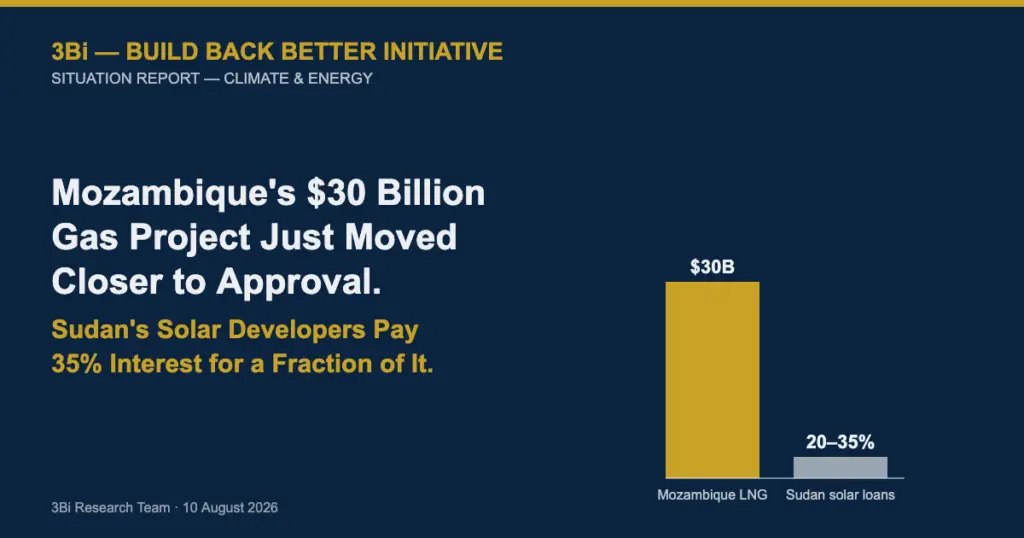
A $30 billion Mozambique LNG project moved toward final investment approval this week. Sudanese solar developers meeting basic energy needs still face 20-35% domestic lending rates for a fraction of that capital.
3Bi Research Team
Headline Fact
Mozambique’s Rovuma LNG project — a $30 billion liquefied natural gas development backed by ExxonMobil, Eni, China National Petroleum Corporation, South Korea’s KOGAS, and Abu Dhabi’s ADNOC via its XRG investment arm — moved a concrete step closer to a final investment decision this week, with two of its four prospective engineering contractors confirming signed letters of intent within 48 hours of each other (McDermott, 5 August 2026; Saipem, 7 August 2026). Nine months earlier, the same project had been frozen under force majeure for nearly four years. In the same week, Sudanese solar developers working to keep clinics, farms, and small businesses running through a collapsed national grid continue to face domestic lending rates of 20–35%, according to a UNDP study — for financing at a fraction of Rovuma’s scale.
Timeline
- April 2021: ExxonMobil declares force majeure on Rovuma LNG, citing security deterioration in Cabo Delgado province, freezing development (Offshore Energy, 7 August 2026; attaqa.net, 8 August 2026).
- August 2024: The SMDC contractor consortium (McDermott, Saipem, Daewoo E&C, and China’s CPECC) is awarded the project’s front-end engineering design (FEED) contract, ahead of any lifting of force majeure (Offshore Energy, 7 August 2026).
- November 2025: ExxonMobil formally lifts the four-year force majeure declaration, citing improved security conditions (attaqa.net, 8 August 2026).
- 5 August 2026: ExxonMobil, on behalf of the Area 4 partners, signs a letter of intent with McDermott for preliminary engineering and procurement work, valued at $32 million, ahead of final award (Offshore Energy, 7 August 2026; LNG Industry, 7 August 2026).
- 7 August 2026: Saipem confirms it has separately signed a letter of intent within the same SMDC consortium, corroborating the McDermott announcement (Offshore Energy, 7 August 2026).
- 8 August 2026: attaqa.net’s Energy Research Unit reports the developments, noting a full engineering, procurement, and construction (EPC) award is expected once FID is reached, targeted “within 2026,” with project start-up projected for 2031 (attaqa.net, 8 August 2026).
- Ongoing, dated 2025–2026: Sudan’s installed solar capacity stands at roughly 190 megawatts, against a pre-war government target of 3,300 megawatts of renewables (including 2,190 megawatts of solar) by 2033; the national grid has absorbed an estimated $3 billion in war damage since April 2023 (UNDP study, relayed via Radio Dabanga and the North Africa Post, May 2026). The same UNDP study identifies financing as the single largest obstacle to wider Sudanese solar adoption, citing commercial lending rates of 20–35% and short repayment windows facing local developers and households.
What We Know / What We Don’t
We know Rovuma LNG’s contracting timeline precisely: two named engineering firms, dated letters of intent, a stated dollar value for the initial work ($32 million), and a five-government ownership structure (Mozambique’s ENH, the United States’ ExxonMobil, Italy’s Eni, China’s CNPC, South Korea’s KOGAS, and the UAE’s ADNOC/XRG) that has moved from a four-year freeze to FID-track financing in nine months. We know Sudan’s solar financing gap from the same category of evidence: a named study (UNDP), a specific lending-rate range (20–35%), and an installed-capacity figure (190 MW) that has barely moved against a 2033 target set before the war.
We do not know the specific interest rates or terms attached to Rovuma LNG’s own project financing, which typically differs from the sovereign or corporate borrowing rates cited for Sudan; a like-for-like financing-cost comparison would require Rovuma’s project-finance term sheet, which is not yet public. We also do not know whether Mozambique’s own domestic renewable-energy developers face financing terms closer to Rovuma’s international backing or to Sudan’s — this piece compares two data points that are well documented individually, not a controlled study of regional capital costs.
Do-No-Harm Note
This item concerns published corporate energy-project financing and national infrastructure statistics, not active conflict, displacement, or any named individual or community. The reference to Cabo Delgado’s 2021 security deterioration describes a matter of public record already reported by the operating companies themselves, without naming or identifying any individual, combatant, or affected community. We checked for identifying or endangering details before publication and found none; no consent or generalization issue applies.
What to Watch
Whether the Area 4 partners announce a formal FID on Rovuma LNG before the end of 2026, and on what financing terms; whether any of the five partner governments or export-credit agencies involved disclose the project’s financing structure, which would allow the kind of like-for-like comparison this item cannot yet make; and whether Sudan’s Ministry of Energy and Mining, the African Development Bank, or Green Climate Fund-adjacent programs announce any blended-finance or guarantee mechanism aimed at bringing Sudanese solar developers’ borrowing costs down from the 20–35% range UNDP has documented.
Sourcing & Next Update
Primary: Offshore Energy, “$30 billion LNG project nears FID: Saipem confirms preliminary award shortly after McDermott,” 7 August 2026; attaqa.net Energy Research Unit, 8 August 2026. Corroborating: LNG Industry, “ExxonMobil awards McDermott LOI for Rovuma LNG project,” 7 August 2026. Sudan comparison figures: UNDP solar-sector study, relayed via Radio Dabanga and the North Africa Post, May 2026. 3Bi will revisit this item if the Area 4 partners announce FID, or if new Sudan-focused climate-finance terms are announced.
This piece was produced through 3Bi’s automated daily publications workflow monitoring regional and international climate and energy reporting.
This publication is produced with support from 3Bi’s institutional donors; see the full funder list at 3bisudan.org.
About the Authors
Related Publications
The Loss and Damage Fund Has Set Aside Its First US$20 Million. Sudan Has Three Requests in Line. Get One Ready for December.
The Fund for responding to Loss and Damage made its first allocation on 22 October, US$20 million for Nepal. Sudan has three requests worth US$48.5 million in its…
The Green Climate Fund Weighs US$1.87 Billion Next Week. Yemen’s First Project Is an Early-Warning System. Sudan Has None in Its Portfolio.
The 46th meeting of the Green Climate Fund Board runs in Songdo from 26 to 29 October 2026, with 21 funding proposals worth US$1.87 billion before it. Sudan’s…
The Paris Compliance Committee Named Three Silent Countries. Sudan Answered. Now It Owes a Date.
The Paris Agreement's compliance committee has named three countries that ignored its letters on missing climate plans. Sudan is not among them: it replied. Before COP31, 3Bi argues,…