
Saudi Arabia Just Signed $1.16 Billion for Grid Batteries in One Announcement. Sudan’s Donors Are Still Buying Storage One Grant at a Time.
How Saudi Arabia's Aggregated Storage Procurement Points to a Fix for Sudan's Fragmented Donor Pipeline
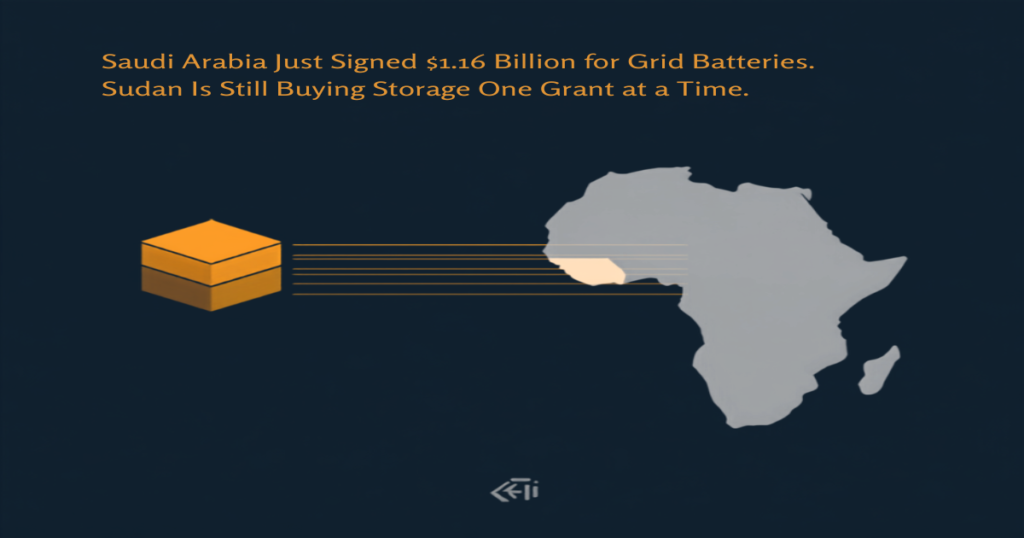
Saudi Arabia just signed $1.16bn for 2,000MW of aggregated grid battery storage under one buyer. Sudan's donor-funded storage programmes are still procured project-by-project — the fix is aggregation, not capital.
Policy Brief | 3Bi Research Team | 21 August 2026
Build Back Better Initiative — Sudan & East Africa Policy Analysis
The Ask
Sudan’s Ministry of Energy and Petroleum, together with the World Bank, UNDP, and GEF, should establish a single “principal buyer” or shared storage-agreement template that aggregates demand across Sudan’s separately-funded solar and mini-grid programmes — rather than continuing to procure battery storage grant-by-grant, plant-by-plant. Saudi Arabia just showed, again, how much scale and price advantage a single aggregating buyer can unlock; Sudan does not need the Gulf’s capital to borrow the structure.
Why Now
On 21 August 2026, Saudi Arabia’s Power Procurement Company — trading as “Principal Buyer” — announced it had signed agreements for four battery-storage projects totalling 2,000 megawatts at four-hour duration (8,000 megawatt-hours), worth more than 4.35 billion riyals ($1.16 billion), across sites in Makkah, Hail, and Qassim (attaqa.net Energy Research Unit, 21 August 2026). This is not a one-off: Principal Buyer is simultaneously qualifying developers for a second, larger group of storage projects — 3,000 MW / 12,000 MWh — having already prequalified 27 developers and technology providers in July 2026 (SaudiGulf Projects, July 2026; energy-storage.news). Saudi storage capacity grew from 35 megawatts in 2024 to 2.08 gigawatts in 2025 — a 5,806% year-on-year jump — putting the Kingdom on course for roughly 48 gigawatt-hours of storage by 2030 (attaqa.net, 21 August 2026).
The mechanism behind that growth is not just money. It is aggregation: one buyer, one standardized 15-year Storage Services Agreement format, and a repeatable procurement pipeline that lets developers plan a business, not chase a single tender (energy-storage.news; ippjournal.com, 2026).
Sudan’s own reconstruction-phase solar and storage programmes are moving at the same time, but through the opposite structure. The World Bank’s $76.3 million ASCENT-Sudan project, financed through the International Development Association, is installing 500 discrete renewable-energy systems across public spaces, farms, telecom sites, and small businesses to reach 150,000 people (World Bank, 2 June 2025). The GEF/UNDP-backed mini-grid pilot run through the Ministry of Energy and Petroleum — 2 megawatts of solar and 6.9 megawatt-hours of storage for roughly 144,000 people — concludes in 2026 after four years (SolarQuarter, 11 February 2026; previously covered in 3Bi’s 15 August 2026 brief on Sudan’s storage financing window). Sudan’s Ministry of Energy has also opened a “National Dialogue on Solar Mini-Grid Models” to define the regulatory and financial frameworks needed to scale mini-grids (Sudan Horizon, 2026). Each of these is a genuine, welcome commitment. None of them talks to the others through a shared procurement structure. That gap — not capital, and not political will — is what this brief addresses.
The Evidence
Saudi Arabia’s structure separates “who pays” from “who buys.” Under the Principal Buyer model, each battery project is built, owned, and operated by a private developer holding 100% equity in a dedicated special-purpose vehicle; that vehicle signs a single, standardized 15-year Storage Services Agreement with Principal Buyer, which aggregates demand and payment risk across the whole national programme rather than leaving each developer to negotiate its own bespoke offtake (energy-storage.news; ippjournal.com, 2026). The Kingdom’s balance sheet and sovereign credit rating make that specific financing instrument — private equity underwriting a 15-year public offtake — available to Saudi Arabia in a way it plainly is not to Sudan. But the underlying insight is transferable: a single standardized agreement, issued by one coordinating buyer, is what lets storage suppliers treat a market as one pipeline instead of dozens of unrelated, one-off deals.
Sudan’s current programmes are, procurement-wise, exactly the “dozens of one-off deals” model Saudi Arabia moved away from. The World Bank’s 500 ASCENT-Sudan systems, the GEF/UNDP mini-grid sites, and UNFPA’s hospital solarization work (which keeps facilities like Al Fasher Maternity Hospital running Emergency Obstetric and Neonatal Care equipment through the current conflict; UNFPA Sudan, accessed 15 August 2026) are each procured, specified, and contracted independently by different implementing agencies. None shares a common technical specification for storage sizing, a common contract template, or a shared pipeline that a battery supplier or installer could plan capacity against. The Africa Finance Corporation’s 2026 infrastructure report found this is the norm across the continent outside South Africa’s centrally procured Battery Energy Storage IPP programme — and named financing structure, not technology or demand, as the binding constraint (Africa Finance Corporation, cited by Nairametrics, 26 April 2026).
Aggregation does not require Sudan to find new money — it requires donors already funding these programmes to agree on shared terms. The GEF/UNDP pilot, the World Bank’s ASCENT-Sudan project, and UNFPA’s solarization programme are all already funded, all already delivering through Sudan’s active conflict, and all already procuring battery storage as a line item. What none of them do yet is specify storage components against a shared technical standard or route procurement through a single coordinating buyer function — the two design choices that let Principal Buyer turn Saudi Arabia’s storage pipeline from isolated projects into a market. Sudan’s Ministry of Energy’s own “National Dialogue on Solar Mini-Grid Models” (Sudan Horizon, 2026) is the natural forum to define exactly that function, if donors bring it to the table explicitly rather than leaving it implicit.
Addressing the Counter-Case
The strongest objection: Saudi Arabia’s model works because of instruments Sudan does not have — a creditworthy sovereign offtaker, private developers willing to hold 100% project equity for fifteen years, and a functioning banking system to clear payments. Importing the “Principal Buyer” label onto a war-affected, grant-dependent market risks looking like a solution built for the wrong country.
That is a fair warning against copying the financing instrument, and this brief is not proposing that Sudan issue 15-year Storage Services Agreements to private-equity-backed developers. It is proposing something narrower and available today: that the donors and agencies already writing Sudan storage grants — the World Bank, UNDP, GEF, UNFPA — agree on one shared technical specification and one standard contract template for storage procurement, and route it through a single coordinating function inside the Ministry of Energy and Petroleum’s existing mini-grid dialogue. That does not require a creditworthy sovereign, private equity, or a working securities market. It requires four or five donor procurement teams to stop specifying batteries independently. The evidence that this specific bottleneck — not capital scarcity — is what keeps African storage adoption “uneven,” even where financing exists, comes directly from the Africa Finance Corporation’s own 2026 assessment, not from this brief’s inference.
What 3Bi Recommends, Specifically
- Sudan’s Ministry of Energy and Petroleum should use its existing National Dialogue on Solar Mini-Grid Models to formally define a coordinating “principal buyer” or aggregator function for storage procurement, covering current and pipeline donor-funded programmes, before ASCENT-Sudan’s remaining systems and any GEF Phase II mini-grid sites are procured independently.
- The World Bank, UNDP, GEF, and UNFPA should adopt one shared technical specification and standard contract template for battery storage components across their Sudan solar and mini-grid programmes, so future donor budgets buy into a common pipeline rather than bespoke, one-off contracts negotiated from scratch each time.
- 3Bi will track Principal Buyer’s Group 2 BESS qualification outcomes (3,000 MW / 12,000 MWh, expected to conclude later in 2026) as a live, public benchmark for storage pricing and contract structure that Sudan-focused donors and implementers can cite directly in FY2027 procurement planning.
- Sudan-focused civil society and diaspora energy-finance advocates should raise the procurement-aggregation gap explicitly in pre-COP31 donor consultations ahead of the Antalya summit (9–20 November 2026), building on the storage-financing-window argument made in 3Bi’s 15 August 2026 brief.
Sourcing & Contact
Primary source: attaqa.net Energy Research Unit, “5 معلومات عن أحدث مشروعات تخزين الكهرباء في السعودية” [“5 facts about Saudi Arabia’s latest battery storage projects”] (21 August 2026), citing the Saudi Power Procurement Company. Cross-checked and extended via: SaudiGulf Projects and energy-storage.news on Principal Buyer’s Group 1 BOO/SPV structure and Group 2 (3,000 MW/12,000 MWh) qualification (July 2026); ippjournal.com on Storage Services Agreement terms; World Bank, “Advancing Energy and Digital Connectivity in Sudan” (2 June 2025); SolarQuarter, “Sudan Advances Solar Mini-Grids” (11 February 2026); Sudan Horizon, “Sudan Launches National Dialogue on Solar Mini-Grid Models” (2026); Africa Finance Corporation, 2026 State of Africa’s Infrastructure, cited by Nairametrics (26 April 2026); UNFPA Sudan, “Solarization of Hospitals” (accessed 15 August 2026); 3Bi Research Team, “Sudan Doesn’t Need More Solar Panels. It Needs the Batteries That Go With Them.” (15 August 2026). For follow-up: 3Bi Research Team, research@3bisudan.org.
This publication was produced through 3Bi’s automated daily publications workflow monitoring regional and international climate and energy reporting.
This publication is produced with support from 3Bi’s institutional donors; see the full funder list at 3bisudan.org.
About the Authors
Related Publications
The Loss and Damage Fund Has Set Aside Its First US$20 Million. Sudan Has Three Requests in Line. Get One Ready for December.
The Fund for responding to Loss and Damage made its first allocation on 22 October, US$20 million for Nepal. Sudan has three requests worth US$48.5 million in its…
The Green Climate Fund Weighs US$1.87 Billion Next Week. Yemen’s First Project Is an Early-Warning System. Sudan Has None in Its Portfolio.
The 46th meeting of the Green Climate Fund Board runs in Songdo from 26 to 29 October 2026, with 21 funding proposals worth US$1.87 billion before it. Sudan’s…
The Paris Compliance Committee Named Three Silent Countries. Sudan Answered. Now It Owes a Date.
The Paris Agreement's compliance committee has named three countries that ignored its letters on missing climate plans. Sudan is not among them: it replied. Before COP31, 3Bi argues,…