Sudan Made Rooftop Solar Cheaper in August. Now It Needs the Rulebook — Before It Repeats Kenya’s Mistakes
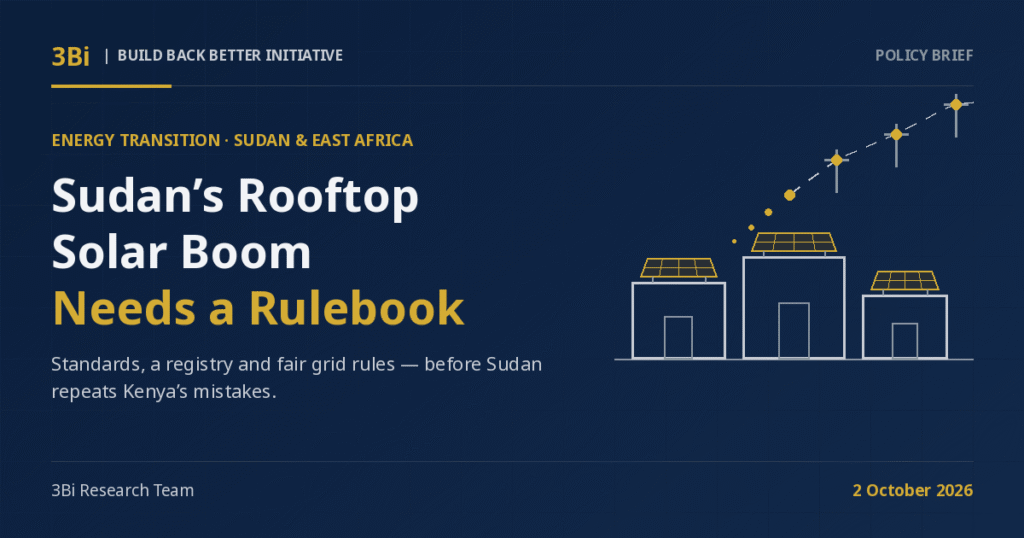
Sudan's August fee exemption will put more solar panels on its roofs. We set out the cheap rulebook it now needs: equipment standards, a system registry and grid-connection rules, before it repeats Kenya's mistakes.
3Bi Research Team | Policy Brief | 2 October 2026
The Ask
Within the next 90 days, Sudan’s Ministry of Energy and Oil and the Sudanese Standards and Metrology Organization should publish an interim rooftop-solar rulebook: installer standards, clear rules for applying existing equipment checks to fee-exempt personal imports, a simple registry of systems, and a draft rule for connecting household and business solar to the grid. The duty cut of 18 August has already done the expensive part, because it pushes more panels onto Sudanese roofs. The rulebook costs almost nothing. Without it, the government can’t see this solar, can’t check its quality, and can’t use it once the grid is rebuilt.
Why Now
On 1 October 2026, attaqa.net reported that rooftop solar in Africa amounts to less than 1% of the continent’s potential, even though Africa receives more sunlight than any other continent. The report draws on a continent-wide mapping study and on an analysis by the International Solar Energy Society published in pv magazine (attaqa.net, 1 October 2026; pv magazine, 18 September 2026). That study used satellite imagery to count 3.37 gigawatts of rooftop solar across Africa, about 71% of it in South Africa. It found that what drives uptake is local electricity demand, not sunshine (iScience, 13 July 2026).
That finding matters for you if you work on Sudan’s power sector, because Sudan is already acting on it. On 18 August 2026, Prime Minister Kamil Idris exempted all imported components of solar systems for personal use from customs duties, taxes and all other government fees. He directed the ministries of finance, energy, and industry and trade, the Central Bank of Sudan and the Sudanese Standards and Metrology Organization to implement the decision (SUNA via Fana News, 18 August 2026). It came a month after the energy ministry had imposed fees on solar panels in July, a move that drew wide public criticism (attaqa.net, 19 August 2026). Earlier that month, Sudanese Customs had announced a customs-fee exemption for solar systems after a fire at the 1.25-gigawatt Merowe Dam power station cut electricity in Khartoum, Northern, River Nile and Red Sea states (pv magazine, 5 August 2026).
The follow-through has started. On 1 September 2026, the Cabinet reviewed the national “Moyah wa Nour for all Sudanese” (water and light for all Sudanese) programme, which the government launched on 13 August with a 12-month timeline to expand solar power and water supply. It directed the finance ministry and the standards body to speed up a new advanced laboratory for testing imported solar equipment (Sudan Tribune, 1 September 2026). That gives Sudan a 12-month window, already under way, in which panels are flowing in and the institutions that should regulate them are being set up. The rules written in this window will shape what gets installed for the next decade.
The Evidence
First, Sudan fits the profile of a rooftop-solar market almost exactly, and its incentive is reliability, not price. The International Solar Energy Society analysis explains why South Africa holds most of Africa’s rooftop solar. It had grid-connected customers who could afford systems, relatively high tariffs, a mature installation industry and, above all, years of scheduled power cuts. These turned solar “from an environmental investment into an insurance product” (pv magazine, 18 September 2026). South Africa’s rooftop capacity grew from about 1.2 gigawatts in 2020 to about 7.3 gigawatts by late 2025 (pv magazine, 18 September 2026). Sudan’s reliability problem is more severe. In July 2026, the Ministry of Energy and Oil said rolling blackouts in Khartoum and several other states frequently exceeded 18 hours a day. It said it had restored more than 260 megawatts to the grid and expected available capacity to exceed 600 megawatts once current repairs were complete (Horn Economic Review, 22 July 2026, reporting the ministry’s statement of 21 July). For a Sudanese household or workshop, a panel and a battery are the most reliable power it can get.
Second, Sudan’s solar boom is already under way, but the state can barely see it. The Africa Solar Industry Association tracks 1,074 megawatts of operational solar in Sudan. Most of that figure is listed as unidentified residential and commercial projects, inferred from Chinese solar imports, including about 482 megawatts last year alone (pv magazine, 5 August 2026, citing the AFSIA project database). The think-tank Ember found that Sudan’s solar panel imports from China rose sixfold in the 12 months to June 2025 (Ember, August 2025). For comparison, Sudan’s own ministry expects grid capacity to pass 600 megawatts only after repairs. Distributed solar may therefore already rival the grid in scale, but that is an estimate built from shipping data, not a count. Nobody knows how much of it works, how much is safe, or where it sits on the network. A registry and a testing regime, which the Cabinet has already ordered in part, are the only way to find out.
Third, East Africa’s leading market shows how badly drafted rules can slow rooftop solar down. Kenya’s thermal independent power producers sell electricity at up to $0.23 per kilowatt-hour, among the most expensive rates in the world, while Kenya buys Ethiopian hydropower at about $0.066 (pv magazine, 18 September 2026). Even so, Kenya has under 300 megawatts of rooftop solar, about 5 watts per person, compared with about 1,000 watts per person in Australia (pv magazine, 18 September 2026). The authors name the net-metering rules as probably one of the most important structural reasons. Kenya’s 2024 regulations cap household systems at 4 kilowatts on single-phase supply and 10 kilowatts on three-phase. They limit the national programme to 100 megawatts over its first five years (Pulse Kenya, 25 September 2026). Exported power earns a credit worth only 50% of the energy exported (pv magazine, 18 September 2026). In September 2026, Kenya’s regulator also formalised charges for unauthorised exports, backdated by more than a year to 1 July 2025, without public explanation (pv magazine, 22 September 2026). Low caps, weak credit and retroactive penalties tell investors that rooftop solar is something the utility tolerates, not something it wants. Sudan can avoid all three by writing its rules first.
Addressing the Counter-Case
The strongest objection is that grid-connection rules are a luxury for a grid that is down most of the day. The ministry’s priority should be restoring generation and transmission, and households will keep buying off-grid systems with or without a rulebook. We agree that restoring the grid comes first, and we are not asking the ministry to divert engineers from it. But two parts of the rulebook have nothing to do with exporting power. Enforcing equipment standards and registering systems protects households from poor-quality imports now, and they give planners data they currently lack. The Cabinet has already accepted half of this logic by ordering a new testing lab. The grid-connection part is a draft for consultation, not an immediate obligation. It matters because of what happened in South Africa. When load-shedding largely disappeared in 2024, rooftop solar uptake “slowed substantially” (pv magazine, 18 September 2026). If Sudan’s rooftop wave is only insurance, it will stall as the grid recovers, and the capacity already on roofs will stay disconnected from the system it could support. A connection rule written now gives those systems a role in the rebuilt grid.
A second objection is that net metering erodes the revenue of an already fragile state utility. This is a real risk, and it is why we are not recommending a full retail-price export credit or any specific tariff level. What we recommend is a rule that grows capacity feeder by feeder as the network can absorb it, rather than one low national cap. It should set export compensation through a published study, and it should not apply charges retroactively. Kenya shows the cost of the alternative: high tariffs, weak uptake and an industry left guessing about the rules.
What 3Bi Recommends, Specifically
First, by the end of December 2026, the Ministry of Energy and Oil and the Sudanese Standards and Metrology Organization should close the personal-import gap. The standards body already requires imported solar panels, batteries and inverters to carry an IEC certificate or a test certificate from an ISO/IEC 17025-accredited laboratory (SSMO Administrative Decision No. 55 of 2025, List B, as summarised by the Logistics Cluster’s Sudan capacity assessment). But SSMO itself has said that solar equipment arriving as personal baggage or through smuggling escapes its checks and is a likely route for low-quality panels (SSMO press statement on solar equipment conformity). That is the personal-use channel the 18 August exemption is designed to encourage. The two bodies should publish how the existing certification applies to fee-exempt personal imports, link it to the testing laboratory the Cabinet ordered on 1 September, and add a basic code of practice for installers.
Second, within the same 90 days, the ministry should open a simple registry for solar systems, starting with commercial and larger household systems. Registration should be free, quick and online or by SMS. Within the Moyah wa Nour programme’s 12-month timeline, the ministry should publish a national estimate of distributed solar capacity built from registry and customs data, and test it against AFSIA’s import-based figure.
Third, the ministry should publish a draft grid-connection and export rule for public consultation before the end of the Moyah wa Nour window in August 2027. The rule should allow capacity to grow feeder by feeder, set export credit through a published, donor-supportable tariff study, and rule out retroactive charges. Sudan’s donor coordination group could be asked to fund that study, which is a modest cost.
Fourth, 3Bi will track the standards, the registry and the draft rule through its monitoring of the Arabic- and English-language energy press. We will publish a follow-up when any of them appears, or by the end of the Moyah wa Nour window if none has.
Sourcing & Contact
Primary sources: attaqa.net, “الطاقة الشمسية على الأسطح في أفريقيا تواجه تحدي انخفاض معدل امتصاص الأشعة (تقرير)” (rooftop solar in Africa faces the challenge of low uptake), 1 October 2026; pv magazine / International Solar Energy Society (Ricardo Rüther and Andrew Blakers), “Very low cost rooftop solar slashes domestic energy cost – Part 3: African Countries”, 18 September 2026; iScience, “High-resolution mapping reveals a profound gap between existing rooftop solar deployment and potential in Africa”, 13 July 2026; SUNA via Fana News, “Prime Minister Exempts Personal-Use Solar Energy Systems from All Fees”, 18 August 2026; attaqa.net, “الطاقة الشمسية في السودان.. إعفاءات جمركية لحل أزمة الكهرباء” (solar in Sudan: customs exemptions to solve the electricity crisis), 19 August 2026; pv magazine, “Sudan exempts solar systems from custom duties”, 5 August 2026; Sudan Tribune, Cabinet meeting report, 1 September 2026; Horn Economic Review, “Sudan ministry cites halt of Ethiopian power link among causes for severe blackouts”, 22 July 2026; Ember, “The first evidence of a take-off in solar in Africa”, August 2025; Pulse Kenya, “EPRA tightens solar export rules: Inside Kenya’s net-metering system”, 25 September 2026; pv magazine, “Kenya backdates solar export charges by over a year”, 22 September 2026; Sudanese Standards and Metrology Organization (SSMO), press statement on solar equipment and accessories and their conformity with standards (ssmo.gov.sd); Logistics Cluster, Sudan Logistics Capacity Assessment, section 1.2 “Sudan Regulatory Departments and Quality Control” (SSMO Administrative Decision No. 55 of 2025). For methodology questions or to propose a correction, contact 3Bi’s Research Team via 3bisudan.org.
This piece was produced through 3Bi’s automated daily publications workflow, which monitors regional and international climate and energy reporting.
This publication is produced with support from 3Bi’s institutional donors; see the full funder list at 3bisudan.org.
About the Authors
Related Publications
The Paris Compliance Committee Named Three Silent Countries. Sudan Answered. Now It Owes a Date.
The Paris Agreement's compliance committee has named three countries that ignored its letters on missing climate plans. Sudan is not among them: it replied. Before COP31, 3Bi argues,…
The Kigali Amendment Turns 10 With 175 Parties. Sudan Should Ratify Before the Montreal Protocol Meets in Kigali.
Ten years after the Kigali Amendment was adopted, 175 of 198 Montreal Protocol parties have ratified it. Sudan has not. As parties meet in Kigali on 2–6 November,…
The Adaptation Fund Board Meets in Bonn With US$146.8 Million to Approve. Sudan Has No Project of Its Own.
The Adaptation Fund Board meets in Bonn from 19 to 23 October with US$146.8 million in approvals before it, including a US$30 million Mandera Triangle project. Sudan has…