The Adaptation Fund Board Meets in Bonn With US$146.8 Million to Approve. Sudan Has No Project of Its Own.
3Bi Situation Report — Climate & Energy Desk | First edition
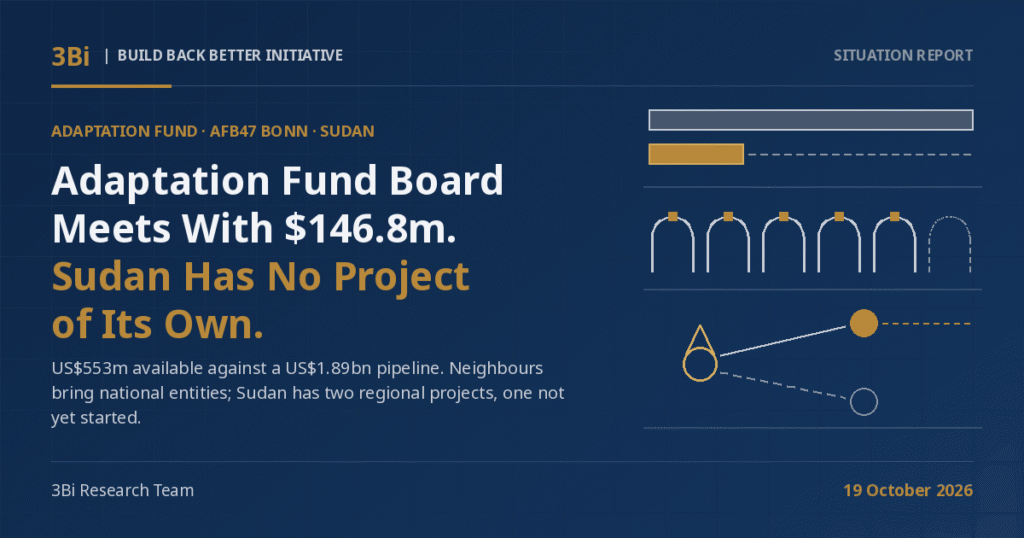
The Adaptation Fund Board meets in Bonn from 19 to 23 October with US$146.8 million in approvals before it, including a US$30 million Mandera Triangle project. Sudan has no single-country project and no accredited national entity.
The 47th meeting of the Adaptation Fund Board runs in Bonn from 19 to 23 October 2026 with US$146.8 million in funding approvals before it. Sudan has no single-country project in the Fund’s portfolio. (Illustration: 3Bi)
3Bi Situation Report — Climate & Energy Desk | First edition | Information cut-off: 19 October 2026, 04:00 UTC
Headline Fact
The Adaptation Fund Board opens its 47th meeting in Bonn today, 19 October, and sits until 23 October (Adaptation Fund, AFB/B.47/1/Rev.1, September 2026). The secretariat has put US$146.8 million in funding approvals before it (Adaptation Fund, AFB/PPRC.38/2/Rev.1, October 2026). The Board will also discuss the Fund’s transition to serve the Paris Agreement exclusively, and a 2026–2029 resource-mobilisation target. One option on the table is at least US$1.2 billion, with an ambition of up to US$1.5 billion (Adaptation Fund, AFB/B.47/5 and AFB/B.47/7, September–October 2026). East Africa is in the package. The secretariat’s technical review recommends approving a US$30 million regional project, run by UNDP, for pastoralist and agro-pastoralist communities in the Mandera Triangle, where Ethiopia, Kenya and Somalia meet (Adaptation Fund, AFB/PPRC.38/23, 10 September 2026). Sudan is not in the package. The Fund’s portfolio table lists no single-country project for Sudan, and no Sudanese entity appears on the Fund’s list of accredited national implementing entities (Adaptation Fund, AFB/B.46-47/8, 17 August 2026; Adaptation Fund, list of National Implementing Entities, accessed 19 October 2026). Sudan’s only Adaptation Fund exposure is through two regional projects. One of them, approved in April 2022, has not yet started implementation.
Timeline
– 11 October 2019: The Board approves a US$13.08 million drought-resilience project for smallholder farmers and pastoralists in the IGAD region, covering Djibouti, Kenya, Sudan and Uganda and implemented by the Sahara and Sahel Observatory (OSS) (Adaptation Fund, AFB/B.46-47/8, 17 August 2026). Sudan’s share is about US$2.58 million, executed by the Hydraulics Research Center of the Ministry of Irrigation and Water Resources (DRESS-EA project website, accessed 19 October 2026).
– 8 April 2022: The Board approves a US$14 million project on integrated water management along the Sudan–Chad border, implemented by FAO. Executing entities include Sudan’s Higher Council for Environment and Natural Resources, the Ministry of Irrigation and Water Resources, the Ministry of Agriculture and Natural Resources and the Meteorological Authority (Adaptation Fund, SCCIWM project page, accessed 19 October 2026).
– 17 November 2025: At COP30 in Belém, contributors pledge about US$134.9 million to the Fund, against a minimum target of US$300 million for 2025 (Adaptation Fund, 17 November 2025). The final decisions “note with concern” that the target could not be met (Carbon Brief, November 2025; Adaptation Fund, AFB/B.47/7, October 2026).
– April 2026: At its 46th meeting, the Board approves a 2026–2029 resource-mobilisation strategy. It also approves single-country projects for Mauritania, Malawi, Nepal and Zambia worth US$52.65 million, and endorses a concept for Kenya (Adaptation Fund, AFB/B.46-47/8, 17 August 2026).
– 30 June 2026: The Fund’s cumulative funding decisions reach US$1,653.04 million. Funds available for new approvals stand at US$553.42 million, and the active pipeline of proposals not yet approved is US$1.89 billion (Adaptation Fund, AFB/B.46-47/8, 17 August 2026; AFB/PPRC.38/2/Rev.1, October 2026).
– 21 September 2026: The Fund has 62 accredited implementing entities: 39 national, nine regional and 14 multilateral. Ninety-six accreditation and re-accreditation applications are in the pipeline (Adaptation Fund, AFB/B.47/13, October 2026).
– 14 October 2026: At virtual consultations with the incoming COP31 Presidency, the African Group of Negotiators asks for a mandate for the Board to begin arrangements for the Fund’s transition to the Paris Agreement through the share of proceeds under Article 6.4 (Naturenews.africa, 18 October 2026).
– 19–23 October 2026: The Board meets in Bonn. Its project and finance committees meet on 20–21 October, and funding decisions are scheduled for 23 October (Adaptation Fund, AFB/B.47/1/Rev.1 and AFB/PPRC.38/Inf.1, September 2026).
What We Know / What We Don’t
We know how Sudan’s two regional projects stand. The IGAD drought project has had its full US$13.08 million transferred and is under implementation. The Sudan–Chad water project is listed as approved, but it had not yet started implementation as at 30 June 2026, and no transfer is recorded against it (Adaptation Fund, AFB/B.46-47/8, 17 August 2026). The Fund defines “approved” as approved but not yet under way.
We know how the neighbours use the Fund. Ethiopia’s Ministry of Finance is a national implementing entity, and a US$10 million Ethiopian project was approved in October 2025. Kenya has two national entities and a US$20 million approved project in the Ewaso Nyiro basin. Somalia has two approved projects through UNEP and IFAD, worth US$15 million combined (Adaptation Fund, AFB/B.46-47/8, 17 August 2026). By 3Bi’s count, the Fund’s published list names 16 national entities from 14 African countries, including Ethiopia, Kenya, Uganda, Tanzania and Rwanda (Adaptation Fund, list of National Implementing Entities, accessed 19 October 2026).
We know the rules that shape Sudan’s options. Each country can draw up to US$40 million, and a single-country project can be as large as US$25 million. Regional projects can reach US$30 million and are funded from a separate annual window outside the country cap, and the secretariat reports no regional proposals on its waitlist (Adaptation Fund, AFB/PPRC.38/2/Rev.1, October 2026). The Board caps cumulative funding through multilateral agencies such as FAO or UNDP at 50 per cent. Only US$104.10 million of room remained under that cap as at 30 June 2026 (Adaptation Fund, AFB/PPRC.38/2/Rev.1, October 2026). A country without its own accredited entity therefore has to compete for the tightest part of the Fund.
We know accreditation may soon carry a second benefit. The Board of the Fund for responding to Loss and Damage has decided to rely on other funds’ accreditation, including the Adaptation Fund’s, for direct access under its Barbados Implementation Modalities. It has asked the Adaptation Fund secretariat to share its assessments of national entities. The Adaptation Fund secretariat says the request “may have unforeseen risks and cost-related implications” and is asking its Board for guidance (Adaptation Fund, AFB/B.47/3, October 2026).
We do not know why the Sudan–Chad project has not started, and 3Bi is not suggesting a reason. We do not know whether a Sudanese entity is among the applicants for accreditation: the Accreditation Panel lists applicants by code only (Adaptation Fund, AFB/B.47/13, October 2026). Nor do we know which resource-mobilisation option the Board will choose, or what it will approve on 23 October.
Implications
The constraint is money as much as access. The Fund has US$553.42 million available against a pipeline of US$1.89 billion (Adaptation Fund, AFB/B.46-47/8, 17 August 2026). Its 2025 target was missed by more than half (Adaptation Fund, 17 November 2025). Its own plan warns that revenue from the new Article 6.4 carbon market is uncertain in timing and scale (Adaptation Fund, AFB/B.47/7, October 2026). In our reading, that is why the African Group’s ask for a COP31 mandate on the transition matters. Until the share of proceeds flows, the Fund depends on voluntary pledges, and those have not met its targets.
For Sudan, the gap is the channel. Its neighbours bring national entities, single-country projects and new regional proposals to Bonn. Sudan’s Adaptation Fund record is one regional project under way and one that has not started. In our view, three low-cost steps would change that. First, Sudan’s authorities for the Fund could ask FAO and the Fund’s secretariat for a public update on starting the Sudan–Chad project. Second, they could nominate a national institution for accreditation, using the Fund’s readiness grants: 53 have been approved so far, totalling US$2.48 million (Adaptation Fund, AFB/B.47/3, October 2026). If the loss-and-damage fund follows through, that entity could open doors at both funds. Third, they could explore a follow-on regional proposal with IGAD neighbours, building on the drought project. The regional window sits outside the country cap, and the Mandera Triangle proposal shows neighbours already using it (Adaptation Fund, AFB/PPRC.38/2/Rev.1, October 2026).
3Bi is not claiming that accreditation is quick. The panel has 96 applications in its pipeline. The applications of five national candidates have been dormant for at least six months. Between October 2025 and September 2026, the Board also changed the status of Niger’s Banque Agricole du Niger and the African Development Bank to “Not Accredited” (Adaptation Fund, AFB/B.47/13, October 2026). The point is sequence. COP31 in Antalya, 9–20 November, will receive the Board’s report (Adaptation Fund, AFB/B.46-47/8, 17 August 2026). Countries that already have the institutions in place will be the first to use whatever new money follows.
Watch Next
– 20–21 October 2026: The Project and Programme Review Committee and the Ethics and Finance Committee meet in Bonn (Adaptation Fund, AFB/PPRC.38/Inf.1, September 2026).
– 22 October 2026: The Board discusses the resource-mobilisation action plan, the readiness strategy and the Accreditation Panel report (Adaptation Fund, AFB/B.47/1/Rev.1, September 2026).
– 23 October 2026: Funding decisions, including on the Mandera Triangle project (Adaptation Fund, AFB/B.47/1/Rev.1, September 2026).
– 26–29 October 2026: The Green Climate Fund’s 46th Board meeting in Songdo (GCF, accessed 19 October 2026).
– 9–20 November 2026: COP31, CMP21 and CMA8 in Antalya, where the Board’s report and an addendum covering this meeting will be considered (Adaptation Fund, AFB/B.46-47/8, 17 August 2026).
Sourcing & Next Update
Primary sources: Adaptation Fund Board documents for the 47th meeting: AFB/B.47/1/Rev.1 (agenda), AFB/B.47/3 (report of the secretariat), AFB/B.47/5 (status of the transition to the Paris Agreement), AFB/B.47/7 (draft resource mobilisation action plan 2026–2029), AFB/B.47/13 (report of the 46th Accreditation Panel meeting), AFB/PPRC.38/2/Rev.1 (screening and technical review report), AFB/PPRC.38/Inf.1 (list of documents) and AFB/PPRC.38/23 (proposal for Ethiopia, Kenya and Somalia, 10 September 2026); Report of the Adaptation Fund Board to CMP21 and CMA8, AFB/B.46-47/8 (17 August 2026); Adaptation Fund, list of National Implementing Entities and SCCIWM project page (accessed 19 October 2026); Adaptation Fund, press release on COP30 pledges (17 November 2025); Carbon Brief, “COP30: Key outcomes agreed at the UN climate talks in Belém” (November 2025); Naturenews.africa, “African negotiators demand delivery of climate finance pledges ahead of COP31” (18 October 2026); DRESS-EA project website, Hydraulics Research Center (accessed 19 October 2026); Green Climate Fund, B.46 meeting page (accessed 19 October 2026). For methodology questions or to propose a correction, contact 3Bi’s Research Team via 3bisudan.org.
Next update expected after the Board’s funding decisions on 23 October, or if the Board sets a resource-mobilisation target or responds to the loss-and-damage fund’s request.
3Bi Research Team. This piece was produced through 3Bi’s automated daily publications workflow, which monitors regional and international climate and energy reporting.
This publication is produced with support from 3Bi’s institutional donors; see the full funder list at 3bisudan.org.
About the Authors
Related Publications
The Paris Compliance Committee Named Three Silent Countries. Sudan Answered. Now It Owes a Date.
The Paris Agreement's compliance committee has named three countries that ignored its letters on missing climate plans. Sudan is not among them: it replied. Before COP31, 3Bi argues,…
The Kigali Amendment Turns 10 With 175 Parties. Sudan Should Ratify Before the Montreal Protocol Meets in Kigali.
Ten years after the Kigali Amendment was adopted, 175 of 198 Montreal Protocol parties have ratified it. Sudan has not. As parties meet in Kigali on 2–6 November,…
Africa Wants COP31 to Measure Adaptation. Sudan’s Own Adaptation Plan Is Ten Years Old.
Africa's COP31 adaptation demands are about measurement: a baseline for tripling adaptation finance by 2035 and working methods for the 59 Belém indicators. Sudan's National Adaptation Plan dates…