
Egypt Signs a Battery Deal With China. Sudan’s Entire Storage Programme Is 40 Times Smaller Than the One Egyptian Plant Already Running.
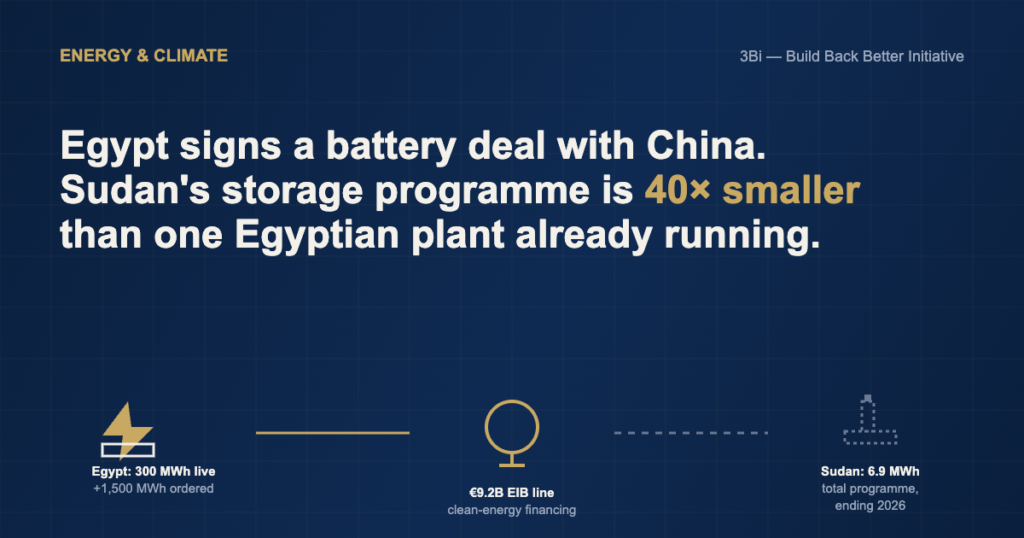
Egypt just signed a battery-manufacturing MOU with China and has a 300MWh storage plant already running, backed by 9.2 billion euros in EIB financing. Sudan's entire national battery-storage programme is more than 40 times smaller.
The Hook
On Wednesday, Egypt’s Ministry of Investment and Foreign Trade announced that Mansour Group had signed a memorandum of understanding with Tianneng Battery, a 40-year-old Chinese battery manufacturer, to study building a factory for lead-acid and lithium batteries inside Egypt (attaqa.net, 2 September 2026). It’s a small, unglamorous piece of paper — a feasibility study, not yet a plant. But it lands on top of a much bigger pile of numbers that tell a story about where grid resilience in this region is heading, and who is being left out of it. Egypt is no longer just buying battery storage. It’s about to start making it. Sudan, next door and mid-collapse, still doesn’t have enough of it to matter.
The Argument
Egypt’s storage buildout is now industrial, not experimental. The Mansour-Tianneng MOU covers two chemistries — lead-acid batteries for vehicles and lithium batteries for new-energy transport — explicitly framed by Investment Minister Mohamed Fareed as part of Egypt’s push to deepen local manufacturing (attaqa.net, 2 September 2026). It doesn’t stand alone. Egypt’s first commercial grid-battery project, a 300-megawatt-hour system integrated with AMEA Power’s 500MW Abydos solar plant in Aswan, has been operating since June 2025 — the first of its kind in North Africa. AMEA Power has already signed on for a follow-on 1,500MWh of storage capacity at the same site. And on 27 August, the European Investment Bank’s board approved a €9.2 billion ($10.5 billion) financing package that explicitly includes renewable-energy support in Egypt, part of a broader EIB push to help non-EU partners balance variable wind and solar output on the grid. Three separate signals — a manufacturing MOU, an operating battery plant with a follow-on order, and a multibillion-euro financing line — point the same direction: Egypt is treating storage as core infrastructure, not a pilot project.
Storage is the part of the clean-energy transition that decides whether the rest of it works. Solar and wind capacity is the easy headline; keeping the lights on when the sun sets or the wind drops is the hard engineering problem underneath it, and it’s the one battery storage exists to solve. Egypt’s own government has said as much: this cooperation comes “at a time when the importance of electricity storage in Egypt is growing amid the country’s expansion in renewable energy projects, and the need for solutions that balance clean-energy production against variable grid demand, especially during peak periods” (attaqa.net, 2 September 2026) — part of a push toward 45% clean energy by 2028. That’s true everywhere renewables scale. It is true with far more urgency in a grid that has already lost the physical capacity to absorb shocks — which is exactly Sudan’s situation, for reasons that have nothing to do with the pace of its energy transition and everything to do with war.
Sudan’s storage programme, measured against Egypt’s, isn’t a smaller version of the same effort — it’s a different order of magnitude entirely. The only dedicated battery-storage initiative currently running in Sudan is a UNDP/Global Environment Facility project retrofitting diesel-based off-grid stations with solar PV and battery storage: a target of 2 megawatts of new solar generation and 6.9 megawatt-hours of storage, on a total project budget of roughly $2.9 million, running since 2022 and due to conclude this year. Set that next to the 300MWh already spinning in Aswan, and Sudan’s entire national battery-storage effort is more than 40 times smaller than the single Egyptian plant that has been operating for over a year. This isn’t a story about Sudan being a few years behind a regional leader. It’s a story about two grids solving structurally different problems at structurally different scales, at the exact moment Sudan can least afford the gap: roughly 15,000 electricity transformers have been destroyed since the war began, the Ethiopian import line that once cushioned peak demand has been down for months, and much of the country has been living with blackouts exceeding 18 hours a day (Sudan Tribune, 22 July 2026; TimesLIVE/Reuters, 28 August 2026). A relaunched Turkish-Sudanese transformer factory south of Khartoum is now producing 150 units a month on a single shift — real progress on hardware, but rehabilitation projects across the sector remain stalled behind a financing impasse, not a technical one.
Why It Matters to the Reader
For Sudan’s Ministry of Energy and Petroleum and the Electricity Regulatory Authority, the lesson from Cairo isn’t “match Egypt’s scale” — that’s not realistic mid-war. It’s narrower and more useful: Egypt didn’t get here through a single grant-funded pilot. It got here by stacking a manufacturing partnership, a commercial project with a repeat order, and a large concessional financing line on top of each other, each one making the next easier to close. Sudan’s technical ministries have real, if smaller, building blocks to work from already — the GEF/UNDP pilot, the reopened transformer factory — but nothing yet that plays the role the EIB package plays for Egypt: a financing instrument sized to match the scale of the damage. For donors and multilateral financiers, the contrast is a legible, quotable data point: a €9.2 billion regional clean-energy financing line exists and is already flowing to Egypt, while Sudan’s comparable storage effort sits at $2.9 million and is scheduled to wind down this year, with no announced successor. For Gulf and Chinese investors scanning the region for the next Mansour-Tianneng-style opportunity, the honest read is that Sudan isn’t ready to compete for that kind of deal today — but the transformer factory and the GEF pilot are proof the underlying demand and some of the industrial base already exist, waiting on financing and stability to catch up.
Close
Egypt’s battery deal with China is not, on its own, a Sudan story. But every regional storage announcement from here forward will keep landing next to the same, stark comparison — until someone changes one side of it. The technology gap is closable. The financing gap is a policy choice, made one grant cycle at a time, and right now it is being made against Sudan.
This piece was produced through 3Bi’s automated daily publications workflow, which monitors regional and international climate and energy reporting to surface developments relevant to Sudan and East Africa.
This publication is produced with support from 3Bi’s institutional donors; see the full funder list at 3bisudan.org.
About the Authors
Related Publications
The Paris Compliance Committee Named Three Silent Countries. Sudan Answered. Now It Owes a Date.
The Paris Agreement's compliance committee has named three countries that ignored its letters on missing climate plans. Sudan is not among them: it replied. Before COP31, 3Bi argues,…
The Kigali Amendment Turns 10 With 175 Parties. Sudan Should Ratify Before the Montreal Protocol Meets in Kigali.
Ten years after the Kigali Amendment was adopted, 175 of 198 Montreal Protocol parties have ratified it. Sudan has not. As parties meet in Kigali on 2–6 November,…
The Adaptation Fund Board Meets in Bonn With US$146.8 Million to Approve. Sudan Has No Project of Its Own.
The Adaptation Fund Board meets in Bonn from 19 to 23 October with US$146.8 million in approvals before it, including a US$30 million Mandera Triangle project. Sudan has…