
Egypt Just Signed a 1,000-Megawatt Wind Deal With Gulf Capital. Sudan Still Has No Contract to Offer the Same Investors — Fix That Now.
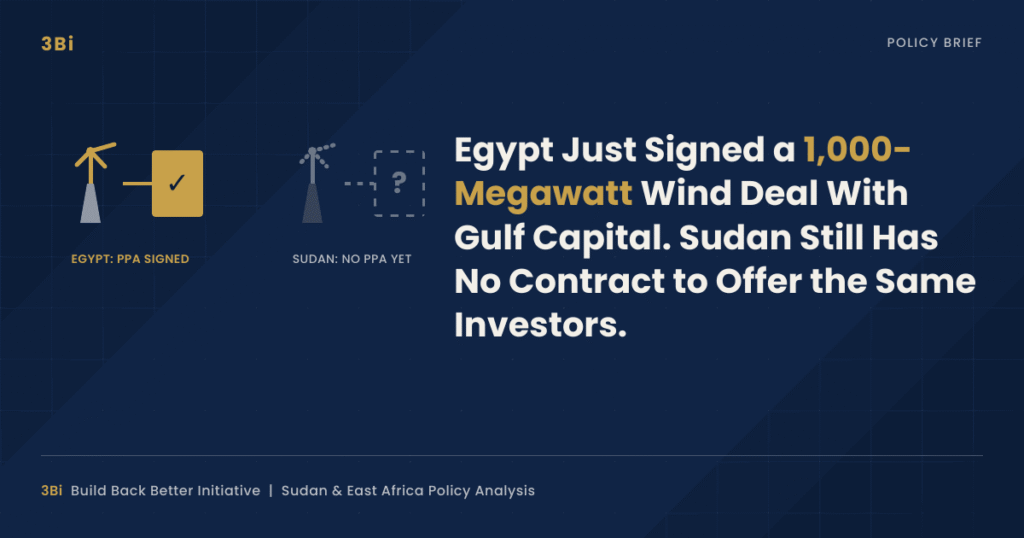
Sudan's Electricity Regulatory Authority should finish, within six months, the standard model power-purchase agreement that a UNDP/GEF-backed effort has left unfinished for over a decade — before reconstruction financing arrives and Sudan misses the same Gulf capital Egypt just signed.
3Bi Research Team | 1 September 2026 | Policy Brief
The Ask
Sudan’s Electricity Regulatory Authority should finish, within six months, the standard model power-purchase agreement (PPA) for utility-scale renewable generators that a UNDP/GEF-backed effort has left unfinished for over a decade. The drafting work does not require a ceasefire, physical access to contested territory, or new capital — only technical staff and donor attention Sudan can commit today, so that when reconstruction financing arrives, Sudan can sign the same class of Gulf investors Egypt just signed, instead of spending its first postwar years writing contract law from scratch.
Why Now
On 1 September 2026, Egypt’s state transmission company signed a power-purchase agreement with the Infinity Power–Hassan Allam consortium for a 1,000-megawatt wind farm at Ras Shaqeeq, targeting commercial operation by December 2029 (attaqa.net, 1 September 2026). The deal is one piece of a much larger pattern: the same consortium, backed by Abu Dhabi’s Masdar through its stake in Infinity Power, is simultaneously developing a 1,000MW solar plant and 600MWh of battery storage in Minya, an existing stake in the 1,465MW Benban solar complex, an 800MW-plus wind portfolio with Elsewedy Electric and Marubeni, and a proposed 10-gigawatt, $10-billion-plus wind project across 3,025 square kilometres in West Sohag — part of Egypt’s push to lift renewables to 45% of its electricity mix by 2028, backed by roughly $2.5 billion in 2025–26 clean-energy investment (Daily News Egypt, 12 August 2026).
None of that capital is Egyptian by origin. It is Gulf capital, actively shopping the region for utility-scale renewable projects with bankable contracts behind them. Sudan cannot compete for it today — not because the resource or the need is missing, but because the paperwork is. That gap is fixable at low cost, in parallel with the war, if Sudan starts now rather than after a ceasefire, when donor and investor attention will be scarce and time-limited.
The Evidence
Sudan has never had a standard renewable PPA, and the gap has been open for more than a decade. A UNDP consultancy brief — part of a joint government/UNDP wind-energy initiative financed by the Global Environment Facility, reviewed on 1 September 2026 — states plainly that “a standard contract for renewable electricity generators does not exist” in Sudan, and seeks a consultant to “develop a model PPA” for large generators and a simplified contract for small ones, plus training for Sudan’s Electricity Regulatory Authority (ERA) on using it. The brief’s own baseline figures — 35% national electrification, 2,723 megawatts of installed capacity, zero wind generation, zero grid-connected solar, drawn from 2012 data — indicate this mandate has sat substantially unaddressed for well over ten years. Sudan’s power sector was unbundled into separate generation, transmission, and distribution utilities specifically to attract private investment, and a Wind Resource Assessment Program was launched to identify sites. Both steps assume a PPA framework will eventually exist to close the loop. It still doesn’t.
Egypt’s deal shows precisely what a finished framework buys. The Ras Shaqeeq agreement was signed directly between Egypt’s state-owned transmission company and a private consortium, at gigawatt scale, with a firm commercial-operation date nearly three and a half years out — the kind of long-horizon commitment that investors will only make against a contract structure they already trust, because Egypt has been signing similar agreements (Ras Ghareb’s 200MW deal, the Benban complex, the Elsewedy-Marubeni portfolio) for years. Sudan Electricity Distribution Company officials described a comparable ambition domestically in 2026 through community-microgrid partnerships with Sudanese banks, but that model works at the scale of a neighbourhood cooperative, not a national grid — it cannot substitute for a sovereign PPA framework capable of anchoring gigawatt-scale investment once the war ends.
The same investor pool is already active in the immediate region, which means it is reachable, not hypothetical. Masdar’s presence in Egypt spans solar, wind, and battery storage projects developed with Infinity Power, and Emirati officials met Egypt’s electricity minister this past week specifically to discuss accelerating grid connection and project delivery timelines (attaqa.net, 1 September 2026). This is not a speculative pool of capital that might someday look at Sudan; it is capital with a demonstrated regional mandate, moving on a multi-year cycle, that will have largely allocated itself to Egypt, the Gulf, and other ready markets well before Sudan’s war ends unless Sudan gives it a reason to look east.
Sudan’s own grid crisis raises the stakes for having this ready. War damage has destroyed roughly 15,000 transmission transformers and stripped some 150,000 kilometres of copper cable nationwide; the Merowe dam, Sudan’s largest single power source, has been targeted directly; and the halt of Ethiopian power imports has pushed blackouts in Khartoum and other cities past 18 hours a day (Sudan Tribune, 22 July 2026; Reuters via TimesLIVE, 28 August 2026). Reconstruction will require new generation capacity fast, at a scale existing utilities cannot finance alone. Renewable IPPs financed by exactly the kind of investor now active in Egypt are the fastest capacity to build if — and only if — the legal groundwork is already in place when the money is ready to move.
Addressing the Counter-Case
The obvious objection: drafting energy-sector contract law while the war continues is premature, a distraction from more urgent humanitarian and security priorities. That objection misreads what this recommendation actually asks for. Finishing a model PPA is a technical, desk-based legal and regulatory exercise — reviewing existing legislation, the draft grid code, and international PPA precedents, then producing a document and running a training workshop for ERA staff. It does not require access to contested territory, new capital, or a ceasefire; it requires the same kind of remote, low-cost technical assistance many Sudanese transitional-governance functions have continued to receive throughout the war. The realistic alternative is not “no cost now, full attention later” — it is starting this same drafting process from zero after a ceasefire, competing for donor and investor attention against every other reconstruction priority, while Gulf capital that could have been captured has already committed elsewhere.
What 3Bi Recommends, Specifically
- Sudan’s Electricity Regulatory Authority, with UNDP/GEF technical support, should finalize a model utility-scale PPA and a simplified small-generator contract within six months, benchmarked explicitly against Egypt’s EETC–Infinity Power structure and international precedents already surveyed under the existing mandate.
- Once finalized, Sudan’s transitional authorities should proactively brief regionally active Gulf investors — Masdar, Infinity Power, and comparable developers — on the framework, rather than waiting for post-ceasefire inbound interest.
- Any reconstruction financing package from the World Bank, African Development Bank, or bilateral donors should include earmarked technical-assistance funding to complete this specific PPA mandate now, not contingent on a ceasefire date.
Sourcing & Contact
Sources: attaqa.net, “مصر تشتري الكهرباء من محطة رياح عملاقة.. ما دور الإمارات؟” (1 September 2026); Daily News Egypt, “Egypt targets 45% renewable energy share by 2028” (12 August 2026); UNDP procurement notice (job ID 57801), “Developing Power Purchase Agreement for Grid Connected Renewable Energy,” reviewed 1 September 2026; Sudan Tribune, “Sudan blames power cuts on Ethiopian line halt, damage to grid” (22 July 2026); TimesLIVE/Reuters, “Extensive power cuts hamper life in Sudan” (28 August 2026). For follow-up: research@3bisudan.org.
This piece was produced through 3Bi’s automated daily publications workflow monitoring regional and international climate reporting.
This publication is produced with support from 3Bi’s institutional donors; see the full funder list at 3bisudan.org.
About the Authors
Related Publications
The Loss and Damage Fund Has Set Aside Its First US$20 Million. Sudan Has Three Requests in Line. Get One Ready for December.
The Fund for responding to Loss and Damage made its first allocation on 22 October, US$20 million for Nepal. Sudan has three requests worth US$48.5 million in its…
The Green Climate Fund Weighs US$1.87 Billion Next Week. Yemen’s First Project Is an Early-Warning System. Sudan Has None in Its Portfolio.
The 46th meeting of the Green Climate Fund Board runs in Songdo from 26 to 29 October 2026, with 21 funding proposals worth US$1.87 billion before it. Sudan’s…
The Paris Compliance Committee Named Three Silent Countries. Sudan Answered. Now It Owes a Date.
The Paris Agreement's compliance committee has named three countries that ignored its letters on missing climate plans. Sudan is not among them: it replied. Before COP31, 3Bi argues,…