
West Africa Is Mapping a Path to Power 110 Million People Off-Grid. Sudan’s Own Pilot Covers 150,000. Map Sudan Next.
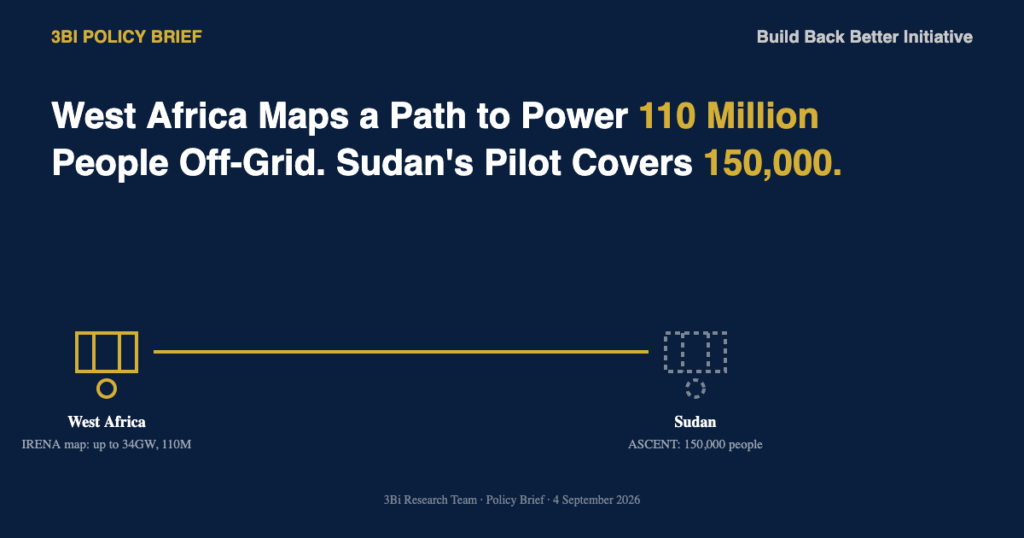
An IRENA study maps up to 34GW of solar mini-grid potential reaching 47-110 million people across four West African countries. Sudan's own World Bank-financed ASCENT project targets just 150,000 with no equivalent mapping — 3Bi recommends Sudan commission the same methodology now.
3Bi Research Team
The Ask
3Bi recommends that Sudan’s Renewable Energy Authority, the World Bank-financed ASCENT-Sudan project team, and interested donors commission an IRENA-style geospatial mini-grid assessment for Sudan’s war-affected states within the next two fiscal quarters, using the same OnSSET methodology and “value of storage” metric IRENA has just applied across Burkina Faso, Mali, Nigeria, and Senegal. Without that mapping exercise, Sudan risks entering the next phase of Mission 300 financing with no shovel-ready pipeline, while a comparable set of West African countries is already scoping tens of gigawatts of investable mini-grid capacity.
Why Now
On 3 September 2026, the International Renewable Energy Agency (IRENA) published a study — reported the same week by the energy-news outlet Attaqa (3 September 2026) — applying its OnSSET geospatial electrification-planning model to four West African countries. The results are striking in scale: solar-battery mini-grids could add between roughly 1 gigawatt and 34 gigawatts of capacity across the four countries depending on demand growth and grid-extension assumptions, and could reach between 47 million and 110 million people who currently lack reliable electricity. Nigeria alone could add 400 megawatts of near-term mini-grid capacity — more than double all of Africa’s registered solar mini-grid capacity in 2025 (149 megawatts, per IRENA’s own figures cited in the study).
This is not an abstract planning exercise. It sits inside a live, multi-billion-dollar financing vehicle: Mission 300, the joint World Bank–African Development Bank initiative launched in April 2024 to connect 300 million Africans to electricity by 2030, with a combined $15 billion in committed financing (the World Bank pledging 250 million connections, the AfDB 50 million). On 16 June 2026, the two banks announced they had already connected 50 million people across 40 African countries — including 7.5 million in Tanzania (five times that country’s pre-initiative annual connection rate), 4.6 million in Ethiopia, and 4.5 million in Nigeria, most of it through mini-grid and off-grid solar, not new central-grid extension.
Sudan is technically inside this pipeline, but only just. The World Bank Board approved the $76.3 million ASCENT-Sudan project in June 2025 — Phase 11 of the regional ASCENT programme that feeds into Mission 300 — targeting electricity and internet access for 150,000 people and the installation of 500 renewable-energy systems, concentrated in Gadaref, Kassala, Northern, and River Nile states (World Bank press release, 2 June 2025). That is a real and welcome commitment. It is also, set against IRENA’s West Africa numbers, roughly three to four orders of magnitude smaller than what a single comparable country in the IRENA study could plausibly scope. Sudan has not had the equivalent geospatial mapping exercise IRENA just ran for Burkina Faso, Mali, Nigeria, and Senegal — so no one, inside or outside government, currently knows what Sudan’s own realistic mini-grid ceiling is.
The war has made the underlying need larger, not smaller. Reporting from Sudan Tribune (22 July 2026) and TimesLIVE, citing Reuters (28 August 2026), documents roughly 15,000 transformers destroyed and some 150,000 kilometres of transmission cable looted or damaged nationwide, alongside the halted Ethiopian import line and blackouts running 18 hours or longer in affected areas. Central-grid repair in active conflict zones is, in IRENA’s own framing for West Africa’s rural and desert populations, “not economically viable” in the near term — which is precisely the condition under which mini-grids outperform grid extension. Sudan meets that condition today more acutely than any of the four West African case-study countries.
The Evidence
Three data points from the IRENA study translate directly into a Sudan planning question:
First, technology mix is not close to a coin flip. IRENA’s modelling finds solar photovoltaic mini-grids dominating 98% of projected new mini-grid capacity across the four West African countries, hydropower serving under 2% of specialised applications, and wind essentially negligible (under 0.1%). For Sudan — a country with strong solar irradiance and a war-damaged hydropower-dependent grid (the Merowe dam has itself been a target) — this is directly transferable evidence that a solar-first mini-grid strategy, not a diversified-generation strategy, is the technically and economically dominant choice.
Second, storage is the variable that makes or breaks project economics. IRENA’s “value of storage” metric — the lifecycle-cost gap between a battery-backed solar-diesel hybrid mini-grid and an equivalent system with no storage, reliant only on diesel generators for flexibility — is what let the agency identify where storage-backed mini-grids clear the bar and where they don’t. ASCENT-Sudan’s own design already includes a pilot solar mini-grid component (per UNDP’s parallel “Promoting Solar Mini-Grids for Clean and Reliable Energy in Sudan” project) but was scoped without an equivalent value-of-storage screening exercise across Sudan’s other war-affected states — meaning the current pilot’s geography was likely chosen on access and security grounds, not on a systematic economic ranking of where storage-backed mini-grids deliver the most value per donor dollar.
Third, scale follows mapping, not the other way around. Nigeria’s 400-megawatt near-term mini-grid opportunity was only identifiable because IRENA ran the OnSSET model specifically for Nigeria. Sudan’s ASCENT project was scoped without that step. The three to four order-of-magnitude gap between ASCENT-Sudan’s 150,000-person target and West Africa’s 47-110 million-person opportunity is not proof that Sudan’s true off-grid opportunity is necessarily small — it is, more plausibly, proof that no one has yet measured it.
Addressing the Counter-Case
The obvious objection is that Sudan is at war and West Africa’s four case-study countries are not, so the comparison is unfair, and mapping exercises are a lower priority than emergency humanitarian energy needs right now. Three responses matter here. First, a geospatial mapping study is a desk exercise built on existing satellite, population, and grid-topology data — it does not require physical access to unstable frontline areas to begin, and IRENA’s own OnSSET applications have been run for other fragile and conflict-affected settings before. Second, ASCENT-Sudan itself is proof the international financing appetite already exists during the conflict — the missing input is not money but a data-driven pipeline of investable sites ready to receive it, which is exactly what a mapping exercise produces. Third, and most importantly, mapping now is what determines whether Sudan is ready to absorb a much larger tranche of Mission 300 or donor financing the moment ceasefire and reconstruction financing conditions improve — countries that arrive at that moment with a shelf-ready project pipeline capture financing faster than countries that start planning from zero.
A second, narrower objection is that Sudan’s Renewable Energy Authority may lack the technical capacity to run an OnSSET-style exercise unassisted. This is a reasonable operational concern, not an argument against the recommendation: IRENA itself, the World Bank’s ESMAP programme (which has already run a comparable off-grid/mini-grid market assessment for South Sudan), and the ASCENT programme’s existing regional platform at COMESA are all standing technical resources built for exactly this kind of country-level analytical support.
What 3Bi Recommends, Specifically
3Bi recommends, first, that Sudan’s Renewable Energy Authority formally request IRENA technical assistance to run an OnSSET geospatial mini-grid assessment covering all Sudanese states, not only the four currently served by ASCENT-Sudan, with results delivered within two fiscal quarters. Second, that the ASCENT-Sudan implementing agency, the Eastern and Southern African Trade and Development Bank, commission a value-of-storage analysis specifically for Sudan’s remaining accessible states, to identify where a battery-backed solar mini-grid outperforms further diesel dependence on strict cost grounds — mirroring the exact metric IRENA applied in West Africa. Third, that Sudanese authorities and donor partners use the resulting map, once complete, to prepare a second, larger ASCENT-Sudan financing phase or a direct Mission 300 pipeline submission, sized against Sudan’s actual off-grid population rather than the current pilot’s administrative footprint. Fourth, that this mapping data be published openly, in both English and Arabic, so that Sudanese civil-society and Resistance/Service Committee networks in mapped areas can verify site selection and flag community-level access needs the satellite data alone will miss.
Sourcing & Contact
Primary source: Attaqa, “Mini-grid solar power is the ideal solution for electricity deprivation — West Africa as a model (study),” 3 September 2026, reporting an IRENA analytical study applying the OnSSET model across Burkina Faso, Mali, Nigeria, and Senegal. Supporting sources: World Bank press release, “Advancing Energy and Digital Connectivity in Sudan,” 2 June 2025 (ASCENT-Sudan project approval and design); World Bank/AfDB Mission 300 programme materials and 16 June 2026 joint progress statement (50 million connections across 40 African countries); UNDP Sudan, “Promoting Solar Mini-Grids for Clean and Reliable Energy in Sudan” project page; World Bank ESMAP, “Pathways to Electricity Access Expansion in South Sudan” (comparable regional off-grid/mini-grid market assessment methodology); Sudan Tribune, 22 July 2026, and TimesLIVE, citing Reuters, 28 August 2026 (Sudan grid-damage figures). This publication was produced through 3Bi’s automated daily publications workflow monitoring regional and international climate and energy reporting.
This publication is produced with support from 3Bi’s institutional donors; see the full funder list at 3bisudan.org.
About the Authors
Related Publications
The Paris Compliance Committee Named Three Silent Countries. Sudan Answered. Now It Owes a Date.
The Paris Agreement's compliance committee has named three countries that ignored its letters on missing climate plans. Sudan is not among them: it replied. Before COP31, 3Bi argues,…
The Kigali Amendment Turns 10 With 175 Parties. Sudan Should Ratify Before the Montreal Protocol Meets in Kigali.
Ten years after the Kigali Amendment was adopted, 175 of 198 Montreal Protocol parties have ratified it. Sudan has not. As parties meet in Kigali on 2–6 November,…
The Adaptation Fund Board Meets in Bonn With US$146.8 Million to Approve. Sudan Has No Project of Its Own.
The Adaptation Fund Board meets in Bonn from 19 to 23 October with US$146.8 million in approvals before it, including a US$30 million Mandera Triangle project. Sudan has…