Biodiversity COP17 Opens in Six Days. Africa Needs a Finance Decision, Not Another Scorecard.
3Bi Research Team | Analytical Article | 13 October 2026
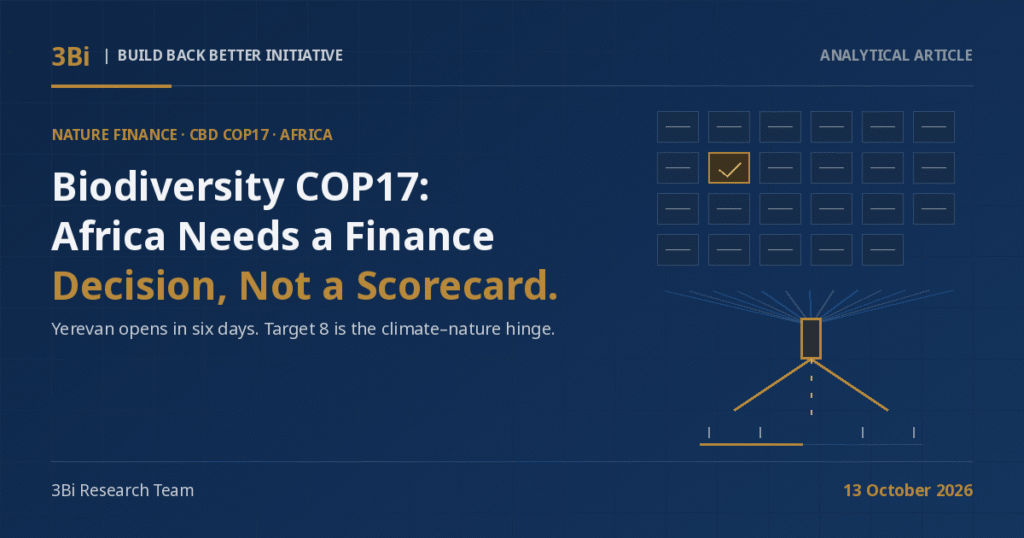
CBD COP17 in Yerevan opens on 19 October for the first Global Biodiversity Framework review. A draft UN report finds the world short on 22 of 23 nature targets. Africa's fight is finance — and Sudan is still building its Biodiversity Finance Plan.
CBD COP17 opens in Yerevan on 19 October for the first Global Biodiversity Framework review. A draft UN report finds countries short on 22 of 23 nature targets — finance is the open fight. (Illustration: 3Bi)
3Bi Research Team | Analytical Article | 13 October 2026
The Hook
Diplomats will gather in Yerevan, Armenia, from 19 to 30 October for the seventeenth Conference of the Parties to the UN Convention on Biological Diversity (CBD COP17). Carbon Brief published a live tracker of the negotiating texts on 12 October, as parties prepare to settle dozens of legal decisions (Carbon Brief, 12 October 2026). The meeting is the halfway point of the Kunming-Montreal Global Biodiversity Framework (GBF), adopted in 2022 with a mission to halt and reverse nature loss by 2030. A draft UN global report, prepared for the review, finds countries falling short on 22 of the framework’s 23 targets for 2030 (Carbon Brief, 29 July 2026). The one target scored “green” in that draft was Target 8 — minimising climate change’s impact on biodiversity through mitigation, adaptation and nature-based solutions (Carbon Brief, 29 July 2026). Nature finance and climate resilience are therefore the same conversation for African governments that arrive in Yerevan with thin budgets and thick National Biodiversity Strategies and Action Plans (NBSAPs). The fight that will decide whether the scorecard moves is finance.
The Argument
First, the scorecard is already written; the open question is the money. The second draft of the CBD’s global progress report says that unless collective implementation “accelerates rapidly”, the 2030 targets and mission “will not be achieved”, and that “no target presents a fully positive picture” (Carbon Brief, 29 July 2026). On Target 19 — international biodiversity finance of at least US$20 billion a year by 2025 and US$30 billion by 2030 — the draft suggests the US$20 billion milestone was “likely not achieved”. Reporting countries recorded a cumulative US$17.7 billion in international public biodiversity funding between 2020 and 2023, an average of about US$4.4 billion a year (Carbon Brief, 29 July 2026). Domestic spending was larger over the same years, but many countries told the CBD that biodiversity “frequently loses out to competing development priorities”. Private and “innovative” finance remains “particularly undeveloped” (Carbon Brief, 29 July 2026). The GEF, which hosts the Global Biodiversity Framework Fund (GBFF), frames COP17 as the first major stocktake under the KMGBF, a formal review of the CBD’s financial mechanism, and a critical moment to mobilise resources for the GBFF (GEF, CBD COP17 event page, accessed 13 October 2026). That is the agenda Africa cannot afford to treat as a side event.
Second, African governments have already named what “adequate” means — and they said it in Nairobi, not Yerevan. After the seventh meeting of the Subsidiary Body on Implementation (SBI-7) in Nairobi in August 2026, South Africa, intervening for the African Group and the Group of Like-Minded Megadiverse Countries, said international biodiversity finance remains below Target 19(a) and that the architecture must provide predictable, adequate and accessible support, with technology transfer and institutional capacity for developing countries (South African Government, 18 August 2026). Significant differences remain on international finance and on the multilateral mechanism for digital sequence information (DSI), including continued Conference of the Parties oversight of the Cali Fund (South African Government, 18 August 2026). Disagreement over creating a permanent financial mechanism under CBD control — rather than leaving it under the GEF — helped suspend COP16 in Cali in 2024; a resumed session in Rome in early 2025 agreed a roadmap toward a permanent mechanism (Carbon Brief, 12 October 2026). Yerevan is where that roadmap either becomes an operational decision or slips again. 3Bi is not claiming South Africa’s SBI-7 lines are a formal African Group decision text for COP17; they are the clearest public African position we have found ahead of the summit.
Third, Africa’s development banks are bringing nature finance into the climate-resilience lane — and Sudan is still assembling its own plan. The African Development Bank Group will participate in COP17 under the theme “Taking Action for Nature”, with Anthony Nyong, Director of Climate and Green Growth, leading the delegation. The Bank will push nature-based solutions, ecosystem restoration, natural capital accounting and innovative financing for countries’ NBSAPs, and will co-host a joint Multilateral Development Banks pavilion (African Development Bank, COP17 event page, accessed 13 October 2026). That framing treats biodiversity as infrastructure for food, water and climate resilience, not as a separate conservation silo. Sudan, for its part, is building a Biodiversity Finance Plan through UNDP’s BIOFIN programme with the Higher Council for Environment and Natural Resources and the Ministry of Finance and Economic Planning. A draft Policy and Institutional Review was completed in April 2026; an expenditure-review methodology covering 2015–2025 is in place, and data collection is under way. Potential solutions under assessment include biodiversity budget tagging, protected-area and forest revenues, Gum Arabic value-chain finance, clean-energy approaches that reduce pressure on forests, and sustainable fisheries finance — all still under assessment, not yet approved (UNDP BIOFIN Sudan country page, accessed 13 October 2026). The NBSAP for 2025–2030 is the plan those tools are meant to fund. A country that arrives in Yerevan without a finance plan cannot easily tell donors which windows to open.
Why It Matters to the Reader
If you work on climate or environment finance for Sudan, or for an East African neighbour, Yerevan is not a biodiversity-only room. Target 8 of the GBF is the climate-nature hinge, and it is the one area the draft global report scored green — while still warning that nature-based solutions are not yet at sufficient scale (Carbon Brief, 29 July 2026). The African Development Bank’s Climate and Green Growth directorate leading the Bank’s COP17 team is a signal that nature finance and climate resilience will be argued together (African Development Bank, accessed 13 October 2026). For Sudan, the practical ask is narrower than a new fund slogan. It is to finish and validate the BIOFIN Finance Plan in time to use whatever COP17 decides on the financial mechanism and the GBFF, and to bring named priorities — Gum Arabic landscapes, forest revenues, clean cooking that eases biomass pressure — into the African Group’s evidence pack. 3Bi has not seen Sudan’s draft Finance Plan. We are not asserting that any BIOFIN option will pass national approval, or that Yerevan will unlock new money for Khartoum by itself.
Our view is that Sudan’s environment and finance focal points, coordinating with the African Group, should treat the COP17 finance and financial-mechanism agenda as a climate-resilience file. They should arrive with the PIR findings, the expenditure baseline that is being built, and a short list of finance solutions that match the NBSAP 2025–2030. The same discipline applies to other African LDCs that have NBSAPs on paper and fragmented biodiversity spending in practice. A second reason to engage early is sequence. COP31 opens in Antalya on 9 November, weeks after Yerevan closes (PINA, 9 October 2026; confirmed in recent 3Bi coverage). Nature-based adaptation and land restoration will reappear in the climate rooms. Positions that Africa locks in on biodiversity finance in Armenia will travel.
Close
Yerevan will count the gaps. Africa’s job is to turn the finance fight into a decision before the decade’s second half starts without one.
Sourcing & Contact
Primary sources: Carbon Brief, “Interactive: Tracking negotiating texts at the COP17 biodiversity summit” (12 October 2026); Carbon Brief, “World falling short on 22 of 23 nature targets for 2030, says draft UN report” (29 July 2026); South African Government / Department of Forestry, Fisheries and the Environment, statement on SBI-7 and COP17 priorities (18 August 2026); African Development Bank Group, CBD COP17 event page (accessed 13 October 2026); Global Environment Facility, “The GEF at CBD COP17” (accessed 13 October 2026); UNDP BIOFIN, Sudan country page (accessed 13 October 2026); CBD Secretariat explainer on the first draft global KMGBF progress report (12 June 2026); PINA on COP31 dates in Antalya (9 October 2026). For methodology questions or to propose a correction, contact 3Bi’s Research Team via 3bisudan.org.
3Bi Research Team. This piece was produced through 3Bi’s automated daily publications workflow, which monitors regional and international climate and energy reporting.
This publication is produced with support from 3Bi’s institutional donors; see the full funder list at 3bisudan.org.
About the Authors
Related Publications
The Paris Compliance Committee Named Three Silent Countries. Sudan Answered. Now It Owes a Date.
The Paris Agreement's compliance committee has named three countries that ignored its letters on missing climate plans. Sudan is not among them: it replied. Before COP31, 3Bi argues,…
The Kigali Amendment Turns 10 With 175 Parties. Sudan Should Ratify Before the Montreal Protocol Meets in Kigali.
Ten years after the Kigali Amendment was adopted, 175 of 198 Montreal Protocol parties have ratified it. Sudan has not. As parties meet in Kigali on 2–6 November,…
The Adaptation Fund Board Meets in Bonn With US$146.8 Million to Approve. Sudan Has No Project of Its Own.
The Adaptation Fund Board meets in Bonn from 19 to 23 October with US$146.8 million in approvals before it, including a US$30 million Mandera Triangle project. Sudan has…