Africa Just Crossed 11 GW of Wind. Sudan Ranks Third in Resource — and Near Last in Turbines.
3Bi Research Team | Policy Brief | 14 October 2026
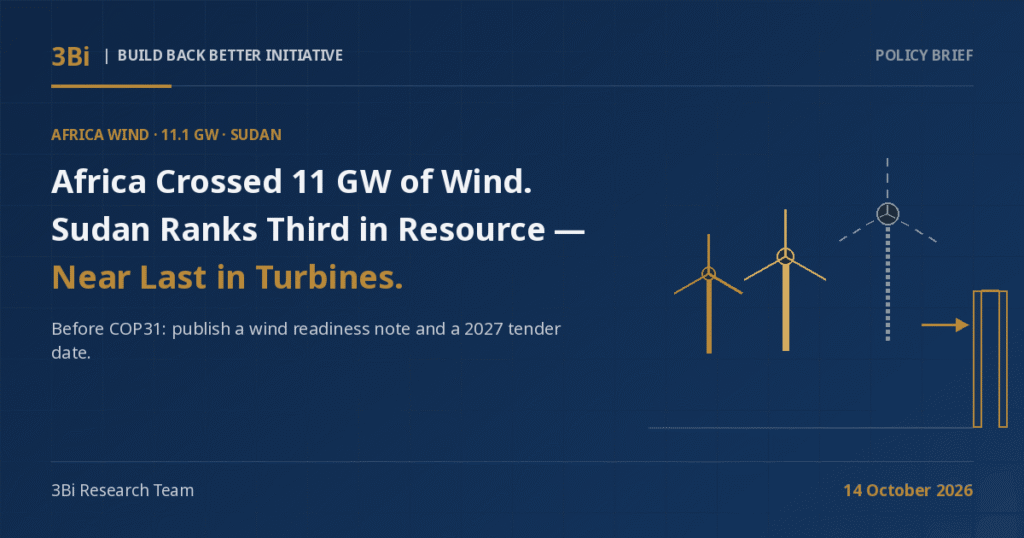
GWEC's new Africa wind report finds the continent at 11.1 GW installed. Sudan ranks third in technical resource, yet Algeria, Libya and Sudan together have built under 200 MW. Sudan should publish a wind readiness note before COP31.
On 7 October 2026 GWEC reported Africa had crossed 11.1 GW of installed wind. Sudan ranks third in technical resource; Algeria, Libya and Sudan together have built under 200 MW. (Illustration: 3Bi)
3Bi Research Team | Policy Brief | 14 October 2026
The Ask
Before COP31 opens in Antalya on 9 November 2026, Sudan’s Ministry of Energy and Oil, working with the Higher Council for Environment and Natural Resources (HCENR), should publish a short wind readiness statement. The statement should say how Sudan will turn its place among Africa’s top wind-resource countries into a bankable pipeline: which offtake models it will allow, when the first wind tender or prequalification round will open, and how wind will appear in Sudan’s next Nationally Determined Contribution (NDC 3.0) and its Green Climate Fund (GCF) country programme. On 7 October the Global Wind Energy Council (GWEC) published The Status of Wind in Africa 2026: the continent has crossed 11.1 GW of installed wind, but Algeria, Libya and Sudan — the three countries with the largest technical resources — have together built less than 200 MW. A two-page statement costs almost nothing. Without one, the next decade of African wind will keep concentrating in South Africa, Egypt and Morocco, and Sudan’s resource ranking will remain a footnote in someone else’s report.
Why Now
On 7 October 2026, at Windaba in Cape Town, GWEC released its Status of Wind in Africa report and said the continent’s wind sector had crossed an industrial threshold. Installed capacity reached 11.1 GW by the end of 2025, up from just under 9 GW in 2023 — a rise of more than 23% in two years. New installations in 2025 hit a record 1.53 GW. The planned pipeline now stands at 186 GW across 259 projects. “Africa’s wind story is no longer a story of potential. It is becoming a story of execution,” said Juliana Kainga, GWEC’s Director for Africa Wind Power (GWEC, 7 October 2026). Arabic-language energy coverage picked the same numbers up on 11 October (attaqa.net, 11 October 2026).
The concentration behind those headlines is the policy problem. South Africa (about 4.2 GW), Egypt (about 3.2 GW) and Morocco (about 2.2 GW) together hold more than 85% of Africa’s installed wind (GWEC, 7 October 2026). Yet GWEC’s underlying resource ranking, built with the International Finance Corporation and Everoze on Global Wind Atlas data, puts Algeria first (about 6,191 GW of technical onshore potential at wind speeds above 7.5 m/s), Libya second (about 5,079 GW) and Sudan third (about 4,628 GW). Those three resource leaders have together built less than 200 MW (GWEC, Status of Wind in Africa 2026; Engineering News, 7 October 2026). Africa’s total technical onshore potential is about 58,400 GW; less than 0.02% has been built. Capacity factors of 35–42% in the better African resource regions already beat the European onshore fleet average of about 25% (GWEC, 2026). The constraint is not the wind.
The calendar sharpens the ask. COP31 opens in Antalya on 9 November 2026. The GCF Board meets in Songdo from 26 to 29 October 2026 (B.46) to consider up to 21 funding proposals and an updated policy for contributions to the Fund’s third replenishment (Green Climate Fund, B.46 provisional agenda and early funding-proposal list, September–October 2026). Sudan’s GCF country page lists three projects and about US$44.8 million of GCF financing, plus a National Designated Authority (NDA) nomination letter dated 8 July 2026 (Green Climate Fund, Sudan country page, accessed 14 October 2026). Sudan’s NDC 3.0 is still listed as pending (African NDC Hub, accessed 14 October 2026). The next four weeks are when a short national wind position can still enter NDC drafting, GCF country programming and the COP31 conversation about African energy transition finance.
The Evidence
First, Sudan sits at the wrong end of a resource–institution mismatch that GWEC has now quantified. The report’s country ranking by technical potential at wind speeds above 7.5 m/s places Sudan third on the continent, behind only Algeria and Libya, and ahead of Mauritania, Mali, Chad and Niger (GWEC, Status of Wind in Africa 2026). The same report shows that the three countries that have built 85% of Africa’s turbines — South Africa, Egypt and Morocco — together hold less than 10% of the continent’s technical potential. GWEC calls this a resource–institution mismatch: wind is built where bankable offtake, predictable procurement and a competent grid coincide, not only where the wind is strongest. The planned pipeline of 186 GW is already geographically wider than the operating fleet and explicitly includes announced and pre-construction projects in markets such as Mauritania, Algeria, central Sudan, Tanzania, Zambia, Madagascar, Cameroon and Angola (GWEC, 2026). Announcement is not construction. Without a national offtake and tender rulebook, Sudan stays on the resource list and off the commissioning list.
Second, the models that unlocked the last three years of African wind do not require perfect utilities — they require clear offtake rules. South Africa’s corporate power-purchase agreements (PPAs) unlocked more than 3.3 GW of wind in under thirty months after regulators raised, then removed, the licensing-exempt generation threshold — faster, for wind alone, than the state’s Renewable Energy Independent Power Producer Procurement Programme delivered across technologies in fifteen years (GWEC, 7 October 2026). Mines, cement plants, smelters and fertiliser producers are now buying wind in volumes that national utilities have struggled to match. Morocco has a longer captive-wind history under Law 13-09; Egypt has scaled with bankable Egyptian Electricity Transmission Company contracts and a sovereign backstop (GWEC, 2026). For a frontier market, the lesson is not to copy Cape Town or Cairo wholesale. It is that Sudan can decide, in writing, whether it will allow utility PPAs, corporate or wheeled offtake, or both — and that silence is also a decision, because developers will read silence as risk.
Third, Sudan’s own near-term electricity process is already moving on solar, which makes a wind-shaped hole easy to close. Sudanese reporting in early October said the Sudan Electricity Holding Company had opened a prequalification window for solar project companies, with a deadline of 30 November 2026 (Alsudantoday, citing Al-Tayar, 6 October 2026). That is the right kind of signal for one technology. GWEC’s five conditions for accelerating African wind — bankable offtake, a repeated procurement calendar, local-currency capital, a grid that can absorb new generation, and regulatory durability — are exactly what a short readiness statement can start to name (GWEC, 7 October 2026). Putting wind beside solar in the same planning cycle costs little compared with discovering, after COP31 and after B.46, that Sudan’s third-place resource ranking still has no domestic tender date attached to it.
Addressing the Counter-Case
The strongest objection is that Sudan cannot usefully publish a wind plan while transmission, offtake creditworthiness and project delivery remain hard. That is a fair concern, and 3Bi is not claiming that a two-page statement will commission turbines by next dry season. GWEC itself warns that the announcement-to-construction conversion rate will decide Africa’s wind trajectory through 2030, and that grid investment is now often more binding than turbine availability (GWEC, 2026; Engineering News, 7 October 2026). But the countries that crossed into self-sustaining wind markets did not wait for perfect grids. They published auction calendars, standardised contracts and offtake rules, then let one bankable round crowd in the next. A readiness statement is the cheapest way into that loop.
A second objection is that solar is cheaper and faster for Sudan, so wind can wait. Daytime solar and wind are complements, not substitutes. GWEC notes that as solar rises, wind’s value is in extending clean supply beyond daylight hours, and that a growing share of new African wind projects above 100 MW are expected to be hybrid with solar and storage by 2030 (GWEC, 2026). Sudan’s solar prequalification is welcome. It does not replace a wind rulebook for the Red Sea and northern corridors where the resource is strongest.
A third objection is that African climate finance talks are already crowded — Pre-COP access-to-finance plans, Article 6 methodologies, Great Green Wall programmes — so another ask will not land. The opposite is true for a short, dated statement. B.46 and COP31 need country positions that name specific technologies and offtake models. Sudan already has a GCF NDA nomination on file from July 2026. Using it to put wind into the country programme is administrative work, not a new institution.
What 3Bi Recommends, Specifically
First, by 9 November 2026, the Ministry of Energy and Oil, with HCENR, should publish a short wind readiness statement. It should acknowledge Sudan’s place in the GWEC 2026 resource ranking; say whether Sudan will allow utility PPAs, corporate or wheeled offtake, or both; name the office that will run wind tenders or prequalification; and set a public date in 2027 for the first wind round.
Second, by the same date, the Sudan Electricity Holding Company should state how wind will sit beside the solar prequalification process already under way — either as a parallel window or as a dated follow-on round — so that developers are not left to invent Sudan’s rules project by project.
Third, HCENR and the GCF NDA should write a wind component into Sudan’s GCF country programme and readiness priorities before the Board’s next programming cycle after B.46, including grid and offtake preparation for high-resource corridors.
Fourth, at COP31, Sudan’s delegation — coordinating with other African Group members that hold large wind resources and thin installed fleets — should ask that energy-transition finance and GCF programming treat resource–institution mismatches as a readiness priority, not only as a private-developer problem.
Fifth, 3Bi will track whether a Sudanese wind readiness statement appears, whether a 2027 tender date is published, and how wind is reflected in NDC 3.0 and GCF documents, using GWEC, attaqa.net, UNFCCC and GCF records. We will publish a follow-up by mid-December 2026.
Sourcing & Contact
Primary sources: Global Wind Energy Council, “Africa Crosses Installation Threshold as Rising Industrial Demand Signals a New Era of Growth” (press release for The Status of Wind in Africa 2026), 7 October 2026; Global Wind Energy Council, The Status of Wind in Africa 2026 (report, July 2026 imprint; launched 7 October 2026); Engineering News / Creamer Media, “African wind power sector has crossed a threshold” (Juliana Kainga keynote at Windaba 2026), 7 October 2026; attaqa.net, “3 دول بينها مصر والمغرب تهيمن على قدرة طاقة الرياح في أفريقيا”, 11 October 2026; Green Climate Fund, Forty-sixth meeting of the Board (B.46) meeting page and documents, Songdo, 26–29 October 2026; Green Climate Fund, GCF/B.46/02/Drf.01, “Consideration of funding proposals” (early publication list), 28 September 2026; Green Climate Fund, Sudan country page and NDA nomination letter (cover date 8 July 2026), accessed 14 October 2026; African NDC Hub, Sudan country snapshot (NDC 3.0 status: Pending), accessed 14 October 2026; Alsudantoday, citing Al-Tayar, Sudan Electricity Holding Company solar prequalification report, 6 October 2026. For methodology questions or to propose a correction, contact 3Bi’s Research Team via 3bisudan.org.
This piece was produced through 3Bi’s automated daily publications workflow, which monitors regional and international climate and energy reporting.
This publication is produced with support from 3Bi’s institutional donors; see the full funder list at 3bisudan.org.
About the Authors
Related Publications
The Loss and Damage Fund Has Set Aside Its First US$20 Million. Sudan Has Three Requests in Line. Get One Ready for December.
The Fund for responding to Loss and Damage made its first allocation on 22 October, US$20 million for Nepal. Sudan has three requests worth US$48.5 million in its…
The Green Climate Fund Weighs US$1.87 Billion Next Week. Yemen’s First Project Is an Early-Warning System. Sudan Has None in Its Portfolio.
The 46th meeting of the Green Climate Fund Board runs in Songdo from 26 to 29 October 2026, with 21 funding proposals worth US$1.87 billion before it. Sudan’s…
The Paris Compliance Committee Named Three Silent Countries. Sudan Answered. Now It Owes a Date.
The Paris Agreement's compliance committee has named three countries that ignored its letters on missing climate plans. Sudan is not among them: it replied. Before COP31, 3Bi argues,…