The Green Climate Fund Weighs US$1.87 Billion Next Week. Yemen’s First Project Is an Early-Warning System. Sudan Has None in Its Portfolio.
3Bi Situation Report — Climate & Energy Desk | First edition
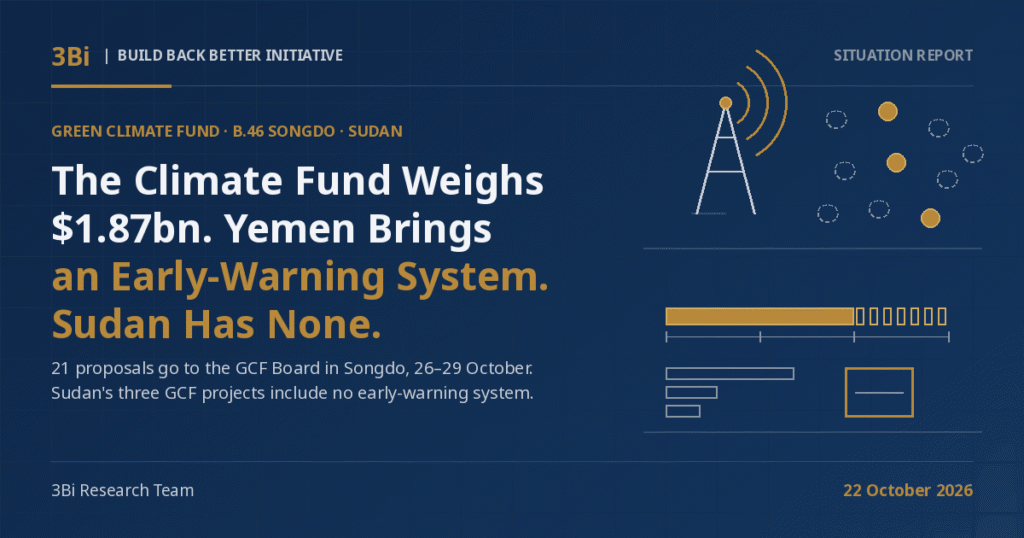
The 46th meeting of the Green Climate Fund Board runs in Songdo from 26 to 29 October 2026, with 21 funding proposals worth US$1.87 billion before it. Sudan’s three GCF projects include…
The 46th meeting of the Green Climate Fund Board runs in Songdo from 26 to 29 October 2026, with 21 funding proposals worth US$1.87 billion before it. Sudan’s three GCF projects include no early-warning system. (Illustration: 3Bi)
3Bi Situation Report — Climate & Energy Desk | First edition | Information cut-off: 22 October 2026, 04:00 UTC
Headline Fact
The Green Climate Fund (GCF) Board meets in Songdo, Republic of Korea, from 26 to 29 October with 21 funding proposals before it. Together they request US$1,866.7 million from the Fund and are worth US$6,798.3 million including co-financing (Green Climate Fund, GCF/B.46/02, 5 October 2026). Five would be the first single-country GCF projects for four countries: Algeria, Cameroon, Moldova and Yemen. Yemen’s is a US$24.73 million grant for Yemen’s Climate Water Information Management and Early Warning Systems project, submitted by the World Bank with UNDP as executing entity (Green Climate Fund, GCF/B.46/02/Add.02, 5 October 2026). It aims to rebuild weather, rainfall, groundwater and flood monitoring across nine priority river basins, reaching 9.2 million direct beneficiaries, and to extend flash-flood warning lead times from about 48 hours to 72 hours or more. The Fund’s technical panel recommends approval. The proposal arrives in the same week that the World Meteorological Organization (WMO) warned that the current El Niño “could be unprecedented in strength”, with wetter-than-normal conditions more likely in parts of East Africa through December (WMO, 21 October 2026). Sudan’s GCF country page lists three projects worth US$44.8 million and US$3.3 million in readiness support (Green Climate Fund, Sudan country page, accessed 22 October 2026). Judging by their published descriptions, none of the three is an early-warning or climate-information project.
Timeline
– 18 April 2016: The GCF receives the concept note for what becomes Sudan’s largest single-country GCF project, a UNDP-implemented programme for rain-fed farmers and pastoralists in nine states. The Board approves it on 21 August 2020, after 1,587 days in the pipeline, with US$25.6 million in GCF grant funding (Green Climate Fund, FP139 project page, accessed 22 October 2026).
– 22 September 2023: The Netherlands commits 52 million Swiss francs to “Water at the Heart of Climate Action”, a five-year early-warning partnership of the IFRC, the Netherlands Red Cross, UNDRR, WMO and the Systematic Observations Financing Facility (SOFF). It covers Ethiopia, South Sudan, Sudan and Uganda in the Nile basin (SOFF, 22 September 2023).
– June 2024: The SOFF Steering Committee records that its operations in Sudan are on hold (SOFF, Decision 8.4.1, June 2024). 3Bi could not find a later public update.
– 15 April 2026: The World Bank first submits the Yemen early-warning proposal to the GCF under the Simplified Approval Process, the Fund’s lane for projects of up to US$25 million with minimal environmental and social risk (Green Climate Fund, GCF/B.46/02/Add.02, 5 October 2026).
– 8 July 2026: A nomination letter for Sudan’s National Designated Authority, the GCF’s national focal point, is posted on Sudan’s GCF country page. The authority is the Higher Council for Environment and Natural Resources (Green Climate Fund, Sudan country page, accessed 22 October 2026).
– 5 October 2026: The GCF publishes the full B.46 list. Adaptation makes up 54 per cent of the requested funding in grant-equivalent terms, and direct-access entities 34 per cent (Green Climate Fund, GCF/B.46/02, 5 October 2026).
– 21 October 2026: WMO and the UN Office for the Coordination of Humanitarian Affairs (OCHA) release a new seasonal outlook. UN relief chief Tom Fletcher says the next two weeks are critical and that Somalia, Ethiopia and Kenya need funding and supplies in place before heavy rains arrive (UN News, 21 October 2026).
– 26–29 October 2026: The GCF Board meets in Songdo (Green Climate Fund, B.46 meeting page and annotated agenda, 20 October 2026).
What We Know / What We Don’t
We know what is on the table for Africa and the Arab region. Ethiopia brings a US$25 million resilience project for vulnerable households with its own Ministry of Finance as the accredited entity. Algeria brings its first single-country project, US$43 million through FAO for the steppe and dry-forest areas of its Green Dam. Cameroon brings two projects, and the Africa Finance Corporation a US$276.7 million sovereign climate facility for Angola, Benin, Côte d’Ivoire and Nigeria. A second tranche of the EBRD’s Green Cities Facility, which covers Jordan, Morocco and Tunisia among others, is also up for approval (Green Climate Fund, GCF/B.46/02, 5 October 2026).
We know how thin Yemen’s starting point is. The proposal says more than 70 per cent of the country’s hydrometeorological stations are not working. It reports no weather radar and no upper-air observations, and siren alerts in only a handful of urban flash-flood hotspots. It also proposes the country’s first operational drought-monitoring and advisory system (Green Climate Fund, GCF/B.46/02/Add.02, 5 October 2026). The GCF grant sits alongside US$150 million in parallel World Bank IDA financing for a wider water-management programme.
We know the weak point the Fund’s reviewers found. The independent Technical Advisory Panel recommends approval but says it “was not able to establish that the system would remain operational beyond the project period”. The proposal itself states that no dedicated public budget line exists for operating, maintaining or calibrating hydrometeorological equipment (Green Climate Fund, GCF/B.46/02/Add.02, 5 October 2026). The panel calls the sustainability of the investment “unresolved”.
We know where Sudan’s GCF portfolio stands. The UNDP rain-fed agriculture project is due to finish on 21 September 2027 and has disbursed 44 per cent of its GCF funding (Green Climate Fund, FP139 project page, accessed 22 October 2026). The other two are an FAO gum arabic project and a regional IFAD green-finance programme (Green Climate Fund, Sudan country page, accessed 22 October 2026). On forecasting, the most recent WMO account 3Bi found dates from March 2024. It describes the Sudan Meteorological Authority collecting data manually from 29 stations and drawing on regional centres such as ICPAC for forecasting support (WMO, MeteoWorld, March 2024).
We do not know whether Sudan has an early-warning concept note in the GCF pipeline, and 3Bi found no public record of one. Nor do we know whether SOFF support for Sudan has resumed, or what the Board will decide next week. One national direct-access proposal for an adaptation loan, worth US$57.8 million, was not recommended by the technical panel; the GCF does not name the country (Green Climate Fund, GCF/B.46/02, 5 October 2026).
Implications
The Yemen proposal shows that a country with a degraded monitoring network can still bring a credible early-warning project to the GCF, and do it quickly. It went from first submission to the Board agenda in under six months. Sudan’s largest GCF project took more than four years to get from concept note to approval. In our reading, the Simplified Approval Process is the realistic lane for a first Sudanese early-warning project: it is capped at US$25 million, uses shorter documents and favours low-risk, scalable designs.
The timing matters too. WMO’s outlook expects El Niño impacts to “continue well beyond” its peak around December (WMO, 21 October 2026), and the African Development Bank estimates the event could cost African countries US$10–20 billion, as cited by UN relief chief Tom Fletcher (UN News, 21 October 2026). Early-warning systems take years to build, so a proposal drafted now would serve the next El Niño, not this one. That is an argument to start, not to wait.
In our view, three low-cost steps follow. First, the Higher Council for Environment and Natural Resources, as Sudan’s GCF focal point, could ask the GCF secretariat and an accredited entity already active in Sudan for an early read on a Simplified Approval Process concept note on climate information and early warning. Second, it could use readiness funds to cost the running of the system before drafting, including maintenance, calibration and staff. That is the gap the panel flagged in Yemen, and a Sudanese proposal that answers it up front would be stronger. Third, it could anchor the design in the Nile-basin early-warning work Sudan already belongs to, such as Water at the Heart of Climate Action and regional forecasting through ICPAC, so the project builds on existing systems rather than duplicating them.
3Bi is not claiming that a Sudanese proposal would pass review, or that Yemen’s approach transfers directly. Monitoring stations need sites that crews can reach and budgets that last. The point is that the Fund has just shown it will finance early warning in difficult settings when the design is credible, and Sudan has an authority in place to ask.
Watch Next
– 23 October 2026: The Adaptation Fund Board takes its funding decisions in Bonn (Adaptation Fund, AFB/B.47/1/Rev.1, September 2026).
– 26–29 October 2026: GCF B.46 in Songdo, including decisions on the Yemen, Ethiopia and Algeria proposals (Green Climate Fund, annotated agenda, 20 October 2026).
– 9–20 November 2026: COP31, CMP21 and CMA8 in Antalya (UNFCCC, COP31 page, accessed 22 October 2026).
– 21 September 2027: Scheduled completion of Sudan’s UNDP rain-fed agriculture project (Green Climate Fund, FP139 project page, accessed 22 October 2026).
Sourcing & Next Update
Primary sources: Green Climate Fund, GCF/B.46/02 “Consideration of funding proposals” (5 October 2026); GCF/B.46/02/Add.02, funding proposal package for SAP074, Yemen Climate Water Information Management & Early Warning Systems, including the Secretariat and independent Technical Advisory Panel assessments (5 October 2026); B.46 meeting page and annotations to the provisional agenda (20 October 2026); Sudan country page and FP139 project page (accessed 22 October 2026); World Meteorological Organization, statement by Secretary-General Celeste Saulo on El Niño and humanitarian action (21 October 2026); UN News, “UN agencies appeal for help to protect weakest from unprecedented El Niño” (21 October 2026); Systematic Observations Financing Facility, “From satellites to sandbags: Putting water at the heart of climate action” (22 September 2023) and Decision 8.4.1 on investment-phase funding requests (June 2024); WMO MeteoWorld, “Sudan Meteorological Authority on the Climate Action Frontline” (March 2024); Adaptation Fund, AFB/B.47/1/Rev.1 (September 2026); UNFCCC, COP31 page. For methodology questions or to propose a correction, contact 3Bi’s Research Team via 3bisudan.org.
Next update expected after the GCF Board’s decisions on 29 October, or if Sudan’s GCF focal point announces an early-warning concept.
3Bi Research Team. This piece was produced through 3Bi’s automated daily publications workflow, which monitors regional and international climate and energy reporting.
This publication is produced with support from 3Bi’s institutional donors; see the full funder list at 3bisudan.org.
About the Authors
Related Publications
The Loss and Damage Fund Has Set Aside Its First US$20 Million. Sudan Has Three Requests in Line. Get One Ready for December.
The Fund for responding to Loss and Damage made its first allocation on 22 October, US$20 million for Nepal. Sudan has three requests worth US$48.5 million in its…
The Paris Compliance Committee Named Three Silent Countries. Sudan Answered. Now It Owes a Date.
The Paris Agreement's compliance committee has named three countries that ignored its letters on missing climate plans. Sudan is not among them: it replied. Before COP31, 3Bi argues,…
The Kigali Amendment Turns 10 With 175 Parties. Sudan Should Ratify Before the Montreal Protocol Meets in Kigali.
Ten years after the Kigali Amendment was adopted, 175 of 198 Montreal Protocol parties have ratified it. Sudan has not. As parties meet in Kigali on 2–6 November,…