The Loss and Damage Fund Has Set Aside Its First US$20 Million. Sudan Has Three Requests in Line. Get One Ready for December.
3Bi Research Team | Policy Brief | 23 October 2026
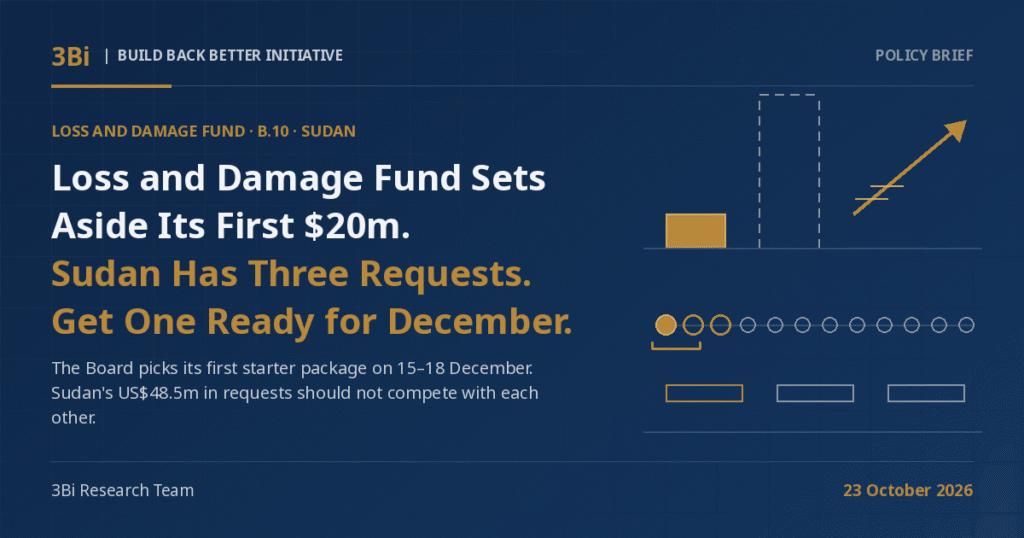
The Fund for responding to Loss and Damage made its first allocation on 22 October, US$20 million for Nepal. Sudan has three requests worth US$48.5 million in its pipeline. Before the Board picks a starter package on 15–18 December, Sudan should prioritise one.
The Fund for responding to Loss and Damage set aside its first US$20 million, for Nepal, on 22 October 2026. Its Board will consider a first starter package of projects on 15–18 December; Sudan has three requests in the pipeline. (Illustration: 3Bi)
3Bi Research Team | Policy Brief | 23 October 2026
The Ask
Before the Board of the Fund for responding to Loss and Damage (FRLD) meets in the Philippines on 15–18 December 2026, Sudan’s FRLD focal point, the Higher Council for Environment and Natural Resources (HCENR), should tell the Fund’s Secretariat which of Sudan’s three pending funding requests it wants considered first, and work with the accredited entity behind that request to answer every outstanding review comment. This costs Sudan nothing but staff time and a letter. Without it, Sudan’s US$48.5 million in requests will compete with each other, and with 173 others, for a first round of money that cannot cover even a fifth of the queue.
On 22 October the FRLD Board made the first allocation in the Fund’s history, setting aside US$20 million for Nepal’s flood recovery (Climate Home News, 22 October 2026). The Board’s next regular meeting will consider the first “starter package” of projects and debate how the Fund should pay out quickly after disasters (FRLD, Barbados Implementation Modalities page, accessed 23 October 2026). Sudan has a stake in both decisions, and seven weeks to prepare.
Why Now
The Board met online on Thursday 22 October in its first-ever extraordinary session, called to respond to Nepal’s request after avalanche-triggered floods on 26 August (FRLD, First Extraordinary Meeting page, 22 October 2026; Loss and Damage Collaboration, 22 October 2026). The meeting was convened after formal requests from Board members representing the least developed countries, the African States and the Asia-Pacific States (The Kathmandu Post, 17 October 2026). Members agreed to set aside US$20 million for Nepal, plus US$1.6 million for administrative and oversight costs, as a one-time window. Nepal must still submit a funding request and win Board approval before money moves (The Kathmandu Post, 22 October 2026). The Board’s co-chair, Camila Minerva Rodriguez, called the decision “truly historic”, the first time the Fund has allocated any money since it was set up three years ago (Climate Home News, 22 October 2026).
The decision also exposed the fight to come. Developed-country members, including Germany’s, warned that it should not set a precedent. Jan Dusik, who sits on the Board for the European Union, said: “we are open for learning but not in setting precedent”. Japan’s member called the case “truly exceptional”. Pakistan’s Ali Tauqeer Sheikh, a member for the Asia-Pacific States, replied that the lessons should “feed the long-term model and its work on rapid disbursement” (Climate Home News, 22 October 2026). That long-term model, including whether and how the Fund disburses quickly after climate disasters, is on the table at the December meeting, the Board’s tenth (B.10).
B.10 matters for a second reason. The Fund’s first call for funding requests under its pilot phase, the Barbados Implementation Modalities (BIM), closed on 15 June 2026. The Secretariat will present “an initial starter package” for approval at B.10, with the next batch at B.11 (FRLD, BIM page, accessed 23 October 2026). COP31 in Antalya (9–20 November) sits between now and then. The Fund’s first replenishment is due to start in 2027 (FRLD/B.9/20/Rev.1, draft report of the Board to COP31/CMA8, 9 July 2026).
The Evidence
First, Sudan is already in the queue, three times over. The Board’s pipeline report lists every request that passed the Secretariat’s compliance check by 29 June 2026. Three are from Sudan (FRLD/B.9/7, Annex I, 5 July 2026):
- “Strengthening Country Response and Recovery Capacities to Climate-Induced Loss and Damage in Sudan”, through the Food and Agriculture Organization (FAO), US$20,000,000 over four years. Stage: review feedback sent to the country.
- “Beyond Floods and Droughts: Water Centred Solutions to Loss and Damage in Sudan”, through UN-Habitat, US$8,700,000 over four years. Stage: completeness check and eligibility screening.
- “Sudan Climate Loss and Damage Response and Recovery Programme: From Data to Action”, through the UN Development Programme (UNDP), US$19,837,500 over four years. Stage: completeness check and eligibility screening.
Together they request US$48.5 million. All three use the Fund’s “modality C”, which runs through entities accredited to the Adaptation Fund, the Global Environment Facility or the Green Climate Fund. Only 50 requests in the whole pipeline (28.4 per cent) use national entities or governments (FRLD/B.9/20/Rev.1, 9 July 2026). Sudan designated HCENR as its national focal point, the office that signs and submits requests and must provide a letter of endorsement before the Board considers any of them (FRLD, national focal points page and BIM terms of reference, accessed 23 October 2026).
Second, the queue is far longer than the money. The pipeline holds 176 requests from 119 countries worth US$2.8 billion. Africa accounts for 81 requests and US$1.4 billion, about half of the total (FRLD/B.9/7, 5 July 2026). Against that, the Board set the BIM at US$250 million for 2025 and 2026. As at 31 May 2026, pledges to the Fund stood at US$826.41 million, of which US$455.96 million had been received (FRLD/B.9/20/Rev.1, 9 July 2026). Climate Home News reports that the Fund has about US$350 million to allocate, with a cap of US$20 million per project (22 October 2026). By our arithmetic, even US$350 million would cover about 17 requests at the maximum size, roughly one in ten of those in the pipeline. The Board’s allocation rules also set a floor of 50 per cent for least developed countries and small island states, Sudan among them, while “safeguarding against the overconcentration of support” in any one country (same document). Three Sudanese requests moving at three different speeds is not a strategy for a round that small.
Third, one of Sudan’s requests is ahead of most of Africa’s, and the next step is in Sudan’s hands. At 29 June, only 4 of the 176 requests had met the Fund’s “tier 1” requirements and 23 had received review comments. The FAO request for Sudan was among those 23. A further 129, including Sudan’s other two, were still at the first screening stage (FRLD/B.9/7, 5 July 2026). Sudan is not alone in the region: Ethiopia, Somalia, South Sudan, Egypt, Djibouti, Kenya, Uganda and Libya all have requests in the same pipeline (same document). A request that has received comments moves forward only when the country and its entity respond. That is a task for HCENR and FAO, not for the Board.
Addressing the Counter-Case
The strongest objection is that Sudan should not choose at all: three requests mean three chances, and naming a favourite might signal that the other two are weaker. This is a fair concern, and 3Bi is not recommending that Sudan withdraw anything. The starter package at B.10 is only the first batch, and the Fund has already said the next will come at B.11 (FRLD, BIM page, accessed 23 October 2026). What we recommend is sequencing. A focal point that tells the Secretariat its order of priority gives the reviewers a clear signal. It also lets the three agencies divide the work, so that a data and early-response programme (UNDP), a water programme (UN-Habitat) and a national response-capacity programme (FAO) build on each other rather than overlap. We have not seen the full proposals, and 3Bi does not judge which is technically strongest. We note only that the FAO request was the furthest along at the last public update.
A second objection is that the Nepal allocation is a one-off with no bearing on Sudan. Developed-country members said as much. But observers expect the Nepal case to inform how rapid-disbursement modalities are designed (Loss and Damage Collaboration, 22 October 2026), and the long-term model debated in December will shape whether any country, Sudan included, can get money quickly after a disaster rather than through a periodic call (Climate Home News, 22 October 2026). Two of Sudan’s own requests name floods, drought and recovery in their titles. Sudan has a direct interest in how that window is designed, and it already has a voice in the room: Sudan holds one of the African States’ alternate seats on the Board (FRLD/B.9/20/Rev.1, Annex III, as at 31 July 2026).
A third objection concerns delivery. The concern is legitimate, but all three Sudan requests are channelled through established UN agencies, which would carry the fiduciary and reporting duties, rather than through new national structures.
What 3Bi Recommends, Specifically
First, before COP31 opens on 9 November, HCENR, as Sudan’s FRLD focal point, should write to the FRLD Secretariat stating Sudan’s order of priority among its three requests and confirming that a signed letter of endorsement is on file for each.
Second, within the same period, HCENR and FAO should complete their response to the Secretariat’s review comments on the FAO-led request, so that it can be assessed for the starter package that the Secretariat will put to the Board at B.10 on 15–18 December. If UNDP or UN-Habitat receive comments in the meantime, the same rule applies: respond within weeks, not months.
Third, FAO, UNDP and UN-Habitat should agree on a one-page map showing how the three Sudan requests divide geography and functions, and share it with HCENR and the FRLD Secretariat before B.10. This costs little and answers the most likely reviewer question about duplication.
Fourth, at COP31, Sudan’s delegation should work with the African Group of Negotiators and the African States’ members on the FRLD Board to support a rapid-disbursement window in the long-term model that is open to every eligible country, building on the lessons from the Nepal response.
Fifth, 3Bi will track the B.10 documents, the starter package and any update to the pipeline report, and will publish a follow-up by the end of December 2026.
Sourcing & Contact
Primary sources: Climate Home News, “Loss and damage fund agrees $20m for Nepal but rich nations warn it should not set precedent”, 22 October 2026; FRLD, First Extraordinary Meeting of the Board page, 22 October 2026; The Kathmandu Post, reports on the call for the Board’s extraordinary meeting, 17 October 2026, and on its outcome, 22 October 2026; Loss and Damage Collaboration, policy update on the First Extraordinary Board Meeting, 22 October 2026; FRLD/B.9/7, “Report on the status of the pipeline for the Barbados Implementation Modalities”, including Annex I (status as at 29 June 2026), 5 July 2026; FRLD, Barbados Implementation Modalities page (accessed 23 October 2026); FRLD, national focal points page (accessed 23 October 2026); FRLD, BIM terms of reference for funding requests, including the focal point’s role, the endorsement letter and the US$5–20 million range; FRLD/B.9/20/Rev.1, draft report of the Board to COP31/CMA8, including the status of resources as at 31 May 2026, the resource allocation parameters and the Board membership list (Annex III), 9 July 2026. 3Bi has not seen the full text of Sudan’s three funding requests and relies on the titles, entities, budgets and review stages published by the Board. The review stages are as at 29 June 2026, the latest public status we found. Correction: our Situation Report of 23 September 2026 said 3Bi had found no public record of a Sudan application to the FRLD. The Board’s pipeline report, dated 5 July 2026, lists three. For methodology questions or to propose a correction, contact 3Bi’s Research Team via 3bisudan.org.
This piece was produced through 3Bi’s automated daily publications workflow, which monitors regional and international climate and energy reporting.
This publication is produced with support from 3Bi’s institutional donors; see the full funder list at 3bisudan.org.
About the Authors
Related Publications
The Green Climate Fund Weighs US$1.87 Billion Next Week. Yemen’s First Project Is an Early-Warning System. Sudan Has None in Its Portfolio.
The 46th meeting of the Green Climate Fund Board runs in Songdo from 26 to 29 October 2026, with 21 funding proposals worth US$1.87 billion before it. Sudan’s…
The Paris Compliance Committee Named Three Silent Countries. Sudan Answered. Now It Owes a Date.
The Paris Agreement's compliance committee has named three countries that ignored its letters on missing climate plans. Sudan is not among them: it replied. Before COP31, 3Bi argues,…
The Kigali Amendment Turns 10 With 175 Parties. Sudan Should Ratify Before the Montreal Protocol Meets in Kigali.
Ten years after the Kigali Amendment was adopted, 175 of 198 Montreal Protocol parties have ratified it. Sudan has not. As parties meet in Kigali on 2–6 November,…