In Bangkok, Sudan Asks for an El Niño Assessment. At Home, Its Central Bank Opens Solar Credit for the Winter Season.
3Bi Situation Report — Climate & Energy Desk | First edition
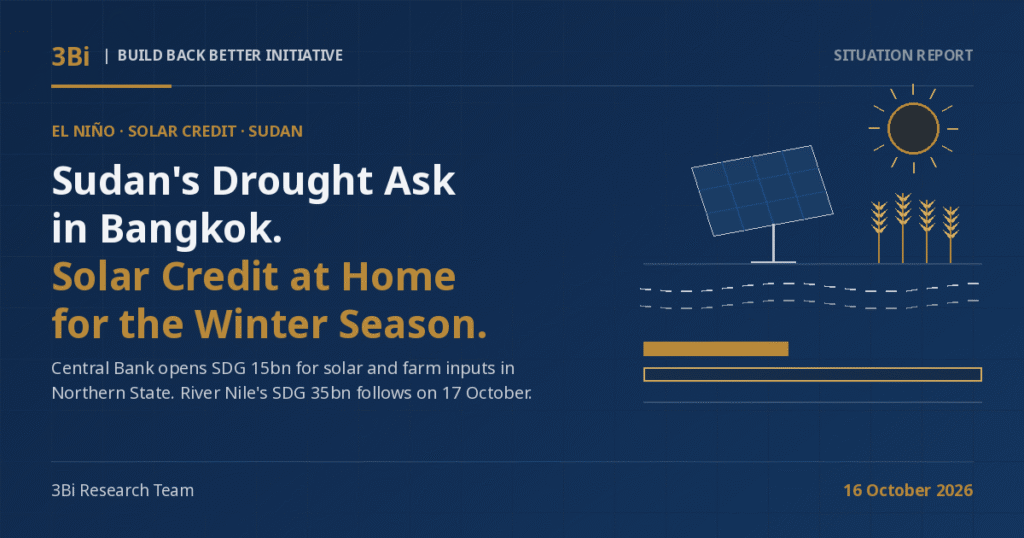
Sudan asked the World Bank and IMF in Bangkok to assess El Niño's impact on its farming season. A day later, the Central Bank opened an SDG 15 billion solar and farm-inputs portfolio in Northern State.
Sudan’s finance minister asked the World Bank and IMF in Bangkok on 14 October for an El Niño impact assessment. On 15 October, the Central Bank opened an SDG 15 billion solar and farm-inputs portfolio in Northern State. (Illustration: 3Bi)
3Bi Situation Report — Climate & Energy Desk | First edition | Information cut-off: 16 October 2026, 04:00 UTC
Headline Fact
On 14 October, at an African Caucus meeting with the leaders of the World Bank Group and the International Monetary Fund (IMF) during their Annual Meetings in Bangkok, Sudan’s Minister of Finance and Economic Planning, Gibril Ibrahim, asked both institutions for an immediate, comprehensive assessment of how El Niño and rainfall deficits will hit Sudan’s farming season, and of the financing and technical support needed to protect it (Sudan Tribune, 14 October 2026; Sudan Radio, 14 October 2026). IMF Managing Director Kristalina Georgieva replied that the Fund is assessing conditions in affected countries to identify likely impacts and financing needs (Sudan Tribune, 14 October 2026). The next day, in Dongola, the Central Bank of Sudan launched a portfolio worth about SDG 15 billion to finance solar energy and farm inputs across Northern State, through five banks led by Bank of Khartoum, targeting about 10,000 beneficiaries (SUNA, 15 October 2026). A second portfolio, worth about SDG 35 billion through seven banks for about 20,000 beneficiaries, is due to open in River Nile State on Saturday, 17 October (Fajag, 14 October 2026; Sudan Independent, 15 October 2026).
Timeline
– 25 June 2024: The Central Bank of Sudan directs banks to finance solar energy systems for agriculture, industry and homes, easing earlier restrictions on such lending (Al-Taghyeer, 25 June 2024).
– 24 September 2026: FAO puts Sudan’s cereal import requirement for 2026 at about 2.8 million tonnes, mainly wheat, and reports that the national average diesel price almost doubled between March and August (FAO GIEWS, 24 September 2026).
– 6 October 2026: The World Bank’s Africa Economic Update warns that climate shocks, including a potential El Niño, could disrupt agricultural production and worsen food insecurity in Sub-Saharan Africa (World Bank, 6 October 2026).
– 8 October 2026: NOAA’s Climate Prediction Center says El Niño continues to strengthen, with a strong-to-very-strong event likely through January–March 2027. It puts the chance that October–December exceeds every El Niño on record since 1950 at 83% (NOAA Climate Prediction Center, 8 October 2026).
– 12 October 2026: The IMF–World Bank Group Annual Meetings open in Bangkok and run to 18 October (QSNCC, accessed 16 October 2026). The same day, the latest IPC alert finds that drought now covers more than half of Sudan, and that rains arriving in late September came too late to save most cereal crops (UN News, 12 October 2026).
– 14 October 2026: Ibrahim makes his request in Bangkok. He separately meets UNOPS Executive Director Jorge Moreira da Silva on fuel and fertiliser supply disruptions and on securing affordable inputs for smallholder farmers (Sudan Tribune, 14 October 2026).
– 15 October 2026: The Central Bank launches the Northern State portfolio, with the Arab Organization for Agricultural Development and the microfinance guarantee agency Tayseer taking part (SUNA, 15 October 2026). In Damazine, the UN Resident and Humanitarian Coordinator, Denise Brown, says smallholder farmers “urgently need support ahead of the winter planting season” (UN Resident and Humanitarian Coordinator in Sudan, 15 October 2026).
– 17 October 2026 (scheduled): The River Nile State portfolio opens (Fajag, 14 October 2026).
What We Know / What We Don’t
We know the shape of the Northern State portfolio. Alongside the Central Bank, five banks take part: Bank of Khartoum, Al-Tadamon Islamic Bank, the Agricultural Bank of Sudan, Farmer’s Commercial Bank and Bank of Nile. The money covers solar energy and farm inputs in every locality of the state (SUNA, 15 October 2026). Tayseer has committed to guaranteeing the portfolio to reduce risk and encourage banks to lend more to productive sectors (Sudan Tribune, 15 October 2026). The state is targeting 1.2 million feddans this winter, 320,000 of them wheat (SUNA, 15 October 2026): about 504,000 and 134,000 hectares respectively (3Bi conversion at 0.42 hectares per feddan). The scheme sits under the Central Bank’s financial-inclusion strategy and its State Financing Portfolios Initiative, sponsored by Central Bank Governor Amna Mirghani Hassan Al-Tom, and is meant to lower production costs and support agricultural value chains. The bank says more states will follow according to their production priorities, and its Dongola branch director invited banks not yet involved to join (SUNA, 15 October 2026).
We know the average size. The announced totals work out at about SDG 1.5 million per targeted beneficiary in Northern State and SDG 1.75 million in River Nile (3Bi calculation). None of the sources gives a dollar value, and we have not converted one.
We know what Sudan asked for in Bangkok: an assessment that identifies financing and technical needs, and concessional funding rather than “non-binding pledges” for vulnerable African states (Sudan Tribune, 14 October 2026). Climate finance, the ministry said, should match the scale of the risks countries actually face (Sudan Radio, 14 October 2026).
We do not know the financing terms. No profit margin, repayment period, collateral rule or down-payment has been published for either portfolio. We do not know how the money splits between solar equipment and seed or fertiliser, or whether solar irrigation pumps specifically qualify. Nor do we know what share will reach smallholders, although the Northern State governor called for the money to be steered towards farm inputs and small farmers (SUNA, 15 October 2026). We have found no World Bank response to Sudan’s request. 3Bi is not claiming that either institution has agreed to a Sudan-specific assessment or committed any money.
Implications
For the Central Bank’s own solar policy, this is the first delivery vehicle we have seen. In August, 3Bi argued that the June 2024 directive had never had a mechanism to turn instructions into installed panels (3Bi, 11 August 2026). Pooled state portfolios, with a guarantee agency absorbing part of the risk, are close to that mechanism. In our reading, the test now is transparency. If the terms are published and the first disbursements reach small farms, the model can travel to other states. If not, the portfolios will repeat the directive’s record of headlines without hardware.
The timing is right, and it is narrow. Winter planting is starting now (SUNA, 15 October 2026; UN Resident and Humanitarian Coordinator in Sudan, 15 October 2026). The national average diesel price almost doubled between March and August (FAO GIEWS, 24 September 2026). Every pump switched from diesel to solar before sowing lowers the season’s running costs for as long as those prices hold. Every tonne of wheat grown in Northern State and River Nile also trims an import requirement of about 2.8 million tonnes (FAO GIEWS, 24 September 2026).
The two moves also fit together. Bangkok was a request for an assessment; Dongola created a domestic channel. In our reading, an assessment that counts the winter season’s pumping and input needs would give any concessional money Sudan secures a place to land quickly, through banks that are already lending and a guarantee that is already in place. El Niño is expected to stay strong through March 2027 (NOAA Climate Prediction Center, 8 October 2026), so the need will not pass with this season.
Watch Next
– 17 October 2026: The River Nile State portfolio launch (SDG 35 billion, seven banks, 20,000 beneficiaries), and whether either portfolio publishes its terms (Fajag, 14 October 2026).
– 18 October 2026: The Annual Meetings close in Bangkok; watch for any World Bank or IMF statement on El Niño assessments (QSNCC, accessed 16 October 2026).
– 19–23 October 2026: The 47th Adaptation Fund Board meeting (Adaptation Fund, accessed 16 October 2026).
– 26–29 October 2026: The Green Climate Fund’s 46th Board meeting in Songdo (GCF, accessed 16 October 2026).
– 9–20 November 2026: COP31 in Antalya (UNEP, AMCEN-21 events calendar, accessed 16 October 2026).
– 12 November 2026: NOAA’s next El Niño diagnostic discussion (NOAA Climate Prediction Center, 8 October 2026).
Sourcing & Next Update
Primary sources: Sudan Tribune, “Sudan finance minister warns of drought risks, seeks climate finance in Bangkok” (14 October 2026); Sudan Radio, Ministry of Finance statement on the African Caucus meeting (14 October 2026); SUNA, Central Bank launch of the Northern State solar and farm-inputs portfolio (15 October 2026); Sudan Tribune (Arabic), Central Bank statement on the portfolio (15 October 2026); Fajag (14 October 2026) and Sudan Independent (15 October 2026) on the River Nile portfolio; Al-Taghyeer on the 2024 solar-finance directive (25 June 2024); FAO GIEWS Country Brief on Sudan (24 September 2026); World Bank, Africa Economic Update press release (6 October 2026); NOAA Climate Prediction Center, ENSO Diagnostic Discussion (8 October 2026); UN News on the IPC alert (12 October 2026); statement by the UN Resident and Humanitarian Coordinator in Sudan (15 October 2026); QSNCC, Annual Meetings event page; Adaptation Fund and Green Climate Fund meeting pages; UNEP, AMCEN-21 events calendar; 3Bi, “Sudan Doesn’t Need Another Solar Mandate. It Needs Jordan’s Financing Model.” (11 August 2026). For methodology questions or to propose a correction, contact 3Bi’s Research Team via 3bisudan.org.
Next update expected when the River Nile portfolio opens or either portfolio publishes its terms, or when the World Bank or IMF responds to Sudan’s request.
3Bi Research Team. This piece was produced through 3Bi’s automated daily publications workflow, which monitors regional and international climate and energy reporting.
This publication is produced with support from 3Bi’s institutional donors; see the full funder list at 3bisudan.org.
About the Authors
Related Publications
The Paris Compliance Committee Named Three Silent Countries. Sudan Answered. Now It Owes a Date.
The Paris Agreement's compliance committee has named three countries that ignored its letters on missing climate plans. Sudan is not among them: it replied. Before COP31, 3Bi argues,…
The Kigali Amendment Turns 10 With 175 Parties. Sudan Should Ratify Before the Montreal Protocol Meets in Kigali.
Ten years after the Kigali Amendment was adopted, 175 of 198 Montreal Protocol parties have ratified it. Sudan has not. As parties meet in Kigali on 2–6 November,…
The Adaptation Fund Board Meets in Bonn With US$146.8 Million to Approve. Sudan Has No Project of Its Own.
The Adaptation Fund Board meets in Bonn from 19 to 23 October with US$146.8 million in approvals before it, including a US$30 million Mandera Triangle project. Sudan has…