
Arab Water Ministers Met in Cairo to Prepare for Abu Dhabi. The Arab League Called for a Regional Water-Adaptation System. Sudan Should Help Design It.
3Bi Situation Report — Climate & Energy Desk | First edition
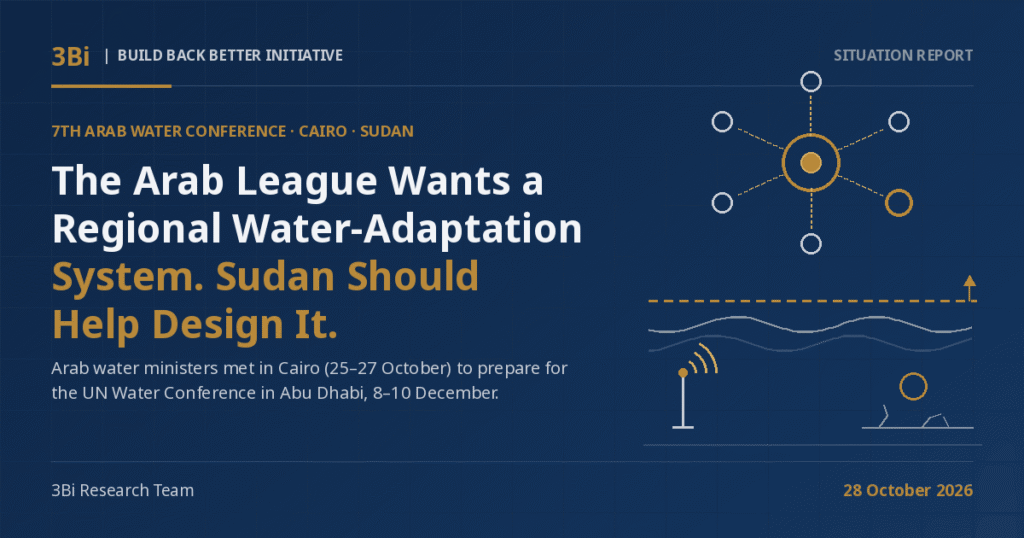
Meeting in Cairo before the UN Water Conference in Abu Dhabi, the Arab League called for an integrated Arab system for water adaptation to climate change, built on early warning, drought and flood risk management and climate finance. Its design is still open, and Sudan should help shape it.
The 7th Arab Water Conference and the 17th session of the Arab Ministerial Water Council met in Cairo alongside Cairo Water Week, 25–27 October 2026, to prepare Arab positions for the UN 2026 Water Conference in Abu Dhabi. (Illustration: 3Bi)
3Bi Situation Report — Climate & Energy Desk | First edition | Information cut-off: 28 October 2026, 04:00 UTC
Headline Fact
The League of Arab States has asked its members to build “an integrated Arab system for water adaptation to climate change”. In a speech to the 7th Arab Water Conference in Cairo on 26 October, delivered on his behalf by Assistant Secretary-General Ahmed Rashid Khattabi, Secretary-General Nabil Fahmy said the system should rest on early warning, better management of drought and flood risk, more resilient infrastructure and the protection of groundwater. He also called for climate-finance tools to pay for water adaptation and resilience projects, and for “bankable” water projects (Arab Time, 26 October 2026; 3Bi translation). The conference ran on 26–27 October alongside Cairo Water Week. Next to it, the Arab Ministerial Water Council held its 17th session, which reviewed the implementation plan of the Arab Strategy for Water Security to 2030 and prepared the Arab region’s participation in the UN 2026 Water Conference in Abu Dhabi (8–10 December) and the 11th World Water Forum in Riyadh in 2027 (Al-Shorouk, 25 October 2026). Sudan is a member of the League and of its water council. The design of the proposed system has not yet been set out, so this is the point at which Sudan can still shape it.
Timeline
- 2 December 2025: The World Meteorological Organization (WMO), with the UN Economic and Social Commission for Western Asia (ESCWA) and the League of Arab States, publishes the first State of the Climate in the Arab Region report. It finds that 2024 was the region’s hottest year on record and that extreme events affected nearly 3.8 million people. Nearly 60% of Arab countries have multi-hazard early warning systems, which the WMO calls “above the global average but still not enough” (WMO, 2 December 2025).
- 20 August 2026: The African Ministers’ Council on Water (AMCOW) and the African Union Commission begin consolidating an African common position for Abu Dhabi. The conference, co-hosted by the United Arab Emirates and Senegal, will hold six interactive dialogues, including one on investments for water (AMCOW, 20 August 2026).
- 16 September 2026: Egypt’s Minister of Water Resources and Irrigation, Hany Sewilam, and Sudan’s Minister of Agriculture and Irrigation, Esmat Qurashi, agree to finalise a bilateral water memorandum for signing during Cairo Water Week. It covers flood protection, rainwater harvesting and training (EgyptToday, 16 September 2026).
- 25 October 2026: Cairo Water Week opens. The Arab Ministerial Water Council holds its 17th session and the 19th meeting of its executive bureau, with Egypt as host (Al-Shorouk, 25 October 2026). The same day, AMCOW’s president tells the week that Africa must “speak with one voice” in Abu Dhabi (AMCOW, 25 October 2026).
- 26 October 2026: Sewilam opens the 7th Arab Water Conference under the theme “Water in the Arab Region: Partnerships for Peace and Sustainable Development”. Egypt currently chairs the Arab Ministerial Water Council (Elwatan News, 26 October 2026). The League’s call for a regional adaptation system is made at the opening session (Arab Time, 26 October 2026).
- 27 October 2026: The conference closes. Its agenda covered innovative financing, non-conventional water resources, climate risks and shared water resources (Ecofin Agency, 27 October 2026).
What We Know / What We Don’t
We know what the League is asking for. Beyond the adaptation system, Fahmy’s speech set out a list of priorities: using water more efficiently, cutting losses, improving irrigation, reusing treated wastewater, expanding desalination “in a studied way” and protecting groundwater. He also called for using artificial intelligence in monitoring and forecasting. He warned of rising temperatures, changing rainfall, longer droughts, flood risk and sea-level rise across the region. He said the real test for joint Arab action is moving “from vision to implementation… from recommendations to measurable results” (Arab Time, 26 October 2026; 3Bi translation).
We know what the host wants. Sewilam called for joint Arab projects that can be implemented and financed, through technology transfer, capacity building and investment mechanisms, and for data and information sharing and stronger early warning systems. He described the conference as a chance to coordinate Arab priorities and positions before Abu Dhabi and Riyadh, and asked for “practical recommendations and implementable initiatives” (Elwatan News, 26 October 2026; Akhbarna, 26 October 2026).
We know what the ministers had on their table. The 17th council session covered the Arab water-security strategy’s implementation plan, the water-related Sustainable Development Goals, cooperation on shared water resources, coordination of Arab positions, and preparation for Abu Dhabi and Riyadh. Assistant Secretary-General Ali bin Ibrahim Al-Malki listed disaster-risk reduction, preparedness for water emergencies and mobilising climate finance among the council’s priorities (Al-Shorouk, 25 October 2026).
We know Sudan has a working warning service to bring. The Sudan Meteorological Authority has issued flood warnings through the Common Alerting Protocol, a standard format for public alerts, using cloud-hosted systems supported by the WMO (WMO, 3 April 2025).
We do not know what the conference and the council decided. As of the cut-off, 3Bi found no published final recommendations or council resolutions, and no Arab common position document for Abu Dhabi. Nor do we know how the proposed adaptation system would be governed, who would fund it, or whether it would link national meteorological services. We could not confirm whether a Sudanese minister spoke in Cairo this week, or whether the Egypt–Sudan memorandum was signed.
Implications
In our reading, the League has made a proposal, not a decision. It has named the parts of a regional adaptation system: early warning, drought and flood risk management, resilient infrastructure, groundwater protection and climate finance. It has not yet said how they fit together. Proposals at this stage are shaped by the countries that send in concrete needs and assets. Those that wait are handed a finished design.
Sudan has reason to take part. It faces both of the risks the League named, floods on the Nile system in the rainy season and drought in rain-fed farming areas. It also sits in both of the blocs preparing for Abu Dhabi: the Arab group coordinating through the water council, and the African group coordinating through AMCOW. A Sudanese input to the Arab system can also serve the African position, and the reverse.
In our view, three low-cost steps follow before the Abu Dhabi conference on 8 December. First, the Ministry of Agriculture and Irrigation could send the Arab Ministerial Water Council, through the League’s secretariat, a short note on Sudan’s adaptation priorities for the proposed system, covering flood seasons, drought monitoring and the data Sudan can share. Second, the Sudan Meteorological Authority could offer its Common Alerting Protocol warnings as a building block, and ask that the regional system support national services’ data exchange rather than run in parallel to them. Third, Sudan’s delegation could ask that any finance window attached to the system be open to countries with limited access to the climate funds, and say so in both the Arab and African coordination meetings.
3Bi is not claiming that a regional system would by itself make Sudan more resilient, or that it will be funded. The point is narrower: the League has opened a design question this week, and Sudan’s interests are best served by answering it early.
Watch Next
- 29 October 2026: Cairo Water Week closes (Egypt State Information Service, 25 October 2026).
- 9–20 November 2026: COP31 in Antalya, where water adaptation and finance will feature in Arab and African statements (UNFCCC, COP31 page, accessed 22 October 2026).
- 8–10 December 2026: The UN 2026 Water Conference in Abu Dhabi, co-hosted by the United Arab Emirates and Senegal (AMCOW, 20 August 2026). Watch for an Arab statement that includes the proposed adaptation system.
- 2027: The 11th World Water Forum in Riyadh (Al-Shorouk, 25 October 2026).
Sourcing & Next Update
Primary sources: Arab Time, “Nabil Fahmy calls for strengthening Arab water diplomacy…” (26 October 2026); Al-Shorouk, “The Arab League takes part in the 17th session of the Arab Ministerial Water Council and the 7th Arab Water Conference in Cairo” (25 October 2026); Elwatan News, opening of the 7th Arab Water Conference (26 October 2026); Akhbarna, “Sewilam: Egypt supports Arab partnerships…” (26 October 2026); Ecofin Agency, “Cairo Conference Explores How to Finance Water Infrastructure as Climate Risks Grow” (27 October 2026); Cairo Water Week, Arab Water Conference 2026 page (accessed 28 October 2026); WMO, “Temperature increase is accelerating in Arab Region, with escalating impacts” (2 December 2025) and “Resilience and Innovation: Advancing Early Warnings in Sudan and South Sudan” (3 April 2025); AMCOW, statements of 20 August and 25 October 2026; EgyptToday (16 September 2026); Egypt State Information Service, Cairo Water Week event page (25 October 2026); UNFCCC, COP31 page. Arabic quotations are 3Bi translations. For methodology questions or to propose a correction, contact 3Bi’s Research Team via 3bisudan.org.
Next update expected when the Arab Water Conference’s recommendations or the council’s resolutions are published, or when an Arab position for Abu Dhabi is released.
3Bi Research Team. This piece was produced through 3Bi’s automated daily publications workflow, which monitors regional and international climate and energy reporting.
This publication is produced with support from 3Bi’s institutional donors; see the full funder list at 3bisudan.org.
About the Authors
Related Publications
Europe Says Spend What’s Already Pledged. Public Climate Money to Africa’s Poorest Countries Fell. Sudan Should Ask Who Gets It.
Europe says COP31 should deploy money already pledged. New CPI data show climate finance to Africa doubled, but international public money to its low-income countries fell 11%. Sudan,…
COP31 Has Opened the Second Global Climate Stocktake. Inputs Close on 28 February. Sudan Should File Its Own Evidence.
COP31 launched the second Global Stocktake in Antalya on 18 November, and inputs are due by 28 February 2027. Sudan has a 2016 adaptation plan, a 2025 national…
COP31 Points Countries to Their Regional Seas on Ocean Action. Sudan’s Is the Red Sea. It Should Report Its Coastal Plan and Work Through PERSGA.
COP31’s new Antalya Ocean and Seas Compact points countries to their regional seas bodies, and the draft cover decision invites ocean reporting. Sudan has about 800 km of…