Europe Says Spend What’s Already Pledged. Public Climate Money to Africa’s Poorest Countries Fell. Sudan Should Ask Who Gets It.
3Bi Research Team | Analytical Article | 20 November 2026
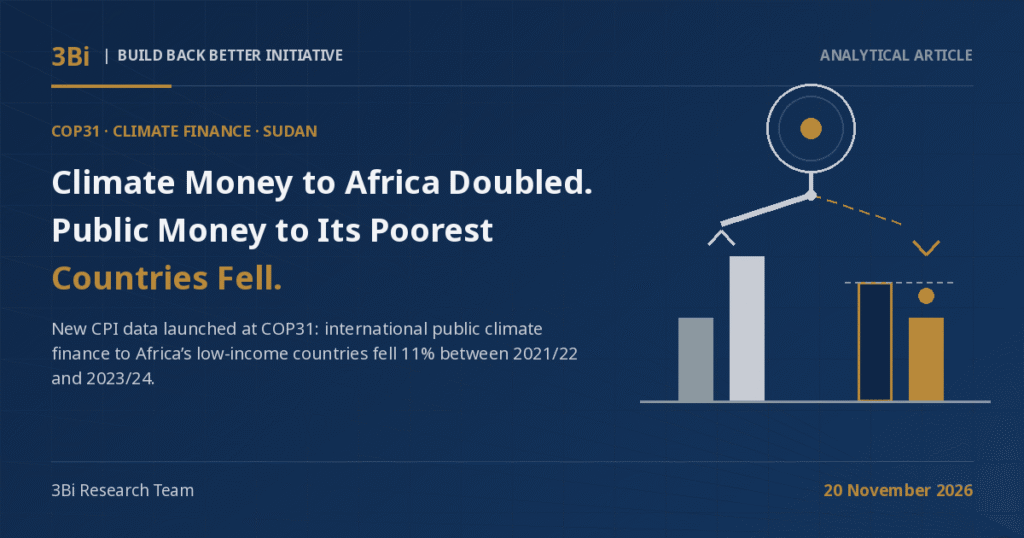
Europe says COP31 should deploy money already pledged. New CPI data show climate finance to Africa doubled, but international public money to its low-income countries fell 11%. Sudan, a low-income country, should make allocation its ask and update its own price tag.
On 13 November 2026, at COP31 in Antalya, Climate Policy Initiative and partners launched the third Landscape of Climate Finance in Africa: tracked climate finance doubled to US$74 billion a year in 2023/24, while international public climate finance to low-income countries fell 11% from 2021/22. (Illustration: 3Bi)
3Bi Research Team | Analytical Article | 20 November 2026
The Hook
COP31 in Antalya is scheduled to close today, and the money question has narrowed. On Thursday afternoon the Presidency published a second, nine-page draft of its cover decision. It drops the proposal to raise adaptation finance to at least US$120 billion a year by 2035, while last year’s commitment to triple adaptation finance remains (RTÉ, 19 November 2026; Deutsche Welle, 19 November 2026). It is not final.
The European Union has been clear about where it stands. “We haven’t come to the table with additional monies or additional capital. It’s about what we have committed already and ensuring it’s deployed,” said Darragh O’Brien, who leads the EU delegation for the Irish presidency of the Council of the EU. European Commissioner Wopke Hoekstra added that if money “is in the bank but does not land on the ground then it is effectively meaningless” for the most vulnerable countries (BBC News, 20 November 2026).
Take Europe at its word. If the coming year is about spending existing money, the question for Sudan is not how big the pot is but who it reaches. A report launched at COP31 a week ago gives an uncomfortable answer for Africa’s poorest countries.
The Argument
First, Africa’s climate finance has doubled, but international public money to its low-income countries has gone backwards. The third Landscape of Climate Finance in Africa, published in Antalya on 13 November by Climate Policy Initiative (CPI), FSD Africa and the governments of Norway and the UK, finds that tracked climate finance in Africa rose from an annual average of US$34 billion in 2019/20 to US$74 billion in 2023/24. International public finance still provides almost two-thirds of it (CPI, press release, 13 November 2026). But the growth went one way. Between 2021/22 and 2023/24, international public climate finance to African middle-income countries rose by 33%, while flows to low-income countries fell by 11% (CPI, 13 November 2026; ESI Africa, 17 November 2026). Energy shows the same split. Middle-income countries received 83% of Africa’s energy climate finance in 2023/24, while energy finance to low-income countries rose only 5% from 2019/20, to US$4.3 billion a year (CPI, Landscape of Climate Finance in Africa, November 2026).
Sudan is a low-income country in the World Bank’s classification (World Bank country data, accessed 20 November 2026), so it sits in the group that lost ground. The loss also falls on the cheapest money. Grants and concessional loans made up almost two-thirds of climate finance to low-income countries in 2023/24, while non-concessional debt made up more than half of flows to middle-income countries (CPI report).
Second, “deploy what’s pledged” turns allocation into the real negotiation, and the pledges are shrinking. Carbon Brief’s analysis found that the public climate finance major donors have pledged for the coming years is around 70% lower than in 2025 (Carbon Brief, 13 November 2026). CPI’s data stop in 2024, before the latest aid cuts. The report cites OECD figures showing that bilateral aid to sub-Saharan Africa fell by 26% in 2025 (CPI report, citing OECD). In other words, the fall for low-income countries happened while overall climate finance was still growing. With a smaller, fixed pot, a country’s share depends on the rules that decide who gets it.
Those rules matter most for adaptation, which is what low-income countries mainly receive. They get around 22% of Africa’s climate finance but 39% of its adaptation finance, and adaptation made up 38% of their flows (CPI report). Yet adaptation’s share of all African climate finance fell from 28% in 2021/22 to 21% in 2023/24. CPI concludes that aggregate growth “does not establish whether adaptation finance reaches countries with the highest climate vulnerability”, which makes “needs- and vulnerability-based allocation important alongside income-status classifications”. It recommends reserving grants and concessional finance for low-income countries, adaptation and projects with limited revenue, and it cites the African Development Fund’s Climate Action Window, which targets low-income and fragile countries and directs 75% of its resources to adaptation (CPI report).
Third, on the continent’s needs map Sudan looks cheaper than it is, and that weakens its case in any allocation fight. CPI builds Africa’s needs estimate from countries’ own climate plans (NDCs). Of the 53 plans in its table, 35 are new “NDC 3.0” submissions dated 2024 to 2026. Sudan’s entry comes from its 2022 NDC: about US$0.87 billion a year for 2025–2030, or 1.4% of GDP (CPI report, Table 4). Only six countries in the table state a lower need relative to the size of their economy; the median is 5.2%. Horn of Africa countries that filed new plans state much more: Ethiopia 7.5% of GDP, Eritrea 6.7%, Somalia 7.8% and Djibouti 7.9%.
We are not saying that Sudan’s real needs are 1.4% of GDP, or any other figure. We are saying that this is the number the continent’s main climate finance map now carries for Sudan. It comes from the NDC Sudan revised in September 2022, which put mitigation and adaptation support needs at US$8.24 billion over ten years (UNDP Climate Promise, Sudan page, accessed 20 November 2026). When funders say they will steer existing money by need and vulnerability, an old and low figure is a quiet disadvantage.
Why It Matters to the Reader
The strongest objection is that money follows ready projects, not income categories. Funders will say low-income countries received less because they brought fewer bankable proposals, and that a fixed pot should go where it can be spent. That is a fair concern, and 3Bi is not arguing that every dollar should be shared out by income group. Our point is narrower. CPI itself concludes that grants and concessional finance should be kept for low-income countries and adaptation, because these countries have the fewest alternatives. Readiness is part of the answer, and it is the part Sudan controls.
Sudan’s national statement to the COP31 leaders’ summit said climate finance “must not remain merely a declared commitment” and must become “resources that developing countries can access fairly, swiftly, easily and predictably”, and it called on developed countries “to scale up funding for adaptation” (SUNA via Fana News, 11 November 2026). On 17 November we argued that Sudan should defend the draft’s lines on faster access (3Bi, 17 November 2026). This is the next step. Access rules decide how fast money moves. Allocation rules decide whether it reaches Sudan at all.
If you work at the Higher Council for Environment and Natural Resources (HCENR), Sudan’s focal point for the UN climate convention, at the Ministry of Finance and Economic Planning, or on Sudan’s negotiating team, three steps follow.
First, in COP31’s closing consultations and in the year that follows, work through the LDC Group and the African Group to put allocation on the table. Any language on deploying existing finance should name low-income countries, least developed countries and adaptation as priorities for grants, and CPI’s findings are ready-made evidence.
Second, update the price tag. Sudan’s next NDC should restate its needs at current prices, with adaptation and mitigation shown separately, so that the next edition of the continent’s finance map carries a figure Sudan has chosen rather than one from 2022.
Third, ask the African Development Bank how Sudan can use windows built for low-income, highly vulnerable countries, such as the Climate Action Window, and publish the answer.
Partners, including the EU, can help: report climate finance commitments and disbursements by recipient income group each year, so that “deploy what’s pledged” can be checked.
Close
COP31 may end without a new number for adaptation finance, and Europe says the job now is to spend the money already promised. CPI’s data show that while climate money to Africa grew, public finance to its poorest countries shrank, and what they mostly receive, adaptation finance, is losing share. Sudan cannot change the size of the pot. It can insist that the rules for sharing it favour the countries with the fewest alternatives, and make sure its own needs appear on the map at their real size. We will follow how the final COP31 outcome treats existing finance, and whether the next data show the decline for low-income countries reversing.
Sourcing & Contact
Primary sources: Climate Policy Initiative (CPI), FSD Africa, Norad and UK FCDO, Landscape of Climate Finance in Africa, third edition, November 2026 (executive summary, section 5, recommendations and Table 4); CPI, launch press release, Antalya, 13 November 2026; ESI Africa, report on the CPI findings, 17 November 2026; BBC News, “COP31: More climate money for Africa? Europe says use what’s already pledged”, 20 November 2026; RTÉ News and Deutsche Welle, reports on the second draft cover decision, 19 November 2026; Carbon Brief, DeBriefed, 13 November 2026 (analysis of public climate finance pledges); World Bank, country classification for Sudan (accessed 20 November 2026); UNDP Climate Promise, Sudan page (accessed 20 November 2026); SUNA (via Fana News), Sudan’s national statement to the COP31 leaders’ summit, 11 November 2026; 3Bi, Analytical Article on COP31’s first draft and faster access, 17 November 2026. CPI tracks commitments, not disbursements, and its data end in 2024. The ranking of Sudan’s needs-to-GDP ratio is 3Bi’s calculation from CPI’s Table 4. For methodology questions or to propose a correction, contact 3Bi’s Research Team via 3bisudan.org.
This piece was produced through 3Bi’s automated daily publications workflow, which monitors regional and international climate and energy reporting.
This publication is produced with support from 3Bi’s institutional donors; see the full funder list at 3bisudan.org.
About the Authors
Related Publications
COP31 Has Opened the Second Global Climate Stocktake. Inputs Close on 28 February. Sudan Should File Its Own Evidence.
COP31 launched the second Global Stocktake in Antalya on 18 November, and inputs are due by 28 February 2027. Sudan has a 2016 adaptation plan, a 2025 national…
COP31 Points Countries to Their Regional Seas on Ocean Action. Sudan’s Is the Red Sea. It Should Report Its Coastal Plan and Work Through PERSGA.
COP31’s new Antalya Ocean and Seas Compact points countries to their regional seas bodies, and the draft cover decision invites ocean reporting. Sudan has about 800 km of…
COP31’s First Draft Asks Climate Funds to Publish How Long Their Money Takes. Sudan Asked for Faster Access. It Should Defend Those Lines.
COP31’s first draft cover decision asks climate funds to publish how long their money takes and to reserve a floor for the poorest countries. Sudan asked Antalya for…