UNEP Says Tripling Adaptation Finance Still Covers Under a Third of Needs. Sudan Is an LDC. It Should Lock the Baseline and Bring Bankable Projects to Antalya.
3Bi Research Team | Policy Brief | 7 November 2026
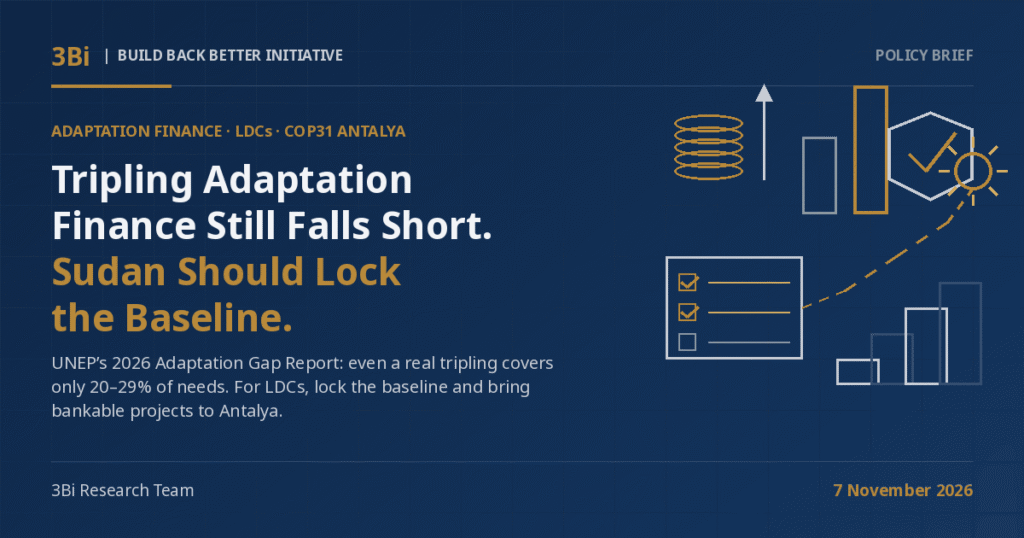
UNEP’s 2026 Adaptation Gap Report finds that even tripling adaptation finance by 2035 covers only 20–29% of developing-country needs. For LDCs like Sudan, tripling could meet 49–84% of their needs — if COP31 locks a baseline year and Sudan brings bankable grant-ready projects to Antalya.
UNEP launched its 2026 Adaptation Gap Report, Ready? Not, in Nairobi on 4 November 2026. International public adaptation finance reached US$28.2–31.7 billion in 2024; even a real tripling by 2035 would cover only 20–29% of developing-country needs, while tripling flows to LDCs and SIDS could meet 49–84% of theirs. (Illustration: 3Bi)
3Bi Research Team | Policy Brief | 7 November 2026
The Ask
Before COP31 closes in Antalya on 20 November, Sudan’s Higher Council for Environment and Natural Resources (HCENR), working with the climate directorate and the negotiation team, should do two things. First, use the new UNEP Adaptation Gap Report’s LDC and SIDS maths to insist that COP31 locks a clear baseline year and delivery terms for the COP30 commitment to triple international public adaptation finance by 2035. Second, put a short list of bankable National Adaptation Plan (NAP) and adaptation projects on the table for grant-based and direct-access channels. The cost is a position paper and a project shortlist. The window is the two weeks of Antalya.
Why Now
On 4 November in Nairobi, the United Nations Environment Programme (UNEP) launched its 2026 Adaptation Gap Report, titled Ready? Not. International public adaptation finance from developed to developing countries reached only US$28.2–31.7 billion in 2024, a rise of about US$1 billion on the year before. Needs sit at around US$305 billion a year by 2035 on UNEP’s central estimate from NDCs, NAPs and models — and that figure largely excludes the private sector’s own needs, which could almost double it (UNEP Adaptation Gap Report 2026; UNEP press release, 4 November 2026).
COP30’s Global Mutirão decision called for efforts to at least triple adaptation finance by 2035. Depending on whether the baseline is current flows or the Glasgow Climate Pact path, that aspiration would lift flows to US$85–120 billion a year. After inflation adjustment, UNEP finds that this would still cover only 20–29 per cent of developing-country needs. For least developed countries (LDCs) and small island developing States (SIDS), the picture is sharper and more useful: tripling flows to them could meet 49–84 per cent of their needs (UNEP Adaptation Gap Report 2026, Executive Summary). Sudan is an LDC. That is the number its negotiators should carry into the room.
COP31 runs in Antalya from 9 to 20 November 2026 (United Nations, COP31 page). UNEP Executive Director Inger Andersen has already framed the ask for the host agenda: at climate COP31 in Türkiye and beyond, nations must intensify efforts to achieve the COP30 aspiration of tripling adaptation finance by 2035 — while understanding that they will need to go even higher (UNEP Adaptation Gap Report 2026, Foreword). A conference that opens without a locked baseline year, and without a delivery track for LDC and SIDS flows, leaves the Mutirão number as aspiration rather than accountability. Sudan’s job is not to invent a new ask. It is to make the existing one measurable, and to arrive with projects that can take the money.
The Evidence
First, the LDC and SIDS maths turns a global shortfall into a concrete negotiating lever. UNEP estimates LDC and SIDS adaptation finance needs over the coming decade at about US$50 billion a year from NDCs and NAPs, or about US$40 billion from its modelling — equivalent to 3–4 per cent of their GDP, twice the relative burden for developing countries as a whole (UNEP Adaptation Gap Report 2026, Executive Summary). Flows to LDCs and SIDS rose in real terms between 2019 and 2024 but have fallen from a 2022 peak, when they should be rising (UNEP press release, 4 November 2026). Almost 90 per cent of finance to LDCs and about 80 per cent to SIDS in 2024 took the form of grants or highly concessional loans; UNEP says that concessionality is vital and must be maintained (UNEP Adaptation Gap Report 2026, Executive Summary). Across all developing countries the mix is already harder: loans were 55 per cent of the total in 2024, grants 44 per cent, and non-concessional loans are rising (UNEP Adaptation Gap Report 2026, Executive Summary). For Sudan, the report therefore does three things at once. It shows that a focused LDC track can cover roughly half to four-fifths of LDC and SIDS needs if tripling is real. It shows that the quality of money — grant and highly concessional — is already the LDC pattern and must not slip. And it shows that the global tripling, left alone, still leaves most of the gap open. That is why a locked baseline year and delivery terms for the LDC and SIDS share belong in Sudan’s Antalya brief, not as a side note.
Second, the Loss and Damage Fund’s first round shows what happens when envelopes are set without matching demand. Developing countries submitted requests worth about US$2.8 billion against an initial funding envelope of US$342 million — roughly eight times the money on the table (UNEP Adaptation Gap Report 2026; UNEP press release, 4 November 2026). UNEP also flags complex procedures and limited capacity as barriers to access. Adaptation finance is a different pot from Loss and Damage, and 3Bi is not collapsing the two. The lesson for Sudan’s adaptation ask is procedural: if COP31 locks a triple-finance aspiration without a baseline year, without reporting on LDC and SIDS shares, and without simpler direct-access routes for NAP projects, Antalya will reproduce the same mismatch at larger scale. A shortlist of bankable, grant-ready projects is how an LDC turns a finance decision into disbursement rather than another unmet request pile.
Third, Sudan already has the institutional hook; what it needs now is a finance-ready package for Antalya. HCENR is Sudan’s established climate focal point and the body that has coordinated NDC and related climate reporting. Sudan’s updated first NDC already costed adaptation and mitigation lines that can seed a project shortlist, including climate-resilient irrigated farming and related measures (Republic of the Sudan, Updated First NDC, October 2021). We are not re-litigating yesterday’s Situation Report on Africa’s grants-not-loans agenda or the US$8.2 billion NDC price tag. Those points stand. This brief adds the missing operational step: use AGR 2026’s LDC and SIDS coverage range (49–84 per cent under a real tripling) to demand a baseline and delivery terms, and walk into Antalya with a handful of projects shaped for grant-based and direct-access windows rather than debt-deepening loans. South–South adaptation flows through multilateral development banks and direct cooperation also rose from US$3.8 billion in 2019 to US$9.6 billion in 2024 (UNEP press release, 4 November 2026). Sudan should treat those channels as part of the same shortlist exercise, not as a substitute for the COP30 public-finance commitment.
Addressing the Counter-Case
The strongest objection is that locking a baseline year is a technical fight that will stall Antalya. This is a fair concern, and 3Bi is not recommending that Sudan alone reopen the Mutirão text. The narrower ask is that Sudan, as an LDC, join others in requiring COP31 to name the baseline year (current flows versus the Glasgow path), to state how LDC and SIDS shares will be tracked, and to keep grant and highly concessional terms as the default for those shares. Without that, “triple by 2035” can mean anything from US$85 billion to US$120 billion — and, after inflation, still only 20–29 per cent of global developing-country needs (UNEP Adaptation Gap Report 2026). Ambiguity is not neutral. It favours delay.
A second objection is that Sudan cannot produce bankable projects in two weeks. Investors and funds are cautious, and 3Bi is not suggesting a full investment prospectus overnight. The case for a shortlist is that UNEP’s own report already ties needs to NDCs and NAPs, and that almost nine-tenths of recent LDC adaptation finance was grant or highly concessional. Three to five projects drawn from existing NDC and NAP lines, each with a named implementing entity, a grant-first financing ask, and a direct-access route where one exists, is enough to test the channel. Projects that need new strategy documents can wait. Projects that already sit in Sudan’s climate plans should not.
What 3Bi Recommends, Specifically
First, before 20 November, HCENR and the negotiation team should issue a one- to two-page Antalya position that (a) cites UNEP’s finding that tripling LDC and SIDS adaptation flows could meet 49–84 per cent of their needs, (b) calls for COP31 to lock a baseline year and delivery terms for the COP30 triple-adaptation-finance commitment, and (c) states that grant and highly concessional terms must remain the default for LDC shares.
Second, within the same window, HCENR, working with the relevant line ministries, should table a shortlist of three to five bankable adaptation and NAP projects for grant-based and direct-access channels, each with an indicative cost, an implementing entity and a preferred access route. Prefer projects already reflected in the updated NDC or NAP process over new concepts.
Third, Sudan’s COP31 delegation should seek meetings in Antalya with the Adaptation Fund, the Green Climate Fund’s direct-access and readiness desks, and relevant multilateral development bank adaptation teams, carrying the shortlist rather than a general appeal.
Fourth, after COP31 closes, HCENR should publish a short note on what baseline and delivery language, if any, Antalya produced for the triple-finance commitment, and which shortlisted projects received follow-up. Transparency is part of the ask.
Fifth, 3Bi will track the Antalya adaptation-finance outcomes against UNEP’s 20–29 per cent and 49–84 per cent benchmarks, and will publish a follow-up after the conference.
Sourcing & Contact
Primary sources: United Nations Environment Programme, Adaptation Gap Report 2026: Ready? Not (report and Executive Summary / Foreword), launched 4 November 2026; UNEP, press release “As world heads for overshoot of 1.5°C, adaptation is too slow”, 4 November 2026; United Nations, “COP31 to take place 9-20 November 2026 in Antalya, Türkiye”, COP31 page; Republic of the Sudan, Updated First Nationally Determined Contribution, October 2021 (UNFCCC registry copy). LDC/SIDS coverage of needs under tripling is cited as 49–84 per cent from the report Executive Summary; the UNEP press release of the same day gives 49–83 per cent. We use the report figure consistently. The US$2.8 billion Loss and Damage request total is from the UNEP press release; the report Foreword describes requests as around eight times the US$342 million envelope. 3Bi is not claiming that Sudan has already tabled a baseline position or a project shortlist for Antalya; we could not verify either. Climate Home News reporting on the African Group’s adaptation-finance agenda push (28 October 2026 and related) was used as context only and was Story-Logged on earlier runs; it is not re-logged here as a lead. For methodology questions or to propose a correction, contact 3Bi’s Research Team via 3bisudan.org.
This piece was produced through 3Bi’s automated daily publications workflow, which monitors regional and international climate and energy reporting.
This publication is produced with support from 3Bi’s institutional donors; see the full funder list at 3bisudan.org.
About the Authors
Related Publications
Europe Says Spend What’s Already Pledged. Public Climate Money to Africa’s Poorest Countries Fell. Sudan Should Ask Who Gets It.
Europe says COP31 should deploy money already pledged. New CPI data show climate finance to Africa doubled, but international public money to its low-income countries fell 11%. Sudan,…
COP31 Has Opened the Second Global Climate Stocktake. Inputs Close on 28 February. Sudan Should File Its Own Evidence.
COP31 launched the second Global Stocktake in Antalya on 18 November, and inputs are due by 28 February 2027. Sudan has a 2016 adaptation plan, a 2025 national…
COP31 Points Countries to Their Regional Seas on Ocean Action. Sudan’s Is the Red Sea. It Should Report Its Coastal Plan and Work Through PERSGA.
COP31’s new Antalya Ocean and Seas Compact points countries to their regional seas bodies, and the draft cover decision invites ocean reporting. Sudan has about 800 km of…