Africa’s Green Climate Fund Request Was Folded Into COP31’s Guidance Talks. Sudan Should Use Them to Tie the Fund’s Next Round to Adaptation.
3Bi Research Team | Policy Brief | 10 November 2026
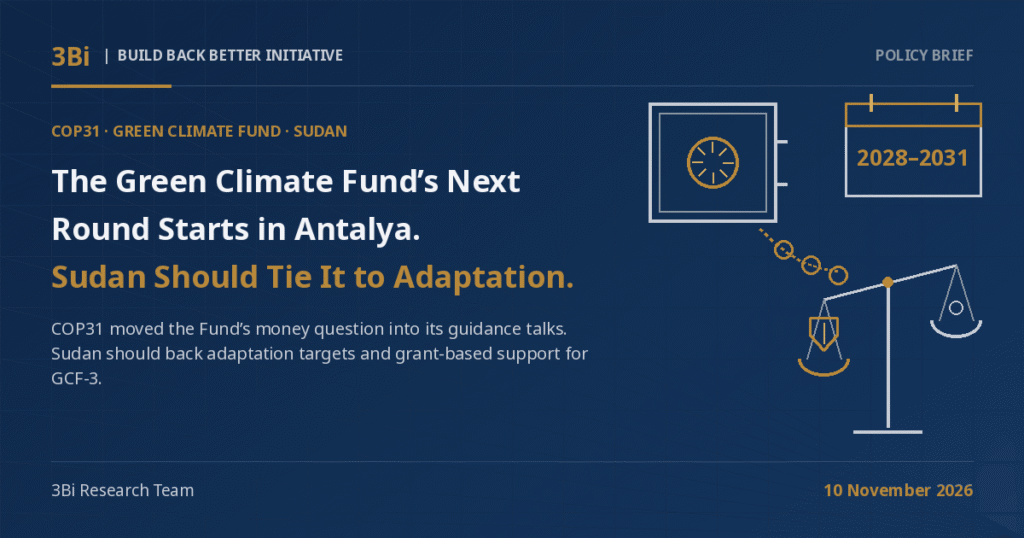
COP31 folded Africa’s request on Green Climate Fund money into the Fund’s guidance talks. As the Fund plans its 2028–2031 round, Sudan should back proposals that tie it to adaptation targets and grant-based support for adaptation plans.
COP31 opened in Antalya on 9 November 2026. The question of Green Climate Fund money before its third replenishment (2028–2031) was folded into the agenda items on the Fund’s report and guidance, where party proposals include adaptation targets and grant-based support for adaptation plans. (Illustration: 3Bi)
3Bi Research Team | Policy Brief | 10 November 2026
The Ask
This week in Antalya, Sudan’s finance negotiators and the Higher Council for Environment and Natural Resources (HCENR), which is also Sudan’s national designated authority for the Green Climate Fund (GCF), should back the lines in COP31’s guidance to the Fund that tie its third replenishment to adaptation: targets for adaptation contributions and approvals in line with the COP30 call to triple adaptation finance, and grant-based support for turning national adaptation plans into projects. The cost is a handful of interventions through blocs Sudan already belongs to. The window is the finance negotiations that close with COP31 on 20 November, before the Fund writes its 2028–2031 strategy in 2027.
Why Now
COP31 opened on 9 November with an agenda fight averted. The African Group had asked for new items, including one to assess the GCF’s funding needs before its third replenishment. COP31 President Murat Kurum told the opening plenary that GCF funding would not get its own item. Instead, it will be taken up alongside the existing items on the GCF’s report and on guidance to the Fund. Tripling adaptation finance was not added to the agenda at all, “without prejudice” to it coming up elsewhere (Carbon Brief, 9 November 2026; Climate Home News, 9 November 2026). In practice, this makes the GCF guidance item, COP agenda item 8(c) and its Paris Agreement twin, CMA item 11(b), one of the few places this session where the money question can be written into a decision that names a fund (UNDP and Gender and Climate Finance Collective, COP31 Supplement, 6 November 2026).
The text on the table is a compilation of party proposals, not agreed language. The UN Standing Committee on Finance gathered submissions for its September meeting in Sydney. Among them, the Arab Group, whose 22 members include Sudan (Arab Reform Initiative, 18 August 2026), proposed that the COP “deplores the $5.1 billion in cuts to GCF funding by developed country Parties since the start of 2025” and urges new pledges, converted into signed agreements, ahead of the third replenishment. Under the Paris Agreement guidance, it asks the GCF Board “to set ambitious contribution and approval targets for adaptation”, in line with the COP30 tripling call. Brazil proposed urging the Board to “significantly scale up grant-based and highly concessional finance for country-driven adaptation action”, including for priorities identified in national adaptation plans (UNFCCC, Standing Committee on Finance, SCF/2026/41/7, meeting of 23–25 September 2026).
The Fund’s own clock makes this round count. In July, the GCF Board launched its third replenishment, known as GCF-3, which will cover 1 January 2028 to 31 December 2031 (GCF, decision B.45/18, July 2026). On 26–29 October it approved the contributions policy for that round. The policy adds sovereign and sub-sovereign guarantees as a new type of input and gives more flexibility to non-grant contributions, while contributors “continue to be encouraged to maximize contributions in the form of grants” (UNFCCC, FCCC/CP/2026/9/Add.1, GCF addendum report to COP31, 9 November 2026). The Fund’s updated Strategic Plan for 2028–2031 must be adopted no later than the Board’s second meeting of 2027 (GCF, decision B.45/18). What the COP says in Antalya is the guidance that the Board has to answer while it writes both.
The Evidence
First, the Fund’s money is shrinking just as its next round is designed. In May 2026 the United Kingdom told the GCF that it was halving its pledge for the current round from £1.6 billion to £0.8 billion. That cut total pledges for 2024–2027 from US$10.6 billion to US$9.6 billion (GCF Watch, reporting from the 45th Board meeting, 30 June 2026). At the opening of COP31, negotiators from the G77 and China noted that several developed countries had halved their signed contributions for 2024–2027 (3News, 9 November 2026). Approvals, meanwhile, are at a record. The Board approved US$1.97 billion at its October meeting, the largest amount ever at a single meeting, taking 2026 approvals to US$3.3 billion. The GCF says its refined Commitment Authority Framework “unlocked additional funding capacity” (UNFCCC, FCCC/CP/2026/9/Add.1, 9 November 2026). A fund that approves more while its contributors pay in less will lean on new kinds of money, which is what the new contributions policy allows. 3Bi is not claiming that this will push the GCF towards loans for the poorest countries. Our point is narrower: COP guidance is where parties can fence adaptation and grants before the new mix is set.
Second, the Fund’s adaptation record is a baseline worth locking in. After the October meeting, the GCF portfolio stands at US$22.27 billion across 379 projects in 137 countries. In grant-equivalent terms, 59 per cent goes to adaptation. Of that adaptation finance, 65 per cent goes to countries that are particularly vulnerable, including least developed countries (LDCs), small island developing states and African states, against a floor of 50 per cent set by the current strategic plan. About 28 per cent of all GCF funding has been committed to LDCs. Grants make up 43 per cent of the portfolio and senior loans 32 per cent (UNFCCC, FCCC/CP/2026/9/Add.1, 9 November 2026). Those shares are policy choices, not laws of nature. The 50 per cent floor belongs to a strategic plan that ends in 2027. Guidance that asks for adaptation targets in GCF-3, and for grant-based support for adaptation plans, is how countries like Sudan keep the floor from becoming a ceiling. The disbursement record adds a second reason. Only 39.6 per cent of the funding for projects under implementation has been disbursed so far (UNFCCC, FCCC/CP/2026/9/Add.1). The Arab Group’s proposal notes “with concern the widening delta between project approvals and disbursements” (UNFCCC, SCF/2026/41/7).
Third, Sudan’s own GCF position shows why the terms matter more to it than the headline. Sudan has three GCF projects worth US$44.8 million in total, and US$3.3 million in approved readiness support. All three projects run through international agencies: UNDP for the rain-fed agriculture and pastoral resilience project (FP139), FAO for the gum arabic belt project (SAP019), and IFAD for a multi-country green-finance programme in the Great Green Wall countries (FP183) (Green Climate Fund, Sudan country page, accessed 10 November 2026). Across Africa, the GCF has approved 292 readiness grants worth US$278.49 million for 54 countries (UNFCCC, FCCC/CP/2026/9/Add.1). By our calculation, that is an average of about US$5.2 million per country, against Sudan’s US$3.3 million. A small client with a thin pipeline gains most from grant terms, from readiness help and from adaptation targets. It gains least from new instruments built around guarantees and private risk-sharing. Sudan’s delegation has said it wants direct, grant-based finance for adaptation and close coordination with the African Group and the LDC group (Al-Ahd, 9 October 2026). The Arab Group and Brazil paragraphs say the same thing in UN language.
Addressing the Counter-Case
The strongest objection is that Sudan is a small GCF client and should spend its negotiating time on bigger files, such as the Global Goal on Adaptation or loss and damage. This is a fair concern, and 3Bi is not recommending that Sudan open a new front. The narrower point is that the plenary pushed adaptation finance out of its own agenda item and into other strands. The Umbrella Group said in plenary that adaptation finance “is not an orphan and will continue to be taken forward” (Carbon Brief, 9 November 2026). GCF guidance is one of the strands where that promise can be tested in text tied to a real fund. Supporting paragraphs that the Arab Group and Brazil have already tabled costs a few interventions, not a new position paper.
A second objection is that grant-heavy language scares off contributors. In June, some developed-country Board members argued that new contributors and new types of input would grow the Fund (GCF Watch, 29 June–2 July 2026). 3Bi is not opposing guarantees or new contributors. Our ask is that, whatever the mix, adaptation in the poorest countries stays grant-based. The European Union’s own proposal makes the same point: new private-sector modalities “should complement, not substitute for grants and highly concessional finance for nonrevenue-generating adaptation and resilience needs” (UNFCCC, SCF/2026/41/7). Sudan can back that sentence as well. It shows the ask is not a North–South fight.
What 3Bi Recommends, Specifically
First, this week, Sudan’s finance negotiators should tell the Arab Group and African Group coordinators on GCF guidance that Sudan supports three lines: adaptation contribution and approval targets in line with the tripling call (Arab Group); grant-based and highly concessional finance to implement national adaptation plan priorities (Brazil); and the European Union’s sentence that private modalities complement, and do not substitute for, grants for adaptation.
Second, before COP31 closes on 20 November, HCENR, as Sudan’s GCF national designated authority, should ask that the final guidance invite the Board to keep at least the current 50 per cent floor for particularly vulnerable countries’ share of adaptation finance in the 2028–2031 Strategic Plan.
Third, in the first quarter of 2027, HCENR should send Sudan’s views into the consultation on the new Strategic Plan, setting out what a small LDC client needs from GCF-3: grant-based adaptation, faster disbursement and readiness support sized to a thin pipeline.
Fourth, HCENR should confirm whether Sudan has asked for a placement under the GCF’s Liaison Officer scheme and, if not, request one. As of 31 October, the GCF had received 102 requests, 61 of them from LDCs or small island states, and signed 60 contracts (UNFCCC, FCCC/CP/2026/9/Add.1). We could not verify whether Sudan is among them.
Fifth, 3Bi will compare the GCF guidance adopted in Antalya with these proposals and publish what survived after the conference.
Sourcing & Contact
Primary sources: Carbon Brief, “COP31: Agenda adopted!” (live coverage, 9 November 2026); Climate Home News, “COP31 Bulletin Day 1: Agenda settled as COP urged to ‘supercharge solutions’” (9 November 2026); UNFCCC, FCCC/CP/2026/9/Add.1, Addendum to the Fifteenth Report of the Green Climate Fund to the Conference of the Parties (GCF text dated 5 November 2026; distributed 9 November 2026); UNFCCC Standing Committee on Finance, SCF/2026/41/7, Background document on the draft guidance to the operating entities of the Financial Mechanism, including the thematically clustered compilation of submissions (SCF 41, 23–25 September 2026); Green Climate Fund, decision B.45/18, Arrangements for the third formal replenishment of the GCF (July 2026); GCF Watch, “Daily updates: 45th GCF Board meeting” (29 June–2 July 2026); Green Climate Fund, Sudan country page (accessed 10 November 2026); 3News, “COP31 opens in Antalya under Super El Niño threat as Africa presses climate finance demands” (9 November 2026); Al-Ahd, «السودان يحدد أولويات وفده التفاوضي لمؤتمر المناخ COP31» (9 October 2026); Arab Reform Initiative, “A MENA Agenda for COP30: Vulnerability, Transition, and Justice” (18 August 2026); UNDP and Gender and Climate Finance Collective, COP31 Supplement (6 November 2026). The SCF compilation records proposals by parties and groups; it is not negotiated text, and the paragraphs cited may change or disappear in Antalya. 3News reported that the African items were added to the agenda; we follow the plenary accounts of Carbon Brief and Climate Home News, which report that they were not, and that GCF funding moved into the guidance items. The GCF-2 pledge totals come from GCF Watch’s report of the Board meeting, not from a GCF document. The per-country readiness average is 3Bi’s calculation. 3Bi is not claiming that Sudan has taken a position on GCF guidance. For methodology questions or to propose a correction, contact 3Bi’s Research Team via 3bisudan.org.
This piece was produced through 3Bi’s automated daily publications workflow, which monitors regional and international climate and energy reporting.
This publication is produced with support from 3Bi’s institutional donors; see the full funder list at 3bisudan.org.
About the Authors
Related Publications
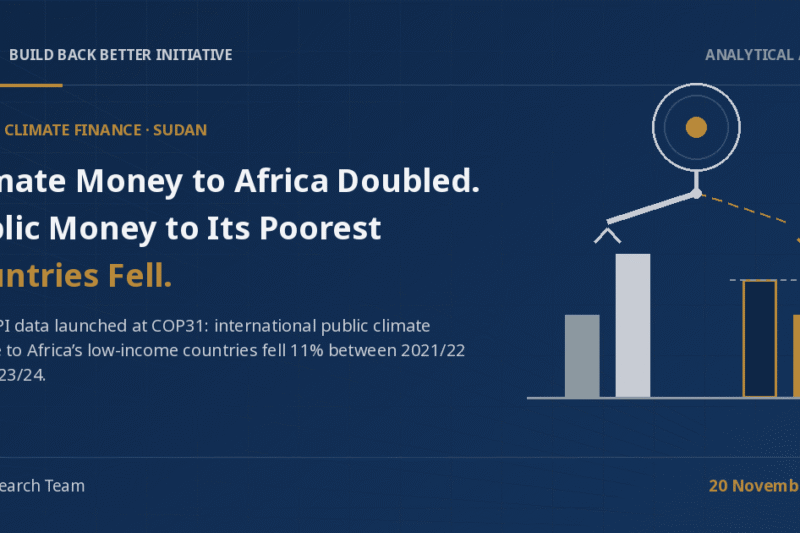
Europe Says Spend What’s Already Pledged. Public Climate Money to Africa’s Poorest Countries Fell. Sudan Should Ask Who Gets It.
Europe says COP31 should deploy money already pledged. New CPI data show climate finance to Africa doubled, but international public money to its low-income countries fell 11%. Sudan,…
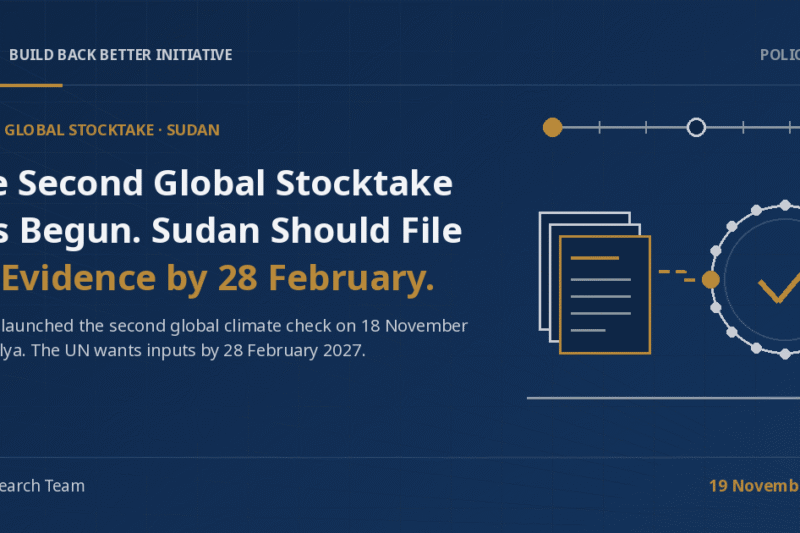
COP31 Has Opened the Second Global Climate Stocktake. Inputs Close on 28 February. Sudan Should File Its Own Evidence.
COP31 launched the second Global Stocktake in Antalya on 18 November, and inputs are due by 28 February 2027. Sudan has a 2016 adaptation plan, a 2025 national…
COP31 Points Countries to Their Regional Seas on Ocean Action. Sudan’s Is the Red Sea. It Should Report Its Coastal Plan and Work Through PERSGA.
COP31’s new Antalya Ocean and Seas Compact points countries to their regional seas bodies, and the draft cover decision invites ocean reporting. Sudan has about 800 km of…