
COP31 Heard That Money for Climate-Technology Plans Is Shrinking. Sudan’s List Dates From 2013 and Calls Solar “Very Expensive”. Time to Refresh It.
3Bi Research Team | Analytical Article | 11 November 2026
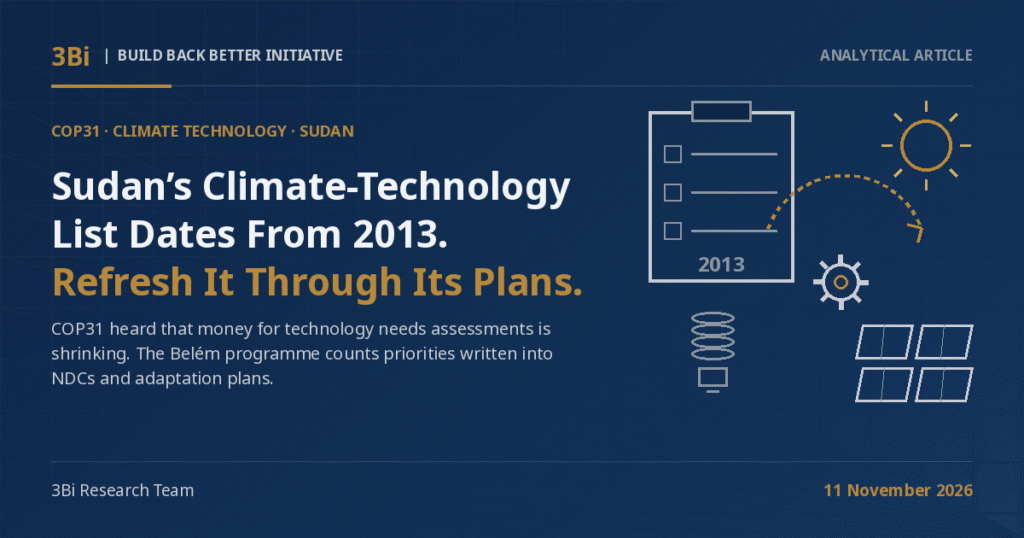
COP31 heard that money for technology needs assessments is shrinking. Sudan’s only assessment dates from 2013 and calls solar “very expensive”. The Belém programme counts priorities in NDCs and adaptation plans, so Sudan should refresh its list there.
On 10 November 2026, the second day of COP31 in Antalya, the G-77 and China said the latest Global Environment Facility replenishment would affect countries’ ability to carry out technology needs assessments. Sudan’s only assessment dates from 2013. (Illustration: 3Bi)
3Bi Research Team | Analytical Article | 11 November 2026
The Hook
On Tuesday, the second day of COP31 in Antalya, negotiators spent about three hours on technology and five on finance. According to the Earth Negotiations Bulletin, there was “lots of opportunity to discuss the recent decline in support” (IISD, Earth Negotiations Bulletin, 11 November 2026). One exchange in the technology rooms deserves more attention than it got. Speaking for the G-77 and China, the bloc of developing countries to which Sudan belongs, a negotiator said the latest replenishment of the Global Environment Facility (GEF) is the lowest in history. The bloc said this would affect countries’ ability to carry out technology needs assessments (TNAs), the national studies that tell funders which climate technologies a country wants (IISD, ENB, 11 November 2026).
In the same session, the bloc complained that the 2027 budget of the Climate Technology Centre and Network (CTCN), the UN’s technical-assistance arm for climate technology, is being kept at 2026 levels. This is happening even though the Centre’s workload is growing and it has a central role in the new Belém Technology Implementation Programme (IISD, ENB, 11 November 2026). The bloc also proposed that the UN climate secretariat prepare a synthesis of countries’ technology needs assessments for the subsidiary bodies’ June 2027 session, SBI 66 (IISD, ENB, 11 November 2026).
For Sudan, this is not an abstract budget argument. Sudan completed its only technology needs assessment in 2013 (UNEP Copenhagen Climate Centre, Sudan TNA country page, accessed 11 November 2026). That document still sets out the country’s formal climate-technology priorities. Its energy priorities are compact fluorescent lamps and efficient dual-fuel boilers. On solar power, it says: “For real development, this is very expensive and to a great extent is still a new technology” (Republic of the Sudan, TNA for Climate Change Mitigation, March 2013). The world has moved on since then. Our argument is that Sudan should not wait for a new, donor-funded assessment that may not come. It should refresh its technology priorities through the national plans it already has to write.
The Argument
First, the money that paid for Sudan’s 2013 assessment is shrinking, and COP31 is unlikely to restore it. Sudan’s 2013 assessment was carried out by the Higher Council for Environment and Natural Resources (HCENR), with the UNEP Risø Centre in Denmark, and was “supported by the Global Environmental Facility (GEF) grant financing” (Sudan TNA for Climate Change Mitigation, March 2013). The GEF announced in April that donors had pledged an initial US$3.9 billion for its ninth funding cycle, which runs from July 2026 to June 2030 (GEF, 9 April 2026). With later pledges from the United Kingdom, Spain and Uzbekistan, the total was close to US$4.4 billion by late October (GEF, 26 October 2026). The previous cycle raised US$5.33 billion (GEF, “The GEF at a Glance”, August 2026). By our calculation, that leaves the new cycle roughly a sixth smaller than the last one, even after the late pledges.
The GEF’s own chart shows that some replenishments in the 1990s and 2000s were smaller in nominal terms, so we have not verified the G-77’s description of this one as “the lowest in history”. The direction is not in dispute. The GEF has set a target of directing 35% of its new-cycle financing to least developed countries (LDCs) and small island states (GEF, August 2026), which helps a country like Sudan. But the same pot has to cover biodiversity, land, chemicals and international waters as well as climate change. A full repeat of the 2013 exercise is not something Sudan can count on.
The technology talks themselves point the same way. The European Union and the United Kingdom proposed closing the long-running agenda item on the Poznan strategic programme on technology transfer. They said related issues would be handled under the new Belém programme. The LDC group supported closing the item but stressed that technology transfer still needs enough funding (IISD, ENB, 11 November 2026). We read this as a sign that technology support is moving out of stand-alone programmes and into the Belém programme.
Second, the new programme agreed in Belém does not require a fresh assessment. It counts the plans countries already write. At COP30 in Belém, the Paris Agreement parties set up the Belém Technology Implementation Programme. Its purpose is to strengthen support for implementing “technology priorities identified by developing countries”. The decision text says those priorities include, but are not limited to, those in technology needs assessments and technology action plans, biennial transparency reports, national adaptation plans, nationally determined contributions (NDCs), and long-term low-emission development strategies (UNFCCC, FCCC/PA/CMA/2025/L.18, 21 November 2025). In plain terms, a country can update its technology priorities in its next climate plan or adaptation plan, and the programme is supposed to treat them as just as valid.
The same decision tells the CTCN and the Technology Executive Committee to help national designated entities, the officials who are each country’s contact point for the CTCN, to integrate technology priorities into national policies and projects. They are also asked to build capacity “for the development of project concept notes and the preparation of fundable projects”, and to support matchmaking and partnerships (FCCC/PA/CMA/2025/L.18). The programme has a calendar. Parties and observers are invited to suggest topics every year by 1 July, starting in 2026. Global dialogues will be held at the June subsidiary-body session each year from 2027. Regional dialogues will be held with the CTCN’s regional forums for national designated entities from 2027, “subject to the availability of resources”. A high-level ministerial dialogue on technology is set for November 2028 (FCCC/PA/CMA/2025/L.18).
This is why the budget fight in Antalya matters. A programme that rests on the CTCN, while the CTCN’s budget stays flat, will ration its attention. Countries whose priorities are current, specific and written into official plans will be easier to serve than countries whose most detailed technology list is 13 years old.
Third, Sudan’s 2013 list was reasonable for its time, but on energy it has aged badly. Parts of the 2013 assessment hold up. For adaptation, it chose agriculture and water: improved crop varieties, conservation agriculture (zero tillage), seasonal forecasting and early-warning systems, and rainwater harvesting with haffirs, the excavated reservoirs used across rural Sudan (Republic of the Sudan, TNA for Climate Change Adaptation, January 2013). That list still reads as relevant. It has also produced results. In February 2024, Sudan’s national designated entity asked the CTCN for technical assistance on water-harvesting technologies. The request cites the 2013 assessment and its technology action plan, and the CTCN lists the work as completed (CTCN, project page, submitted 21 February 2024, accessed 11 November 2026). A national technology list, once written, can turn into a funded request.
The energy side is different. For mitigation, the stakeholders behind the 2013 assessment chose biogas units and improved stoves for land use, mass transport and compact fluorescent lamps for energy, and efficient dual-fuel boilers for industry (Sudan TNA for Climate Change Mitigation, March 2013). The document noted Sudan’s high solar radiation. But it said high ambient temperatures above 35°C and dust, which could cut solar system efficiency by up to 40%, were limiting factors. It suggested that solar and wind be considered for demonstration plants only, and saw geothermal as the route to “real reduction” (Sudan TNA for Climate Change Mitigation, March 2013).
Since then, the economics have turned around. The International Renewable Energy Agency (IRENA) reports that the global average cost of electricity from new solar photovoltaic plants has fallen by 89% since 2010, to US$44 per megawatt-hour in 2025 (IRENA, Renewable Power Generation Costs in 2025, 2026). The International Energy Agency expects solar to account for three-quarters of an almost 60% rise in renewable capacity growth in 2026–2031 compared with the previous six years (Climate Home News, 10 November 2026, citing the IEA). Sudan’s own policy has moved too. On 3 November, the Minister of Energy and Oil, Al-Mutasim Ibrahim, told the Sudan News Agency that solar energy is “an important option for Sudan” because the sun is available most days of the year and projects can be delivered quickly, through self-financing or investment partnerships. He said the ministry has renewable-energy plants and projects in River Nile, Northern and Red Sea states, including Port Sudan (SUNA, 3 November 2026, 3Bi translation). We have written in recent weeks about solar pumps (27 October), solar mini-grids (17 October) and an African solar facility (4 November). The official technology list that a funder would open does not reflect any of that.
Why It Matters to the Reader
The strongest objection is that this is paperwork. Sudan has urgent energy needs and a small delegation, and COP31 has bigger fights over adaptation finance, the Green Climate Fund and the just transition. A technology list sounds like a low priority. That is a fair concern, and 3Bi is not recommending a new, multi-year national study. We are also not claiming that Sudan has no newer internal technology priorities. We could not find a technology needs assessment for Sudan more recent than 2013 on the UNEP Copenhagen Climate Centre’s country page, and that is the document the international system points to.
Our point is narrower. The Belém programme lets Sudan update its priorities through documents it must produce anyway, such as its next NDC and its national adaptation plan. As we noted on 18 October, the adaptation plan dates from 2016. If those documents carry a short, current technology section, Sudan gets a refreshed list without waiting for a GEF round. If they do not, the 2013 list remains the official record, with compact fluorescent lamps and a sceptical view of solar.
If you work at the HCENR, at the national designated entity for the CTCN (listed on the 2024 request as the Ministry of Environment, Natural Resources and Physical Development), in the Ministry of Energy and Oil, or in the negotiation team in Antalya, three steps follow.
First, this week, support the G-77 and China proposal for a synthesis of technology needs assessments for SBI 66, and the call for an adequate CTCN budget. Ask, through the bloc, that the synthesis record how old each country’s assessment is. A count of outdated assessments is the evidence that the Belém programme’s support should reach countries that cannot afford a new one.
Second, when the next NDC and the national adaptation plan are drafted, add a technology annex of two to four pages. Keep the 2013 adaptation priorities that still hold, such as improved crop varieties, zero tillage, early warning and haffirs, with current costs. Replace the dated energy entries with the technologies Sudan is actually deploying or planning, such as solar pumping, mini-grids and efficient lighting and cooking. For each, give the barrier and the kind of support needed. This uses the decision text’s own route: priorities “identified by developing countries” in NDCs and national adaptation plans count.
Third, by 1 July 2027, submit a topic to the Belém programme’s annual call. One example is how least developed countries with old assessments can update technology priorities through their NDCs. Then use the CTCN’s regional dialogues for national designated entities in 2027, if they go ahead, to turn one refreshed priority into a technical-assistance request, as Sudan did for water harvesting in 2024.
Close
Technology transfer rarely makes the headlines at a climate summit. It was not the headline in Antalya on Tuesday either. But the fight over a flat CTCN budget and a smaller GEF decides who gets help to move from a list of technologies to a funded project. Sudan’s list was written when solar looked like a demonstration-plant technology. It is now the option its own energy minister calls important. Updating the list costs a few pages in plans Sudan already has to write. We will follow the technology outcomes at COP31 and report whether the synthesis report and the CTCN budget survive the final texts.
Sourcing & Contact
Primary sources: IISD, Earth Negotiations Bulletin, Vol. 12 No. 903, “Antalya Climate Change Conference: Tuesday, 10 November 2026”, 11 November 2026; Global Environment Facility, “Countries pledge $3.9 billion to Global Environment Facility towards ambitious ninth replenishment”, 9 April 2026; Global Environment Facility, “UN Biodiversity Conference gets finance boost for action on nature with $500 million in additional pledges to the GEF and GBFF”, 26 October 2026; Global Environment Facility, “The GEF at a Glance”, August 2026; UNFCCC, “Belém Technology Implementation Programme”, draft decision -/CMA.7, FCCC/PA/CMA/2025/L.18, 21 November 2025; Republic of the Sudan (HCENR), Technology Needs Assessment for Climate Change Mitigation, March 2013, and Technology Needs Assessment for Climate Change Adaptation, January 2013; UNEP Copenhagen Climate Centre, Sudan Technology Needs Assessment country page (accessed 11 November 2026); Climate Technology Centre and Network, “Improving the efficiency and sustainability of water harvesting technologies in Sudan”, project page (submitted 21 February 2024; accessed 11 November 2026); IRENA, Renewable Power Generation Costs in 2025 (executive summary), 2026; Climate Home News, “COP31 Bulletin Day 2: Momentum builds on electrification and fossil fuel transition”, 10 November 2026; Sudan News Agency (SUNA), interview with the Minister of Energy and Oil, 3 November 2026. For methodology questions or to propose a correction, contact 3Bi’s Research Team via 3bisudan.org.
3Bi Research Team. This piece was produced through 3Bi’s automated daily publications workflow, which monitors regional and international climate and energy reporting.
This publication is produced with support from 3Bi’s institutional donors; see the full funder list at 3bisudan.org.
About the Authors
Related Publications
Sudan Has Imported More Than a Gigawatt of Solar Panels Since January 2025. Its Grid Rebuild Should Be Planned Around Them.
Sudan imported 140 MW of Chinese solar panels in September and more than a gigawatt since January 2025. As a grid diagnostic with Algeria’s Sonelgaz begins, Sudan should…

COP31 Went Into Overtime, but It Has Already Created a Platform to Turn Poor Countries’ Adaptation Plans Into Projects. Sudan Should Join Early.
COP31 ran past its deadline, but Friday’s plenary created a platform to help the least developed countries turn adaptation plans into fundable projects. It brings no new money.…
Europe Says Spend What’s Already Pledged. Public Climate Money to Africa’s Poorest Countries Fell. Sudan Should Ask Who Gets It.
Europe says COP31 should deploy money already pledged. New CPI data show climate finance to Africa doubled, but international public money to its low-income countries fell 11%. Sudan,…