COP31’s Early-Warning Stocktake Says Systems Fail When the Projects End. Sudan Has a Roadmap. Now It Needs a Budget That Lasts.
3Bi Research Team | Analytical Article | 14 November 2026
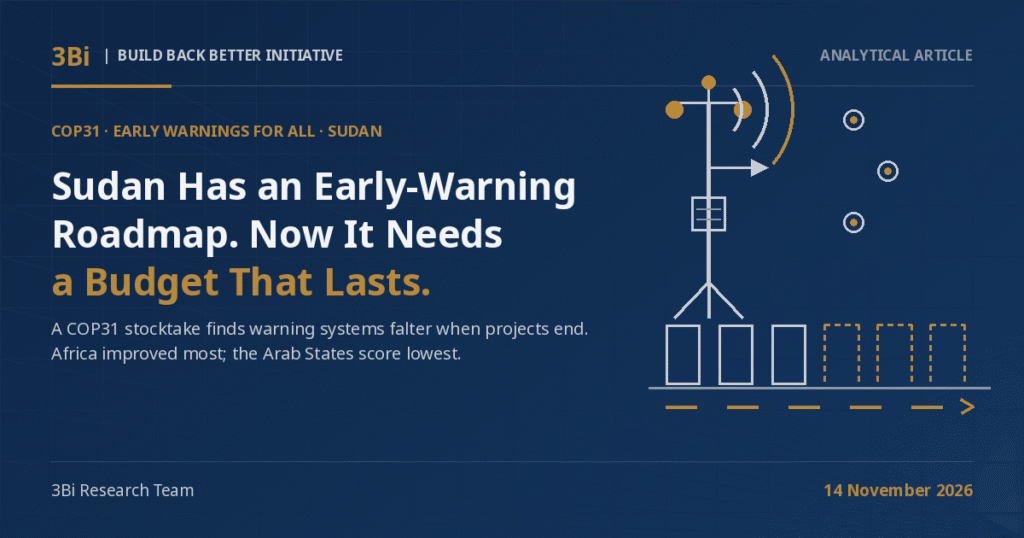
A COP31 stocktake finds Africa improved early warning faster than any region, but warns that systems falter when project money ends. Sudan now has a roadmap. It should cost the running budget and ask the UN observation fund to lift its hold.
On 11 November 2026, UNDRR and WMO launched the Global Status of Multi-Hazard Early Warning Systems 2026 at COP31 in Antalya. It names Sudan among countries that developed early-warning roadmaps and warns that many systems lack budgets to keep running after projects end. (Illustration: 3Bi)
3Bi Research Team | Analytical Article | 14 November 2026
The Hook
On Wednesday, at COP31 in Antalya, the UN Office for Disaster Risk Reduction (UNDRR) and the World Meteorological Organization (WMO) launched the Global Status of Multi-Hazard Early Warning Systems 2026. The report is the annual stocktake of the UN’s Early Warnings for All initiative, which aims to protect everyone on Earth with early warnings by 2027 (UNDRR, report page, November 2026). Its headline is good news. 136 countries now report having a multi-hazard early warning system, 70 per cent of all countries and 143 per cent more than in 2015. Countries with substantial to comprehensive systems record disaster deaths 6.1 times lower than countries with limited or moderate ones (UNDRR and WMO, Global Status of MHEWS 2026, November 2026).
Africa is the success story. Eleven more African countries reported some early warning capability over the past year, which brings the region’s coverage to 77 per cent (UNDRR and WMO, press release, 10 November 2026). Speaking at an African Union event the next day, WMO Secretary-General Celeste Saulo put it plainly: “No region has improved its early warning systems more than Africa” (WMO, statement, 12 November 2026).
Sudan sits on the seam between two very different results. The report groups Sudan with the Arab States, where more than four in five countries report having a system, but where the average system is now the least complete of any region (UNDRR and WMO, Global Status of MHEWS 2026). The report also names Sudan among the countries that “advanced national EW4All implementation through the development of roadmaps and operational action plans” (UNDRR and WMO, Global Status of MHEWS 2026, section 3.4.3).
That is real progress, and it deserves credit. But the same report warns about what usually happens next. Early warning systems are often built with short-term project money, and many countries cannot keep them running once the project ends. Our argument is that Sudan has done the planning. Its next task is to put a price on keeping the system running, and to put that price where funders will see it.
The Argument
First, the report’s central warning is not about building systems. It is about keeping them alive. More than 180 countries receive technical or financial help for early warning, the report says, but “funding is often short term”, and many countries lack the operating budgets to keep services going after projects end (UNDRR and WMO, Global Status of MHEWS 2026, section 2.4.4). It is blunt about where the money goes: “Many investments continue to depend on externally financed project cycles and focus primarily on infrastructure and initial capacity development. Far less attention is given to the long-term requirements that determine whether systems remain functional over time: operations and maintenance, institutional capacity, workforce development, local preparedness and sustained service delivery” (Global Status of MHEWS 2026, section 2.4.4, Box 12).
The gaps are visible in the numbers. Of the 136 countries reporting a system, only 64 report capabilities across all four parts of the warning chain: knowing the risk, forecasting it, getting the warning out, and being ready to act (UNDRR, report page, November 2026). Least developed countries (LDCs), the UN group that includes Sudan, have the lowest average scores of any country group, even though they have improved the most since they started reporting (UNDRR and WMO, press release, 10 November 2026).
The people who run these systems said the same thing in Antalya. Saulo told the African Union event that national weather services must be funded “as we fund other essential public services. Like hospitals, they must be paid for year after year, not only on the day they open” (WMO, statement, 12 November 2026). At the launch, speakers asked for “predictable, largely grant-based financing mechanisms”, as well as trained staff, maintenance and “operating budgets that last well beyond installation” (UNDRR, 12 November 2026). The initiative’s 2027 target date is close, and its partners are already consulting on what comes after it. They held a regional consultation for Africa in September and plan a global meeting in the middle of next year (UNDRR, 12 November 2026).
Second, Sudan has built the front end of a system. Most of it rests on projects and partnerships. Sudan launched Early Warnings for All nationally in November 2024, in two workshops with UNDRR, WMO, the International Federation of Red Cross and Red Crescent Societies and the International Telecommunication Union, which set out first steps towards a multi-year national roadmap (UNDRR, 13 November 2024). In July 2025, the Sudan Meteorological Authority hosted a three-day workshop that finalised an Early Warning Framework and closed with an implementation roadmap “including clear roles, timelines, and commitments from key stakeholders” (DRESS EA project, workshop update, July 2025). The new global report credits Sudan with roadmap work of this kind.
The report also shows Sudan trying new approaches. A partnership called DARAJA + AI works with the Sudan Meteorological Authority, the Sudan Red Crescent, Save the Children and the mobile operators Zain and MTN. It turns official weather alerts into audio messages and sends them through WhatsApp, local radio and community networks. The service is being piloted in Sudanese Arabic, Bedawit and Dongolawi, so that people who cannot easily read a text alert can still hear the warning (Global Status of MHEWS 2026, section 2.4.6). Sudan is also one of five countries in Water at the Heart of Climate Action, a programme on flood and drought warnings run by the IFRC, the Netherlands Red Cross, UNDRR, WMO and the Systematic Observations Financing Facility (Global Status of MHEWS 2026, section 3.3.2). And Sudan’s own climate plan lists “strengthened climate monitoring and early warning systems” among its adaptation measures (UNFCCC, Sudan Updated First NDC, October 2021).
Look at how this is paid for. A pilot, a multi-country programme, workshops supported by partners: this is the project-cycle model the report warns about. That does not make it wrong. It is how almost every LDC starts. But a roadmap that lists roles and timelines is not the same thing as a budget line. We have not seen a published version of Sudan’s roadmap or a cost estimate for running it, and we could not find a country score for Sudan in the global report.
Third, the cheapest missing piece is the observing network, and Sudan’s neighbours are already being funded for it. Every forecast starts with observations: weather stations, rain gauges and upper-air soundings that measure what the atmosphere is doing. The Systematic Observations Financing Facility (SOFF) is a UN fund, co-created by WMO, the UN Development Programme and the UN Environment Programme, that helps developing countries upgrade and maintain their observing networks to global data-sharing standards (Global Status of MHEWS 2026, section 3.2.2). It now supports 80 per cent of all LDCs and small island developing states (Global Status of MHEWS 2026, section 3.2.2).
Sudan is on SOFF’s list of countries programmed for support, but its entry carries two words: “on hold” (SOFF, Countries page, accessed 14 November 2026). It is the only country marked that way. The hold is not new. SOFF’s annual report for 2023 named Sudan and Guatemala as the two programmed countries that had not yet received readiness funding, and said that “in Sudan, all SOFF-related activities are on hold” (SOFF, Annual Narrative Progress Report 2023, May 2024). SOFF’s October portfolio report, with data to 30 August 2026, counts 66 programmed countries, of which 64 are receiving support and one has a readiness request on hold (SOFF, INF 15.1, 21 October 2026). The documents we reviewed do not give a reason for Sudan’s hold, and we do not speculate on one.
Meanwhile, the money has moved next door. SOFF has approved investment-phase grants of about US$7.0 million for Chad (June 2024), US$10.0 million for Ethiopia (March 2024) and US$2.1 million for South Sudan (February 2026), roughly US$19 million across three of Sudan’s neighbours (SOFF, INF 15.1, Annex I, 21 October 2026). SOFF’s first step, the readiness phase, is cheap and practical: SOFF has committed US$9.5 million in readiness funding across 64 countries (SOFF, INF 15.1, 21 October 2026). It produces a gap analysis of the observing network, a national contribution plan and a Country Hydromet Diagnostic (SOFF, Annual Narrative Progress Report 2023). In other words, it produces the costed baseline that Sudan’s roadmap appears to lack.
Why It Matters to the Reader
The strongest objection is that this is the wrong moment to ask Sudan for recurrent budgets. Public finances are stretched, and every ministry has more urgent bills than the upkeep of weather stations. That is a fair concern, and 3Bi is not recommending that the treasury take on the full running cost of an early warning system this year. We are also not claiming that Sudan’s existing systems do not work, or that the SOFF hold is in Sudanese hands to lift.
Our point is narrower, and it follows the report’s own advice. The report asks countries to build business cases for early warning “that cover both initial capital expenditure and ongoing operational costs”, and to embed early warning in their nationally determined contributions (NDCs) and national adaptation plans (Global Status of MHEWS 2026, findings 1 and 4). A country that knows what its system costs to run each year can ask for that money. A country that only has a list of projects will keep getting projects. The next phase of Early Warnings for All is being designed now, region by region, and COP32 will be held in Ethiopia next year. Saulo called it “the African COP” (WMO, statement, 12 November 2026).
There is also an opening in Antalya this week. In Friday’s consultations on the COP31 cover decision, the Environmental Integrity Group listed early warning systems among the important elements of the presidency’s informal note. The LDCs said the decision must include concrete adaptation measures, and the African Group warned that overshooting 1.5°C will raise adaptation costs (IISD, Earth Negotiations Bulletin, 14 November 2026). In our view, early warning is one of the easier adaptation topics on which to build agreement.
If you work at the Sudan Meteorological Authority, the Higher Council for Environment and Natural Resources (HCENR), the finance ministry, or on Sudan’s negotiating team in Antalya, three steps follow.
First, before COP31 closes on 20 November, work through the LDC and African groups to keep early warning in the cover decision, and push for wording on sustained operational support, not only new equipment. This costs nothing and matches what the WMO and UNDRR asked for on the conference floor.
Second, by mid-2027, before the global meeting on the future of Early Warnings for All, publish a short costed annex to the national roadmap. It should separate one-off capital costs from yearly running costs, such as staff, station maintenance, communications and data. Then carry the running-cost figure into the update of the 2016 national adaptation plan and into Sudan’s next NDC, so that funders see it in the documents they already read.
Third, now, the Sudan Meteorological Authority, which as the national weather service is Sudan’s focal point for SOFF, should ask the SOFF Secretariat in writing what it would take to lift the hold and start the readiness phase. A gap analysis and a hydromet diagnostic would give Sudan the costed baseline it needs for the second step. Taken to COP32 in Addis Ababa, they would show that Sudan is ready for the same investment its neighbours are already receiving.
Close
Early warning is the rare climate investment with a clear payoff. The new report finds that countries with fuller systems record disaster death rates about six times lower. Sudan has done the hard first part. It has a framework and a roadmap, a partnership piloting AI-voiced alerts in three local languages, and a place in the global stocktake. What it does not yet have is a number for what it costs to keep all that running, or a route to the observation funding its neighbours already receive. Saulo’s hospital comparison fits. Nobody builds a hospital and then budgets for opening day only. We will follow whether early warning survives in the COP31 cover decision and whether Sudan’s entry on SOFF’s list changes.
Sourcing & Contact
Primary sources: UNDRR and WMO, Global Status of Multi-Hazard Early Warning Systems 2026, launched at COP31 on 11 November 2026 (report PDF, sections 2.1–2.2, 2.4.4 including Box 12, 2.4.6, 3.2.2, 3.3.2, 3.4.3 and key findings); UNDRR and WMO, “Early warning protection expands worldwide”, press release via ReliefWeb, 10 November 2026; UNDRR, Global Status of MHEWS 2026 report page (accessed 14 November 2026); UNDRR, “COP31 leaders back a long-term future for Early Warnings for All”, 12 November 2026; WMO, “COP31: Towards early warnings for all in Africa”, statement by Secretary-General Celeste Saulo, 12 November 2026; IISD, Earth Negotiations Bulletin, Vol. 12 No. 906, “Antalya Climate Change Conference: Friday, 13 November 2026”, 14 November 2026; Systematic Observations Financing Facility, Countries page (accessed 14 November 2026); SOFF, INF 15.1, “SOFF Portfolio and Implementation Progress”, Fifteenth Steering Committee, 21 October 2026; SOFF, MPTF Office Annual Narrative Progress Report for 2023 (May 2024); UNDRR, “Strengthening early warning systems in Sudan: UNDRR and partners lead pivotal workshops”, 13 November 2024; DRESS EA project, “Sudan Meteorological Authority (SMA)” workshop update, July 2025; UNFCCC, Sudan Updated First Nationally Determined Contribution, October 2021. For methodology questions or to propose a correction, contact 3Bi’s Research Team via 3bisudan.org.
3Bi Research Team. This piece was produced through 3Bi’s automated daily publications workflow, which monitors regional and international climate and energy reporting.
This publication is produced with support from 3Bi’s institutional donors; see the full funder list at 3bisudan.org.
About the Authors
Related Publications
Europe Says Spend What’s Already Pledged. Public Climate Money to Africa’s Poorest Countries Fell. Sudan Should Ask Who Gets It.
Europe says COP31 should deploy money already pledged. New CPI data show climate finance to Africa doubled, but international public money to its low-income countries fell 11%. Sudan,…
COP31 Has Opened the Second Global Climate Stocktake. Inputs Close on 28 February. Sudan Should File Its Own Evidence.
COP31 launched the second Global Stocktake in Antalya on 18 November, and inputs are due by 28 February 2027. Sudan has a 2016 adaptation plan, a 2025 national…
COP31 Points Countries to Their Regional Seas on Ocean Action. Sudan’s Is the Red Sea. It Should Report Its Coastal Plan and Work Through PERSGA.
COP31’s new Antalya Ocean and Seas Compact points countries to their regional seas bodies, and the draft cover decision invites ocean reporting. Sudan has about 800 km of…