IRENA Names Sudan Among Six African Countries Where Off-Grid Finance Counts Most. Adopt the Mini-Grid Framework Before COP31.
3Bi Research Team | Policy Brief | 17 October 2026
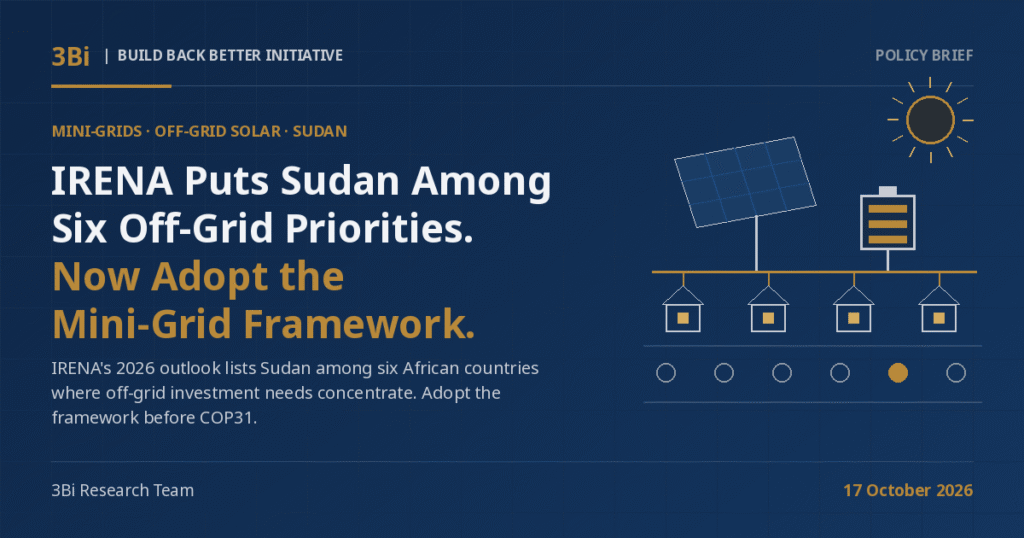
IRENA's new World Energy Transition Outlook names Sudan among six African countries where off-grid investment needs are concentrated. Sudan's first mini-grid regulatory framework is drafted; it should be adopted and published before COP31.
On 13 October 2026, IRENA’s World Energy Transition Outlook named Sudan among six African countries where off-grid investment needs are concentrated. Sudan’s first mini-grid regulatory framework has been drafted; no adoption has been announced. (Illustration: 3Bi)
3Bi Research Team | Policy Brief | 17 October 2026
The Ask
Before COP31 opens in Antalya on 9 November 2026, Sudan’s Ministry of Energy and Petroleum and the Electricity Regulatory Authority should formally adopt and publish, in Arabic and English, the country’s first regulatory framework for solar mini-grids, with five investor-facing terms written into it: a registration-only route for small low-voltage systems, a published tariff method, clear rules for what happens when the national grid arrives, a fast track for converting existing diesel mini-grids to solar hybrids, and a live digital licensing platform with public timelines. The framework is already drafted and its design has been paid for, so adoption costs little; the window to turn it into investment is narrowing because the International Renewable Energy Agency (IRENA) has just named Sudan as one of six African countries where off-grid investment needs are concentrated and where finance “can have the greatest impact” (IRENA, 13 October 2026). A finished text that stays in a ministry drawer will not be read by the investors IRENA is pointing towards Sudan.
Why Now
On 13 October 2026, IRENA released its World Energy Transition Outlook 2026: 1.5°C Pathway in Abu Dhabi (IRENA press release via Zawya, 13 October 2026). For Africa, the report records the continent’s largest renewable capacity growth on record in 2025, with 11.3 GW added, but finds that installed renewable capacity would need to grow about sevenfold by 2035 and about thirtyfold by 2050 from the 82 GW reached in 2025 to stay on the 1.5°C pathway. It names high financing costs, inconsistent policies and the need for stronger infrastructure as the obstacles to overcome (IRENA, WETO 2026, 13 October 2026). “We cannot deliver the transition by simply adding renewables to an unchanged energy system,” said Francesco La Camera, IRENA’s Director-General (IRENA press release, 13 October 2026).
The passage that matters most for Sudan sits in a box on decentralised electricity access. More than 565 million people in sub-Saharan Africa still lack electricity. IRENA’s regional analysis finds that about 60% of the new connections needed by 2030, around 401 million people, would be served most economically by mini-grids and standalone solar. It then says investment needs are concentrated in six countries: the Democratic Republic of Congo, Ethiopia, Niger, Nigeria, Sudan and Tanzania (IRENA, WETO 2026, Box 2.2; Ecofin Agency, 13 October 2026). IRENA also says a fuller regional energy transition outlook for Africa is forthcoming.
Sudan’s own process has reached its last step at the same moment. On 4 October 2026, UNDP Sudan’s Deputy Resident Representative, Surayo Buzurukova, wrote that three days of national discussion had opened in Khartoum to finalise a draft framework covering delivery models, legal and regulatory provisions and licensing procedures, alongside the Ministry of Energy and Petroleum, the Sudan Electricity Holding Company and the Electricity Regulatory Authority. She described it as the first such framework in the country’s history (Buzurukova, public LinkedIn post, 4 October 2026). The work sits inside a GEF- and UNDP-funded project whose listed period is 2022 to 2026 (UNDP Sudan project page, accessed 17 October 2026). As of 17 October, 3Bi has found no public announcement that the framework has been adopted, and we have not seen the draft text.
The Evidence
First, IRENA has told financiers where off-grid money will count; Sudan’s rules decide whether that money can land. Being on IRENA’s list of six is a signal of need, not a commitment of capital. UNDP’s own project description explains the gap. Around a third of people in Sudan have no electricity access at all; informal diesel mini-grids operate in some communities but are “expensive to run, highly polluting and largely unregulated”; and “in the absence of a clear regulatory framework for renewable energy mini-grids, private sector investment and innovation has been limited” (UNDP Sudan project page, accessed 17 October 2026). IRENA makes the same point at continental scale: mobilising finance is “just as crucial as deploying technology”, and it cites Nigeria’s World Bank-backed DARES programme, which targets 17.5 million people and 1,350 mini-grids, as an example of what integrated public and private finance can reach (IRENA, WETO 2026, Box 2.2). Programmes of that size rest on published regulations; Nigeria’s are discussed below. Sudan’s draft would give financiers the same footing, but only once it is adopted and public.
Second, the economics now favour solar-battery hybrids over diesel, and fuel prices are making the case for us. IRENA reports that Africa’s off-grid renewable capacity rose from 294 MW in 2014 to 1.35 GW in 2024, and that mini-grid generation costs have fallen from US$0.55 to US$0.38 per kWh since 2018, citing World Bank ESMAP data. Solar PV–battery hybrid mini-grids can cut diesel use by as much as 80%. With storage, their levelised cost rises by only 10–15% even if fuel prices double, and every dollar spent on batteries avoids US$2–4 in lifetime fuel costs (IRENA, WETO 2026, Box 2.2). Fuel prices are not standing still: December Brent crude futures rose 3.72% on 16 October to US$109.86 a barrel, the highest level since 19 May (attaqa.net, 16 October 2026). Every month that Sudan’s informal diesel mini-grids stay unregulated is a month in which communities pay diesel prices for electricity that a licensed hybrid could supply for less. The UNDP project already plans to retrofit at least two existing diesel-based stations with solar, targeting 2 MW of new PV and 6.9 MWh of battery storage (UNDP Sudan project page, accessed 17 October 2026). A hybridisation track in the framework would let private operators repeat that model without a bespoke negotiation each time.
Third, the slow part of the job is done; what remains is adoption, and the details that investors check first are known. UNDP put the framework out to tender in September 2025, with three tasks: a national dialogue on delivery models, a registration process for low-voltage mini-grids, and a full regulatory framework with streamlined licensing (UNGM notice UNDP-SDN-00386, 12 September 2025). Workshops in Port Sudan on 13–15 January 2026 diagnosed investment risks with developers, contractors and financiers (Africa Minigrids Program, 9 February 2026). A four-day national dialogue in Khartoum from 5 to 8 July reached consensus on delivery models and priority regulatory reforms, with representatives of Red Sea and Kassala states, the project’s target areas (SUNA, 5 July 2026; Africa Minigrids Program, 26 July 2026). A follow-up technical session chaired by the Sudan Electricity Holding Company called for an integrated framework and an incentive tariff, built on the Electricity Act and the law on private investment in electricity (Alnawrs News, 7 July 2026). Elsewhere in Africa, the clauses that unlocked investment are specific. Nigeria’s 2023 Mini-Grid Regulations give distribution companies 15 business days to respond to a developer’s request, after which consent is deemed given. They also require 12 months’ notice before the main grid reaches an isolated mini-grid, entitle the operator to compensation for transferred assets, and let operators agree tariffs with the community, subject to the regulator’s review (Dentons ACAS-Law, 6 February 2024). Sudan does not need to copy Nigeria’s text, but its framework should answer the same questions just as plainly.
Addressing the Counter-Case
The strongest objection is that a regulation cannot fix the currency risk, high borrowing costs and thin local finance that keep investors away from Sudan. That is a fair concern, and 3Bi is not claiming that adopting a framework will, on its own, bring capital. IRENA itself lists high financing costs first among Africa’s obstacles (IRENA, WETO 2026, 13 October 2026). But concessional lenders, guarantee providers and results-based funds need something to attach their instruments to: a licence, a tariff method and a grid-arrival rule. The de-risking analysis UNDP ran in January was designed to inform exactly those instruments (Africa Minigrids Program, 9 February 2026). Without the framework, there is nothing for de-risking finance to wrap around.
A second objection is that cost-reflective tariffs will price out poor rural households. Two points narrow this. The real comparison is not with subsidised grid power these households do not receive; it is with the informal diesel supply UNDP describes as expensive and unregulated. And a tariff method does not have to mean unchecked pricing: community-agreed tariffs reviewed by the regulator, paired with targeted connection subsidies, can protect households while letting operators recover costs. The 7 July session’s call for an incentive tariff shows that Sudanese officials already see tariff design as central.
A third objection is that rushing adoption before COP31 risks locking in a weak text. The better answer is to adopt now with a built-in review. A framework adopted in November with a 12-month review clause will improve with use. A perfect framework adopted after the project period ends may lose the funding and momentum that produced it.
What 3Bi Recommends, Specifically
First, by 9 November 2026, the Ministry of Energy and Petroleum and the Electricity Regulatory Authority should formally adopt the mini-grid regulatory framework and publish the full text in Arabic and English. It should include a registration-only route for small low-voltage systems with a fixed response deadline; a published tariff method that allows either cost-reflective or community-agreed tariffs under regulator review; written grid-arrival rules with a notice period and a compensation formula; a hybridisation track for existing diesel mini-grids; and a 12-month review clause.
Second, by the same date, the Ministry’s dedicated mini-grid unit should put the digital registration platform online with published service timelines, so that the first applications can be filed and tracked publicly.
Third, before the project period closes, the Ministry and UNDP should publish the findings of the January 2026 de-risking analysis and launch the planned diesel-to-hybrid retrofits as a public, replicable tender. This gives private operators and lenders a reference project and a standard contract to work from.
Fourth, at COP31, Sudan’s delegation should present the adopted framework as the country’s off-grid investment offer. It should ask IRENA to reflect it in the forthcoming regional outlook for Africa, and ask partners to match IRENA’s six-country finding with concessional and risk-sharing finance. This complements the settlement-level mapping we called for on 4 September.
Fifth, 3Bi will track adoption, publication, the platform’s launch and the first licences issued, using Ministry, regulator, UNDP, Africa Minigrids Program and IRENA records, and will publish a follow-up by mid-December 2026.
Sourcing & Contact
Primary sources: International Renewable Energy Agency (IRENA), World Energy Transition Outlook 2026: 1.5°C Pathway (report, Box 2.2 “Decentralised electricity access in Africa” and regional section on Africa), released 13 October 2026; IRENA, “Electrification with renewables holds key to world’s energy needs” (press release via Zawya), 13 October 2026; Ecofin Agency, “IRENA projects cheaper power for 401m Africans via off-grid renewables by 2030”, 13 October 2026; Surayo Buzurukova, UNDP Sudan Deputy Resident Representative, public LinkedIn post on the national discussion to finalise Sudan’s solar mini-grid regulatory framework, 4 October 2026; UNDP Sudan, “Promoting solar mini-grids for clean and reliable energy in Sudan” (project page), accessed 17 October 2026; UNGM, “RFP – Minigrid Policy, Regulatory, and Digital Licensing Frameworks” (UNDP-SDN-00386), 12 September 2025; Africa Minigrids Program, “AMP Sudan Advances De-Risking Renewable Energy Investment for Solar Minigrids”, 9 February 2026; Africa Minigrids Program, “AMP Sudan Charts a Path Forward for Solar Minigrids”, 26 July 2026; SUNA, via Sudan Akhbar, Khartoum mini-grid workshop opening, 5 July 2026; Alnawrs News, Sudan Electricity Holding Company technical session on mini-grid implementation, 7 July 2026; Dentons ACAS-Law, “Key highlights of the NERC Mini-Grid Regulations 2023”, 6 February 2024; attaqa.net, oil price report (December Brent futures), 16 October 2026; UNFCCC, COP31 overview schedule (Antalya, 9–20 November 2026); 3Bi, “West Africa Is Mapping a Path to Power 110 Million People Off-Grid…”, 4 September 2026. For methodology questions or to propose a correction, contact 3Bi’s Research Team via 3bisudan.org.
This piece was produced through 3Bi’s automated daily publications workflow, which monitors regional and international climate and energy reporting.
This publication is produced with support from 3Bi’s institutional donors; see the full funder list at 3bisudan.org.
About the Authors
Related Publications
The Paris Compliance Committee Named Three Silent Countries. Sudan Answered. Now It Owes a Date.
The Paris Agreement's compliance committee has named three countries that ignored its letters on missing climate plans. Sudan is not among them: it replied. Before COP31, 3Bi argues,…
The Kigali Amendment Turns 10 With 175 Parties. Sudan Should Ratify Before the Montreal Protocol Meets in Kigali.
Ten years after the Kigali Amendment was adopted, 175 of 198 Montreal Protocol parties have ratified it. Sudan has not. As parties meet in Kigali on 2–6 November,…
The Adaptation Fund Board Meets in Bonn With US$146.8 Million to Approve. Sudan Has No Project of Its Own.
The Adaptation Fund Board meets in Bonn from 19 to 23 October with US$146.8 million in approvals before it, including a US$30 million Mandera Triangle project. Sudan has…