The UN Carbon Market Just Opened to Clean Cooking. Sudan Should Set Its Terms Before COP31
3Bi Research Team | Policy Brief | 11 October 2026
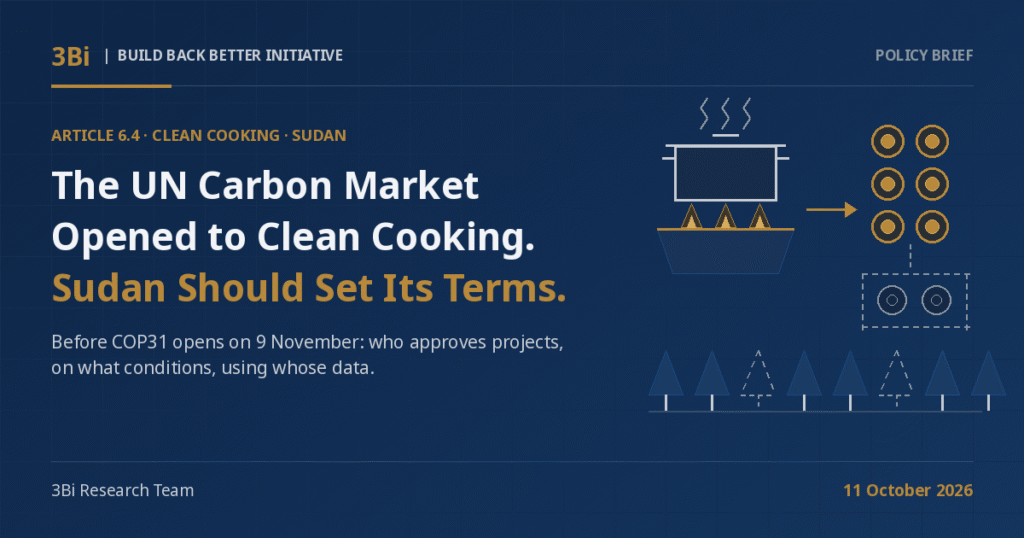
On 9 October the UN carbon market adopted its first clean cooking methodologies and a tool that discounts credits for reversal risk. Sudan should confirm who approves projects and publish its terms before COP31.
On 9 October 2026 the Article 6.4 Supervisory Body, meeting in Bonn, adopted the UN carbon market’s first two clean cooking methodologies and a tool for reversal risk. Sudan should set its terms before COP31. (Illustration: 3Bi)
3Bi Research Team | Policy Brief | 11 October 2026
The Ask
Before COP31 opens in Antalya on 9 November 2026, Sudan’s Higher Council for Environment and Natural Resources (HCENR), the country’s climate focal point, should confirm who approves carbon-credit projects under the Paris Agreement’s new UN carbon market and publish a short statement of the terms on which Sudan will accept clean cooking projects. On 9 October, the body that runs that market adopted its first two methodologies for household cooking, together with a tool that discounts credits for the risk that the forest they save is later lost. A two-page statement costs almost nothing to write. Without one, the first project developers will arrive with their own assumptions about Sudan’s forests and households, and Sudan will be negotiating from behind.
Why Now
On 9 October 2026, the Article 6.4 Supervisory Body, which oversees the Paris Agreement Crediting Mechanism (PACM), adopted two methodologies that let cleaner cooking projects earn UN-backed carbon credits. One covers more efficient wood and charcoal stoves; the other supports a broader shift to cleaner, lower-emission cooking. Alongside them, the body adopted the first version of a tool to assess “reversal risk” in activities that reduce the use of non-renewable biomass, and it said that countries may use country-specific values for natural risks where suitable data exist (UNFCCC, 9 October 2026). “This decision gives cleaner cooking projects a new pathway under the UN carbon market, with clear rules to ensure that each credit represents a real and credible emission reduction,” said the body’s chair, Mkhuthazi Steleki (UNFCCC, 9 October 2026). The decision also exempted some projects from a mechanism-wide safeguard (Carbon Pulse, 10 October 2026): the 1% annual tightening of the crediting baseline was waived, from the second year, for the efficient-stove methodology but not for the fuel-switching one (CarbonMeld, 10 October 2026).
The window to shape how these rules apply is short. At COP31, the Supervisory Body will present its annual report to Parties, who may clarify or expand its mandate and guide future work on methodologies and market rules (UNFCCC, 9 October 2026). The body’s next meeting is not expected until February 2027, and the cookstove debate was already expected to be argued over in Antalya (Argus Media, 18 September 2026; Fastmarkets, 5 October 2026). For a host country, the next four weeks are when its view can enter the guidance.
Sudan’s own clock is running too. Its 2021 NDC says Sudan “does not exclude” voluntary cooperation under Article 6 (Republic of the Sudan, updated first NDC, October 2021), and its next Nationally Determined Contribution (NDC 3.0) is listed as pending (African NDC Hub, accessed 11 October 2026). The Article 6 Implementation Partnership’s country page for Sudan lists no Article 6.4 designated national authority and states that there is “no publicly available information” on authorization or tracking arrangements (Article 6 Implementation Partnership, accessed 11 October 2026). That is the gap a short statement would close.
The Evidence
First, cooking is where Sudan’s climate plan and its households meet. In 2024, 47% of Sudanese had access to clean cooking fuels and technologies: 63% in towns and cities, 40% in rural areas (World Bank, World Development Indicators, updated 8 October 2026). That is above the sub-Saharan average of about 23%, and above Kenya (32%) and Ethiopia (7%), but far below Egypt’s 100% (World Bank, 8 October 2026). Sudan’s 2025 Forest Reference Level submission says biomass makes up more than 60% of the national energy balance, and that unsustainable extraction of fuelwood and charcoal causes 19.8% of deforestation and forest degradation (Forest National Corporation, Forest Reference Level submission to the UNFCCC, 2025). Sudan’s updated NDC already contains three cooking measures: improved cookstoves for more than 300,000 rural households under its REDD+ programme, liquefied petroleum gas (LPG) in place of biomass and charcoal for 10% of the urban population, and improved stoves for 20% of the rural population (Republic of the Sudan, updated first NDC, October 2021). By 3Bi’s addition of the NDC’s own table, these three measures add up to about 2.76 million tonnes of CO2-equivalent of reductions in 2030, at an estimated cost of about US$57 million. This is the kind of pipeline the new methodologies were written for.
Second, the new rules credit less, and the route a country chooses matters. The first credits ever issued under the PACM, approved in February 2026, came from a clean cooking project in Myanmar, and updated values and more conservative calculations cut the credited reductions by about 40% compared with what the older Clean Development Mechanism would have issued (UNFCCC, 26 February 2026). Before the October decision, the Supervisory Body’s Methodological Expert Panel published illustrative estimates: buffer contributions for reversal risk could reduce credits by about 6% for a charcoal-to-electricity project under a 10% reversal scenario, but by about 60% for a fuelwood-efficiency project under a 50% scenario (Argus Media, 18 September 2026). The panel also warned that PACM clean cooking projects would be more expensive, which could push activity toward other project types or toward clean cooking outside the PACM (Argus Media, 18 September 2026). These are scenarios, not final figures, and the efficient-stove methodology now carries the baseline exemption that fuel switching does not. The trade-off between the two routes is real, and Sudan should decide where it stands rather than let each developer decide project by project.
Third, the numbers that decide Sudan’s credits will be set on someone else’s data unless Sudan supplies its own. The reversal-risk tool applies default values at the same geographic level as the fraction of non-renewable biomass used to calculate credits. Draft national defaults for natural reversal risk, reported before the meeting, ranged from 7.4% in Kenya to 12.8% in Nigeria among Africa’s main cookstove markets, and below 4% in Somalia; the expert panel separately proposed a human-induced risk factor of 20% to 45% (Fastmarkets, 5 October 2026). For sub-Saharan Africa as a region, the panel had proposed a wildfire factor of 0.2% and 12.3% for all other natural risks (Argus Media, 18 September 2026). We could not open the adopted tool, so we do not know the final value for Sudan. What we do know is that Sudan has the beginnings of its own evidence. Its 2021 National Forest Inventory found signs of burning on only 3.63% of forest area, and the Forest National Corporation (FNC) itself notes that regular fire-monitoring data are not available and that its 1995 forest products demand survey, including household surveys, needs updating (Forest National Corporation, 2025). Those are exactly the data a country needs if it wants country-specific values rather than regional defaults.
Addressing the Counter-Case
The strongest objection is that the rules are now so strict that developers will avoid the UN mechanism, so Sudan would be preparing for a market that may never come. The expert panel’s own warning gives this weight (Argus Media, 18 September 2026), and we are not claiming that PACM will bring large volumes of finance to Sudanese kitchens soon. But PACM credits are the ones that can count toward another country’s national climate target. In the Myanmar case, credits authorized for use in the Republic of Korea can be transferred into Korea’s emissions trading system, while the remainder count toward Myanmar’s own NDC (UNFCCC, 26 February 2026). If Sudan wants any of that demand, it needs clear terms. And stating terms obliges Sudan to nothing; it simply means that credits from Sudanese households would rest on Sudan’s own data and Sudan’s own conditions.
A second objection is that households need affordable fuel now, not carbon accounting. That is true. Carbon finance does not replace fuel supply or stove programmes, and at best it tops them up. But the statement we ask for is cheap, and it can protect households directly. The PACM’s sustainable development tool already requires project proponents to identify positive and negative impacts and show how social and environmental risks are addressed (UNEP Copenhagen Climate Centre, Article 6 Pipeline, accessed 11 October 2026). Sudan can add its own minimum conditions on benefit-sharing and complaints.
A third objection is capacity. Here Sudan starts from a stronger base than many assume. HCENR has signed memoranda of understanding with 10 federal entities and 18 state-level institutions to support measurement, reporting and verification (Republic of the Sudan, updated first NDC, October 2021), and the FNC completed a Forest Reference Level submission in 2025. The ask builds on institutions that already exist.
What 3Bi Recommends, Specifically
First, by 9 November 2026, HCENR should confirm to the UNFCCC, or notify if this has not yet been done, Sudan’s designated national authority for the Article 6.4 mechanism, and say publicly which office signs project approvals.
Second, by the same date, HCENR, working with the Ministry of Energy and Oil and the FNC, should publish a short clean cooking statement. It should say which of the two new methodologies Sudan will consider; whether Sudan will authorize credits for international transfer or keep them as mitigation contribution units that count toward its own NDC; and what minimum benefit-sharing and grievance arrangements every project must meet. The same position should be written into Sudan’s NDC 3.0.
Third, at COP31, Sudan’s delegation should use the review of the Supervisory Body’s annual report to ask for readiness support so that least developed countries can produce country-specific values for non-renewable biomass and natural reversal risk.
Fourth, by April 2027, the FNC should update its forest products demand survey with new household fuel surveys and start regular fire monitoring, so that Sudan can apply for country-specific values instead of relying on defaults.
Fifth, 3Bi will track whether Sudan’s Article 6.4 authority and a clean cooking statement are published, and what COP31 decides on the Supervisory Body’s report, using UNFCCC records and Arabic- and English-language reporting. We will publish a follow-up by mid-December 2026.
Sourcing & Contact
Primary sources: UNFCCC, “Clean cooking projects gain access to UN carbon market”, 9 October 2026; UNFCCC, event page and meeting documents of the 23rd meeting of the Article 6.4 Supervisory Body (SBM 023), Bonn, 5–9 October 2026; Carbon Pulse, “UN carbon market opens door to clean cooking projects, grants downward adjustment exemption”, 10 October 2026; CarbonMeld, “Five PACM Methodologies, One Exemption: The UN Carbon Market Opens to Clean Cooking”, 10 October 2026; Fastmarkets, “UN Article 6 body faces pivotal cookstove decision as developers warn of steep credit cuts”, 5 October 2026; Argus Media, “UN carbon market sticks to clean cooking reversal rules”, 18 September 2026 (as republished by the World Ports Organization); UNFCCC, “UN carbon market approves first-ever issuance of credits under the Paris Agreement”, 26 February 2026; World Bank, World Development Indicators, access to clean fuels and technologies for cooking (EG.CFT.ACCS.ZS and urban/rural series), last updated 8 October 2026; Forest National Corporation, Republic of the Sudan, “Forest Reference Level Submission to the UNFCCC”, 2025; Republic of the Sudan, “First Nationally Determined Contribution under the Paris Agreement, Updated October 2021”; Article 6 Implementation Partnership, Sudan country page, accessed 11 October 2026; UNEP Copenhagen Climate Centre, Article 6 Pipeline, Sudan country page (last updated 4 September 2026), accessed 11 October 2026; African NDC Hub, Sudan country snapshot, accessed 11 October 2026. For methodology questions or to propose a correction, contact 3Bi’s Research Team via 3bisudan.org.
This piece was produced through 3Bi’s automated daily publications workflow, which monitors regional and international climate and energy reporting.
This publication is produced with support from 3Bi’s institutional donors; see the full funder list at 3bisudan.org.
About the Authors
Related Publications
The Paris Compliance Committee Named Three Silent Countries. Sudan Answered. Now It Owes a Date.
The Paris Agreement's compliance committee has named three countries that ignored its letters on missing climate plans. Sudan is not among them: it replied. Before COP31, 3Bi argues,…
The Kigali Amendment Turns 10 With 175 Parties. Sudan Should Ratify Before the Montreal Protocol Meets in Kigali.
Ten years after the Kigali Amendment was adopted, 175 of 198 Montreal Protocol parties have ratified it. Sudan has not. As parties meet in Kigali on 2–6 November,…
The Adaptation Fund Board Meets in Bonn With US$146.8 Million to Approve. Sudan Has No Project of Its Own.
The Adaptation Fund Board meets in Bonn from 19 to 23 October with US$146.8 million in approvals before it, including a US$30 million Mandera Triangle project. Sudan has…