
The Mediterranean Is Building a $792 Billion Power Grid. Sudan Is Plugged Into It at 70 Megawatts.
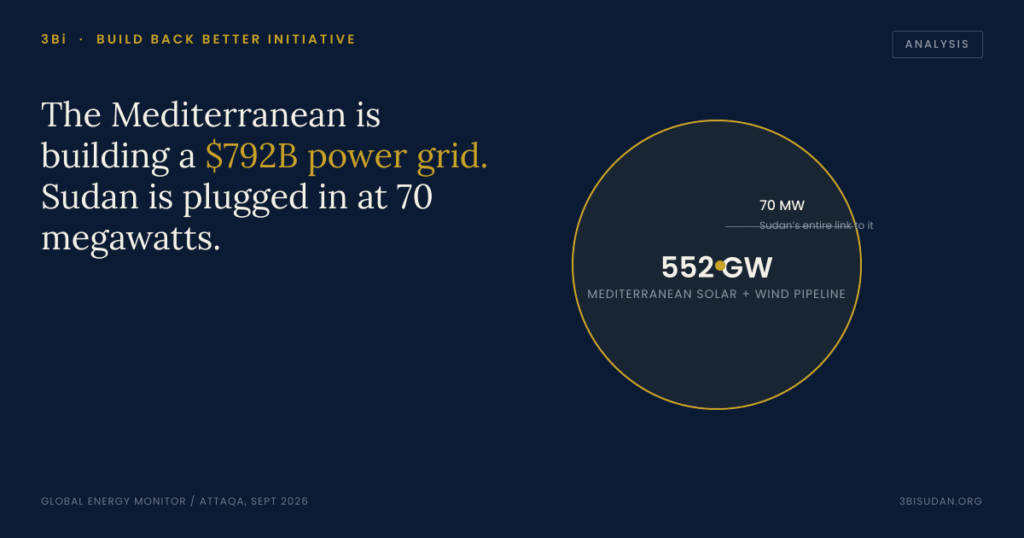
New data puts the Mediterranean's solar and wind pipeline at 552GW and $792 billion. Egypt leads North Africa's share. Sudan's only link to any of it: a 70MW grid connection nobody is currently financing to expand.
3Bi Research Team | 14 September 2026
The Hook
The Mediterranean basin’s solar and wind pipeline has reached a scale that puts it ahead of the United States’ entire planned generation fleet. New data from Global Energy Monitor, reported by regional energy outlet Attaqa on 13 September 2026, puts announced and in-development solar and wind capacity across the Mediterranean region at 552 gigawatts (GW) — 361.3 GW of it likely operating commercially by 2030 — carrying a combined price tag of roughly $792 billion. Egypt leads North Africa’s share of that pipeline with 94.6 GW in development. Egypt is also, since 2021, Sudan’s only direct electricity-grid connection to the outside world. That link carries 70 megawatts (MW) — roughly 0.07% of what Egypt alone has in its renewables pipeline, and a figure nobody in the current financing conversation is proposing to change.
The Argument
First, the Mediterranean’s renewable buildout is shifting its center of gravity toward exactly the region Sudan borders. Today, Europe holds 82.5% of the Mediterranean’s operating solar and wind capacity (251.6 GW combined: 100.9 GW wind, 150.7 GW solar). But the pipeline reverses that imbalance: of capacity expected online by 2030, Europe’s share falls to 51%, while North Africa and southwest Asia rise to 49%. Egypt is the clearest driver of that shift. It had 6.3 GW of installed wind and solar as of February 2026 — about 7% of its total power capacity — and now has 94.6 GW in development (46.7 GW solar, 47.9 GW wind), with roughly a quarter of that, 22.9 GW, expected to reach commercial operation before the decade ends. Cairo has earmarked 37.7 GW of that pipeline specifically for hydrogen production, on top of 5 GW of planned nuclear and 2.6 GW of gas capacity under construction. This is not a distant European trend 3Bi has covered before in the abstract; it is Sudan’s immediate northern neighbor building out a power system an order of magnitude larger than Sudan’s entire grid, a few hundred kilometers from Sudan’s own borders.
Second, the interconnection infrastructure to move any of that power into Sudan already exists — it is simply too small to matter. The Egypt–Sudan electricity grid, commissioned as the first stage of the African Union’s continental electrical-interconnection programme (PIDA), has been operational since 2021, carrying up to 70 MW from Egypt into Sudan. Consultations to expand that capacity have been referenced periodically since, with no public financing commitment or timeline attached as of this writing. Seventy megawatts is a rounding error against Egypt’s 94.6 GW pipeline — it is roughly what a single mid-sized solar farm produces, not a serious cross-border energy relationship. The physical precedent for scaling this link is not the obstacle; the absence of a financing and negotiating track that treats Sudan as part of the Mediterranean-to-Nile interconnection story is.
Third, the region’s own financing numbers show where Sudan currently doesn’t fit. Global Energy Monitor’s cost breakdown allocates roughly $300 billion in financing needs to the Eastern Mediterranean through 2030, and around $89 billion to North Africa through 2050 for renewable-energy goals. Egypt’s financing conversations — grid modernization funded internationally, new interconnections with Turkey, Jordan, Cyprus, Greece, and Libya — are explicitly named in the reporting 3Bi reviewed. Sudan is not named in any of it, despite already holding a physical, operational connection to the Egyptian grid. The gap is not technical; it is that Sudan has not been brought into the region’s interconnection planning and financing conversations as a party with something to gain from the buildout next door.
Why It Matters to the Reader
For Sudanese energy planners and the donors who fund them, the Mediterranean pipeline is not a foreign story — it is a description of the exact infrastructure sitting on Sudan’s northern border, being built at a scale and pace Sudan cannot replicate domestically in the near term but could, in principle, draw on through the interconnection that already physically exists. COP31 in Antalya this November is explicitly framed by the region’s own energy analysts as a test of whether Mediterranean states can convert renewable potential into operating capacity — the same test Sudan faces domestically, except Sudan’s version of that test currently has no seat at the regional table where financing for interconnection is being discussed. A donor or multilateral considering how to support Sudan’s power sector should treat expanding the 70 MW Egypt link — not just building new domestic solar — as a live, comparatively low-cost option sitting next to a $792 billion regional buildout that has already solved the harder parts of the financing and construction problem for capacity Sudan could import rather than build alone.
Close
Sudan does not need to wait for its own 94.6 gigawatts. It needs a seat in the conversation about the 70 megawatts already connecting it to a neighbor building that much every few days.
This publication was produced through 3Bi’s automated daily publications workflow, which monitors regional and international climate and energy reporting.
This publication is produced with support from 3Bi’s institutional donors; see the full funder list at 3bisudan.org.
About the Authors
Related Publications
Turkey’s COP31 Electrification Push Is Sudan’s Opening. Khartoum Should Table a Pledge Before Antalya, Not After.
Turkey's COP31 electrification coalition rewards early, credible pledges with finance access. Sudan should draft and table one before Antalya, not after.
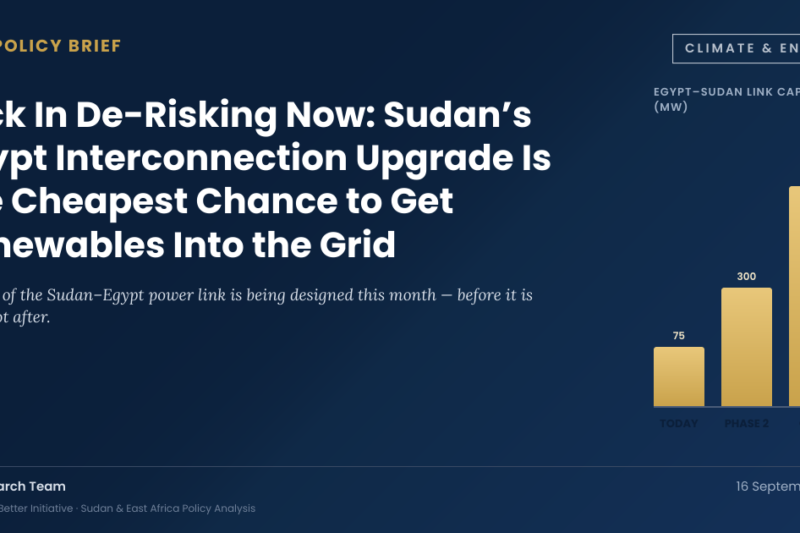
Lock In De-Risking Now: Sudan’s Egypt Interconnection Upgrade Is the Cheapest Chance to Get Renewables Into the Grid
Sudan's Egypt interconnection is being redesigned this month. 3Bi recommends locking in a renewable-generation share and a currency-risk guarantee now, before Phase 2 is built on last decade's…
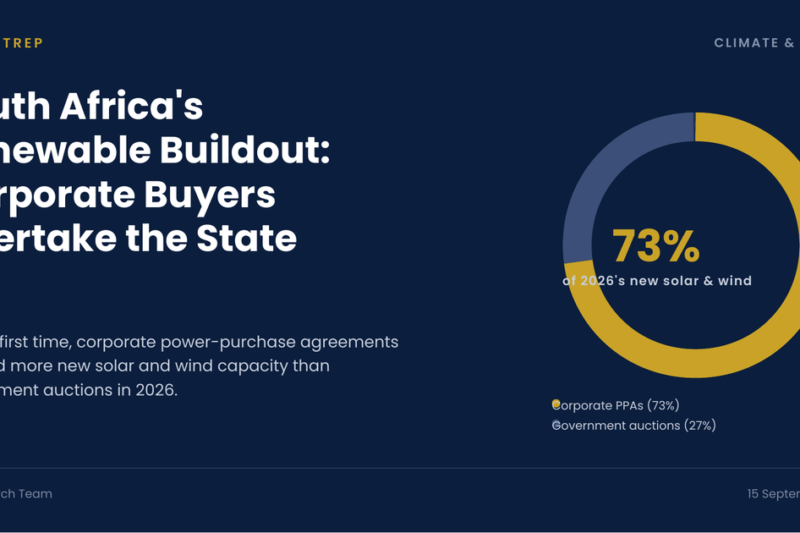
SITREP: South Africa’s Renewable Buildout — Corporate Buyers Overtake the State
For the first time, corporate power-purchase agreements will fund more of South Africa's new solar and wind capacity than government auctions in 2026 — even as national renewable…