
Turkey’s COP31 Electrification Push Is Sudan’s Opening. Khartoum Should Table a Pledge Before Antalya, Not After.
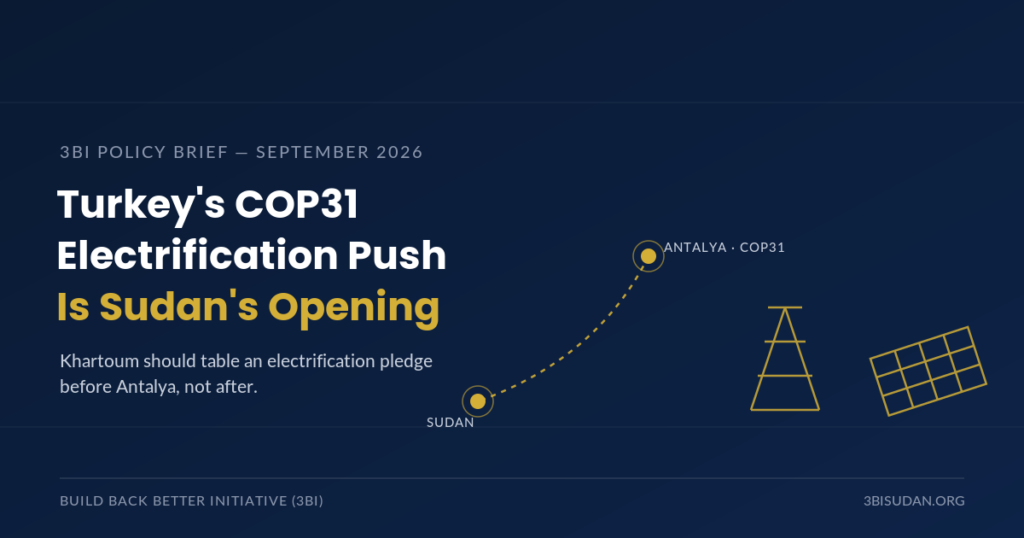
Turkey's COP31 electrification coalition rewards early, credible pledges with finance access. Sudan should draft and table one before Antalya, not after.
3Bi Research Team
The Ask
Sudan’s Higher Council for Environment and Natural Resources (HCENR), working with the Ministry of Energy and Mining, should draft and table a short, dated national electrification pledge — grid rehabilitation plus off-grid renewables targets — before COP31 opens in Antalya on 9 November 2026, explicitly framed as Sudan’s contribution to the summit presidency’s flagship “35% by 2035” electrification initiative. Without a pledge on the table, Sudan will again watch a global finance conversation about electrification happen around it, in a country that needs it more than almost anyone attending.
Why Now
Turkey, as COP31 host, has spent 2026 building a voluntary coalition around a single, concrete target: raising electricity’s share of global final energy demand from roughly 20% today to 35% by 2035. Ankara first floated the proposal at the Bonn intersessional climate talks in June 2026, and has spent the months since building support among governments, cities, and companies ahead of hosting the summit in Antalya from 9 to 20 November (attaqa.net, 14 September 2026; UNFCCC, “The Road to Antalya”). Because it is voluntary rather than a formal UN negotiating text, participation is open to any government prepared to state a target and a plan — a far lower bar than the near-200-party consensus a binding COP decision requires.
That structure is Sudan’s opening. A voluntary coalition built around electrification access rewards early, credible entrants with visibility and — because the initiative explicitly frames finance and technology transfer for developing economies as central to its credibility, according to the same reporting — a plausible channel toward concessional support that a country in Sudan’s fiscal position cannot otherwise easily access. Sudan has roughly seven weeks between the date of this brief and the summit’s opening to draft a pledge; a country that shows up in Antalya without one has ceded a positioning opportunity that will not recur before the next COP cycle.
The Evidence
Sudan’s starting point makes the case for participation, not against it. Access to electricity stood at 66% of the population as of the most recent World Bank data (2023–24) — well below the global average of about 88% — and the gap is concentrated exactly where Turkey’s initiative says finance should flow: rural and conflict-affected areas with no grid connection at all (World Bank, “Access to electricity,” 2024 update). Sub-Saharan Africa as a region accounts for roughly eight in ten people worldwide who lack electricity access, with rural access nationally averaging around 31% against 80% in urban areas — Sudan sits inside a regional crisis, not an isolated one (World Bank regional data, 2023).
Sudan’s generation mix compounds the case. Most of the country’s electricity comes from hydropower, concentrated on the Blue Nile system, making supply directly exposed to the rainfall variability climate change is intensifying across the basin — a vulnerability an electrification pledge can name explicitly as a reason Sudan needs diversified, distributed renewable capacity, not just more of the same hydropower it already depends on. Sudan also holds a disproportionate share of East Africa’s oil-based generation capacity, which a renewables-and-grid pledge would begin to displace rather than lock in further.
The Turkish proposal’s own logic reinforces why a Sudan-specific pledge would carry weight in Antalya. The initiative’s authors argue explicitly that electrification without decarbonising the underlying generation mix simply moves emissions from the point of use to the power plant — meaning a credible pledge cannot be electrification targets alone; it has to pair grid expansion with renewable generation. Turkey’s own domestic plan — 120 gigawatts of wind and solar capacity by 2035 — is the model of that pairing at a scale Sudan cannot replicate, but the same pairing logic scales down: a Sudanese pledge tying rural mini-grid and off-grid solar expansion to a stated generation-mix shift would meet the initiative’s own credibility test, on Sudan’s terms and at Sudan’s scale.
Addressing the Counter-Case
The obvious objection is that a government managing active conflict, a fractured state apparatus, and contested legitimacy has no realistic capacity to deliver on a formal electrification target, and that tabling one it cannot meet risks looking performative rather than credible. This is a fair concern, and it is answered by scope, not by silence. A voluntary coalition pledge is not a binding NDC commitment enforced through UN compliance mechanisms; Sudan has continued to engage UN climate processes even through the conflict, including prior NDC-related submissions, without those submissions being read as guarantees of full-state delivery capacity. The pledge this brief recommends should be explicit about what it is: a statement of electrification need and an off-grid, donor-partnered delivery pathway for the areas where Sudanese and international humanitarian and development actors are already operating mini-grid and solar programmes, not a claim that Khartoum will rehabilitate the national grid unassisted. Scoped that way, the pledge is more credible, not less, because it matches ambition to actually deployable capacity.
A second objection is that Sudan’s diplomatic bandwidth ahead of COP31 is better spent on core conflict-resolution and humanitarian-access diplomacy than on a voluntary climate-finance initiative. That is true as a matter of priority ranking, but it understates how little this specific action costs: drafting a short pledge document is a task for HCENR technical staff and does not require senior political capital or a large delegation, and it can piggyback on Sudan’s existing UNFCCC national-focal-point channel rather than requiring a new diplomatic track.
What 3Bi Recommends, Specifically
First, HCENR should draft a two-to-three-page electrification pledge within four weeks of this brief, built around three elements: a stated ambition to raise off-grid and mini-grid renewable electricity access in underserved and conflict-affected states; an explicit link to the Blue Nile hydropower system’s climate exposure as the rationale for diversification; and an explicit ask for concessional finance and technology transfer channelled through the humanitarian-development actors already active in Sudan’s energy-access space, rather than through state utilities alone.
Second, Sudan should coordinate this pledge with the African Union’s and UN Economic Commission for Africa’s climate-finance tracks ahead of Antalya, positioning it as a model for how the Turkish initiative’s finance promise should work for conflict-affected, low-capacity states specifically — a framing that serves Sudan’s own case and gives other fragile African states a template to follow.
Third, Sudan’s delegation to COP31, however small, should use the pledge as the basis for at least one side-event engagement or bilateral request specifically targeting the initiative’s stated finance and technology-transfer mechanisms, rather than attending Antalya purely as an observer to the main negotiating track.
Fourth, any public version of the pledge — including this brief’s own coverage of it — should state plainly that it addresses electrification access and off-grid delivery, not a claim of national grid rehabilitation capacity, to avoid the credibility risk raised in the counter-case above.
Sourcing & Contact
Primary source: “الكهربة في تركيا.. مقترح طوعي يدعم استضافة قمة المناخ كوب 31” (“Electrification in Turkey: a voluntary proposal supporting its COP31 hosting”), by Dr. Omud Shukri, attaqa.net, 14 September 2026. Cross-checked against UNFCCC, “The Road to Antalya” and COP31 participant guidance confirming a 9–20 November 2026 Antalya summit; World Bank, “Access to electricity (% of population) — Sudan,” 2024 update; World Bank regional electricity-access data for Sub-Saharan Africa, 2023. For questions on this brief, contact 3Bi’s Research Team via 3bisudan.org.
This publication was produced through 3Bi’s automated daily publications workflow, which monitors regional and international climate and energy reporting.
This publication is produced with support from 3Bi’s institutional donors; see the full funder list at 3bisudan.org.
About the Authors
Related Publications
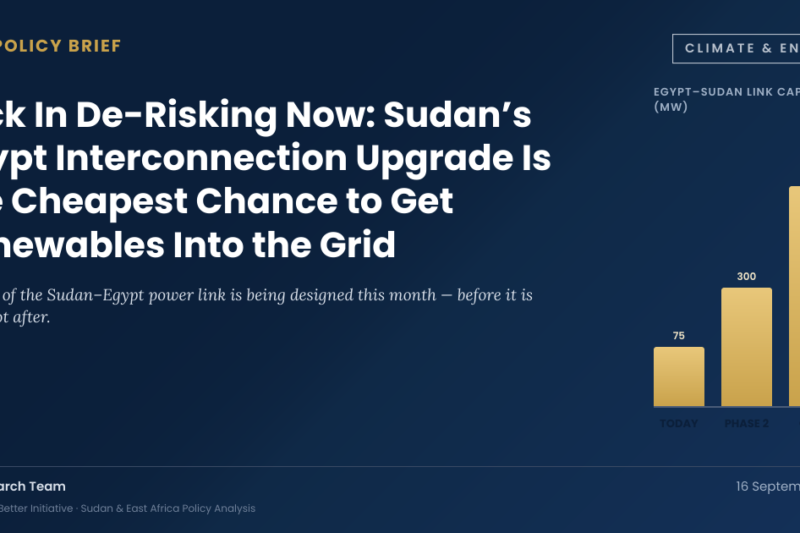
Lock In De-Risking Now: Sudan’s Egypt Interconnection Upgrade Is the Cheapest Chance to Get Renewables Into the Grid
Sudan's Egypt interconnection is being redesigned this month. 3Bi recommends locking in a renewable-generation share and a currency-risk guarantee now, before Phase 2 is built on last decade's…
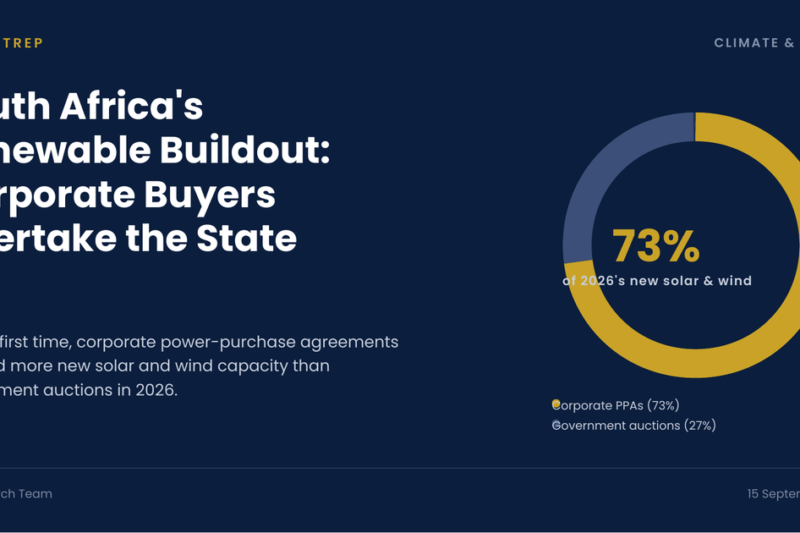
SITREP: South Africa’s Renewable Buildout — Corporate Buyers Overtake the State
For the first time, corporate power-purchase agreements will fund more of South Africa's new solar and wind capacity than government auctions in 2026 — even as national renewable…
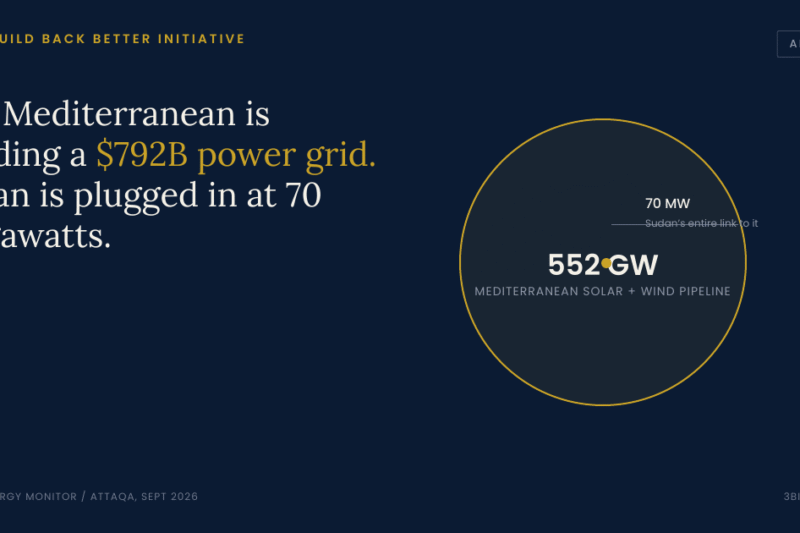
The Mediterranean Is Building a $792 Billion Power Grid. Sudan Is Plugged Into It at 70 Megawatts.
New data puts the Mediterranean's solar and wind pipeline at 552GW and $792 billion. Egypt leads North Africa's share. Sudan's only link to any of it: a 70MW…