
Lock In De-Risking Now: Sudan’s Egypt Interconnection Upgrade Is the Cheapest Chance to Get Renewables Into the Grid
Phase 2 of the Sudan-Egypt power link is being designed this month — before it is built, not after.
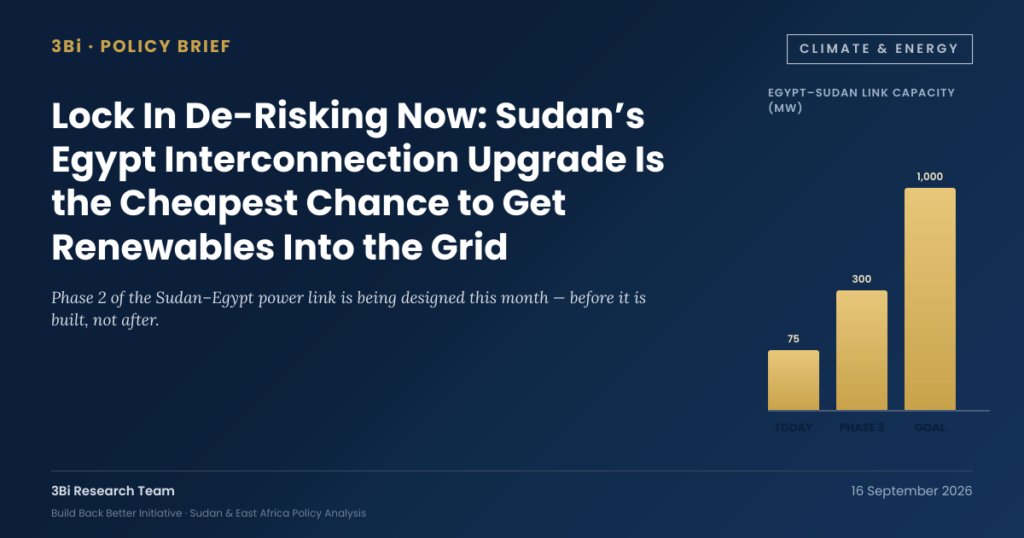
Sudan's Egypt interconnection is being redesigned this month. 3Bi recommends locking in a renewable-generation share and a currency-risk guarantee now, before Phase 2 is built on last decade's fossil-import terms.
3Bi Research Team | 16 September 2026 | Climate & Energy Policy Desk
The Ask
Sudan’s Ministry of Energy and Petroleum and the multilateral financiers already funding the Egypt–Sudan interconnection upgrade should attach a binding renewable-generation share and a currency-risk guarantee to the project’s Phase 2 design — now, while it is still being negotiated, not after it is built. Every week that passes without those terms locked in makes it more likely Sudan’s newest cross-border power link comes online as pure thermal-import infrastructure, repeating a mistake the rest of Africa is currently paying to unwind.
Why Now
On 14 September 2026, Sudan’s Ministry of Energy and Petroleum announced that interconnection capacity with Egypt had risen to 75 megawatts (MW), and that both governments had agreed to accelerate a second phase that would lift capacity to 300MW, with a longer-term goal of 1,000MW (Middle East Monitor, 14 September 2026). A new double-circuit transmission line between Toshka 2 in Egypt and Wadi Halfa in Sudan is already under construction, and officials say they discussed — but have not yet formalized — cooperation on solar and wind projects to diversify Sudan’s generation mix.
This is the decision window. Phase 2’s technical scope is being drawn up now, not five years from now. The Multilateral Cooperation Center for Development Finance (MCDF) has already committed $2.7 million toward project-preparation studies for the wider corridor (WebSearch findings, September 2026), meaning the financing conversation — where conditions are cheapest to attach — is already open. Once Phase 2’s engineering specifications are finalized, retrofitting a renewables mandate becomes a redesign, not a design choice.
The regional cost backdrop makes the timing sharper still. A new industry report cited by attaqa.net’s Energy Research Unit (15 September 2026, sourced to Mordor Intelligence) finds utility-scale solar tariffs in Egypt and Morocco fell below $0.03 per kilowatt-hour in 2025 — more than 40% cheaper than new coal or gas generation — while panel prices hit $0.12 per watt in early 2026 amid a global polysilicon glut. That pricing window will not stay open indefinitely: the same report projects Africa’s solar-plus-wind capacity will overtake hydropower continent-wide by 2029, as manufacturing capacity and financing structures lock in around whichever countries move first.
The Evidence
Sudan’s solar base is negligible next to regional peers moving right now. Sudan has built only about 10MW of solar PV capacity, of which just 5MW is grid-connected — against the government’s own target of 2,190MW of grid-connected solar plus 50MW of solar thermal by 2035 (UNDP Sudan, Solar Energy Value Chain Study, March 2026). By contrast, Algeria alone commissioned 400MW across its two largest solar plants this year as the first phase of a 3,200MW national program, and is projected to post the fastest renewable-capacity growth rate in Africa — 42.51% annually through 2031 — on the back of a 1-gigawatt solar tender and green-hydrogen export plans (Mordor Intelligence, via attaqa.net, 15 September 2026). Continent-wide, renewable capacity is projected to rise from 77.91 gigawatts (GW) in 2025 to 179.66GW by 2031, a compound annual growth rate of 15.62%. Sudan is not named once in that report’s country-by-country breakdown of South Africa, Algeria, Egypt, Morocco, Nigeria, Kenya, and Ethiopia — a conspicuous absence for a country currently negotiating new cross-border generation infrastructure.
The financing risks the rest of the region is fighting over right now will hit Sudan harder, not softer. Mordor Intelligence’s analysis flags currency risk as one of two binding constraints on Africa’s renewable buildout (alongside weak grid absorption capacity). In Nigeria, $2.5 billion in investor dividends have been withheld because of foreign-currency rationing for fuel imports. Zambia’s currency fell 40% between 2024 and 2025, eroding tariff revenue on newly built solar projects and pushing investors toward compensation claims. Ethiopia has capped foreign-currency repatriation at 50% of quarterly profits, forcing developers to reinvest locally or accept discounted exchange rates. Sudan’s currency crisis is more acute than any of these three cases, and its electricity grid has already absorbed up to $3 billion in war damage since 2023, with roughly 40% of the transmission and generation system affected (UNDP; Actum Sudan reporting, 2026). Global panel prices have fallen sharply, but local currency depreciation means Sudanese developers’ effective costs have quadrupled — exactly the kind of currency exposure that a hard-currency-denominated tariff structure, built into financing terms from the outset, is designed to absorb (UNDP Sudan, Solar Energy Value Chain Study, March 2026).
The interconnection expansion is a financing moment that is already moving — attaching conditions now is nearly free; retrofitting later is not. Two solar projects are already reported in planning alongside the interconnection corridor — a 50MW plant in Red Sea State and a 20MW plant in Northern State, alongside a 10MW plant in River Nile State (cross-referenced reporting, September 2026) — but none of this is yet locked into Phase 2’s binding technical scope. South Africa offers the cautionary counterfactual: its grid can now absorb only 2GW per year of intermittent renewable generation without voltage problems, forcing costly retrofits of battery storage and curtailment protocols that could have been designed in from the start of its seven-round auction program. Sudan has the rare advantage of building its interconnection upgrade and its renewable-generation capacity at the same time, on the same negotiating table — an advantage South Africa, Nigeria, and Zambia did not have.
Addressing the Counter-Case
The strongest objection is that Sudan’s active conflict and displacement crisis make structural energy-sector conditionality premature — that the priority must be emergency restoration of existing capacity, however generated, not new requirements layered onto an already fragile negotiation. This is a fair concern, and 3Bi does not dispute the urgency of stabilizing supply for hospitals, water pumping, and displaced communities in the near term.
But the choice on the table is not “renewables versus stabilization.” The Phase 2 interconnection upgrade and the Toshka 2–Wadi Halfa transmission line are proceeding regardless, under a bilateral agreement already announced. The only open question is whether that infrastructure is designed, from day one, to carry a renewable-generation share and a currency-risk buffer, or whether it is built as pure thermal-import capacity and retrofitted later at greater cost — the path South Africa is now paying to reverse. Attaching conditions to financing and technical-assistance packages that are already being negotiated does not require new money or a new political process; it requires the donors and technical partners already at the table to ask a different question during design meetings that are happening this month regardless.
What 3Bi Recommends, Specifically
First, Sudan’s Ministry of Energy and Petroleum and its Egyptian counterparts should publish the Phase 2 (300MW) technical scope with an explicit renewable-hybridization floor, anchored to the solar capacity already reported in planning — the Red Sea State, Northern State, and River Nile State projects — treated as a minimum commitment rather than an aspiration.
Second, the MCDF and any additional project-preparation funders should condition further phase funding on a currency-risk mitigation mechanism — a hard-currency-denominated tariff guarantee, modeled on lessons from Zambia’s and Ethiopia’s tariff-revenue erosion — rather than leaving Sudanese developers exposed to the currency risk that has already quadrupled their local costs.
Third, donor coordination bodies active in Sudan’s energy-sector recovery should fast-track technical assistance for grid-absorption and battery-storage planning now, during Phase 2’s design phase, rather than after capacity is built — learning directly from South Africa’s current 2GW/year absorption ceiling rather than repeating it.
Fourth, 3Bi will publish a follow-up technical note once Phase 2’s terms are made public, assessing whether a renewable-hybridization floor and currency-risk mechanism were in fact included.
Sourcing & Contact
Sources: Middle East Monitor, “Sudan says electricity interconnection capacity with Egypt increased to 75 MW,” 14 September 2026; attaqa.net Energy Research Unit (Mai Magdy), “الطاقة المتجددة في أفريقيا قد تتضاعف بحلول 2031.. والجزائر الأسرع نموًا,” citing Mordor Intelligence, 15 September 2026; UNDP Sudan, Solar Energy Value Chain Study, March 2026; Actum Sudan reporting on Sudan’s electricity shortfall, 2026. Methodology note: capacity and cost figures are as reported by the cited sources at time of publication and have not been independently re-verified by 3Bi beyond cross-referencing across the sources listed. For follow-up, contact 3Bi’s Research Team via 3bisudan.org.
This publication was produced through 3Bi’s automated daily publications workflow, which monitors regional and international climate and energy reporting.
This publication is produced with support from 3Bi’s institutional donors; see the full funder list at 3bisudan.org.
About the Authors
Related Publications
Turkey’s COP31 Electrification Push Is Sudan’s Opening. Khartoum Should Table a Pledge Before Antalya, Not After.
Turkey's COP31 electrification coalition rewards early, credible pledges with finance access. Sudan should draft and table one before Antalya, not after.
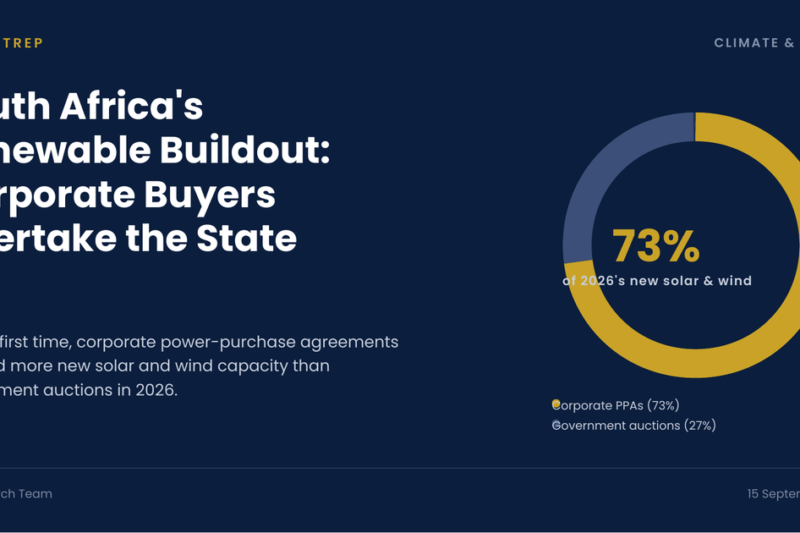
SITREP: South Africa’s Renewable Buildout — Corporate Buyers Overtake the State
For the first time, corporate power-purchase agreements will fund more of South Africa's new solar and wind capacity than government auctions in 2026 — even as national renewable…
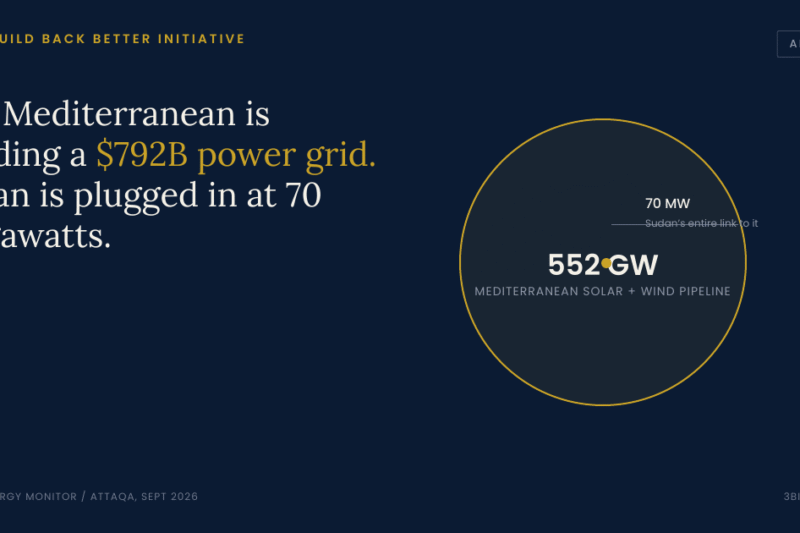
The Mediterranean Is Building a $792 Billion Power Grid. Sudan Is Plugged Into It at 70 Megawatts.
New data puts the Mediterranean's solar and wind pipeline at 552GW and $792 billion. Egypt leads North Africa's share. Sudan's only link to any of it: a 70MW…