COP31’s First Draft Asks Climate Funds to Publish How Long Their Money Takes. Sudan Asked for Faster Access. It Should Defend Those Lines.
3Bi Research Team | Analytical Article | 17 November 2026
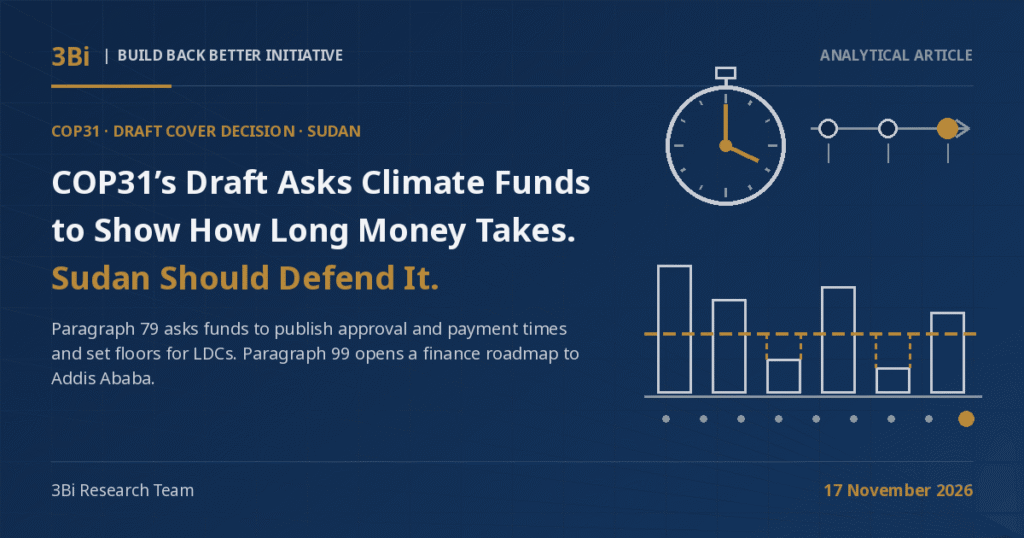
COP31’s first draft cover decision asks climate funds to publish how long their money takes and to reserve a floor for the poorest countries. Sudan asked Antalya for faster, simpler access. It should defend those lines and take its own record to Addis Ababa.
On 16 November 2026, at COP31 in Antalya, the COP31 Presidency published its first draft cover decision. Paragraph 79 asks climate funds to publish the time from submission to approval and from approval to first disbursement, and to set minimum allocation floors for least developed countries; paragraph 99 launches an Antalya-to-Addis Ababa roadmap on adaptation and resilience finance. (Illustration: 3Bi)
3Bi Research Team | Analytical Article | 17 November 2026
The Hook
On Monday afternoon, the COP31 Presidency in Antalya published the first draft of its proposed “cover decision”, the political text that would sum up the conference. It runs to 144 paragraphs over 18 pages (Carbon Brief, 16 November 2026; Anadolu Agency, 16 November 2026). Most of the coverage went to one number. The draft “decides” that tripling adaptation finance should mean at least US$120 billion a year by 2035, measured against a baseline built on Oxfam’s method for counting only the grant value of climate finance (UNFCCC, COP31 Presidency draft cover decision, unedited version 16 November 2026, paragraphs 73–74).
The paragraphs that matter most for Sudan are a few pages further on, and they are about plumbing. Paragraph 79 urges developed countries, the Green Climate Fund, the Global Environment Facility, the Adaptation Fund and the loss and damage fund to “operationalize simplified, harmonized and expedited approval and disbursement procedures, and publish the time taken from submission to approval and from approval to first disbursement”. In the same paragraph it asks them to “establish dedicated minimum allocation floors for small island developing States and least developed countries”, to offer readiness support “that extends beyond the preparation of strategies and pipelines to support implementation”, to cut co-financing requirements, and to deliver support mainly through grants (draft cover decision, paragraph 79). Paragraph 99 then launches an “Antalya-to-Addis Ababa Roadmap on Adaptation and Resilience Finance”, a year of work led by the COP31 and COP32 Presidencies to find “predictable and scaled-up public sources of finance for adaptation and loss and damage” and “mechanisms for access”. It would report to COP32 (draft cover decision, paragraph 99).
Five days earlier, Sudan’s national statement to the COP31 leaders’ summit asked that climate finance be “translated into resources that developing countries can access fairly, swiftly, easily and predictably, alongside capacity-building for national institutions” (SUNA, 11 November 2026). The draft now contains a working version of that request. Our argument is that Sudan should spend its effort this week defending those access lines, not only the headline number, and then carry its own evidence down the road to Addis Ababa.
The Argument
First, the headline number is the most fought-over part of the text. The access lines are cheaper to agree, and they decide whether any number reaches a country like Sudan. The Presidency’s own note says the draft “is not intended to reflect consensus” and that every element, including whether it stays in at all, is still open (Daily Nation, 17 November 2026; Carbon Brief, 16 November 2026). The US$120 billion figure is already contested. An African delegation source told Anadolu that developed countries had not agreed to it and that a lower figure of US$100 billion was also under discussion (Anadolu Agency, 16 November 2026). Amos Wemanya of PowerShift Africa pointed out that last year’s tripling pledge, also placed in a cover decision, “gave us no clarity on what is being tripled, whether it is grants or loans, or who is paying” (Daily Nation, 17 November 2026).
Access is a different kind of ask. It does not require a single donor to write a larger cheque. It asks funds to report how long they take and to protect a share for the poorest countries. That is exactly what the Least Developed Countries (LDC) Group came to Antalya for. Its opening statement said “simpler, faster access” is central to its position and that “the practical test is whether finance can be secured and used in time” (LDC Group, press release, 9 November 2026). The group’s chair, Ambassador Adão Soares Barbosa of Timor-Leste, said that “the process for accessing finance is extremely complicated, and simplifying it at COP31 is essential” (Dhaka Tribune, 12 November 2026). Sudan is one of the 44 countries in that group.
Second, Sudan’s own record shows why the time to first disbursement matters, and the data to measure it already exists. Sudan has three projects with the Green Climate Fund (GCF), worth US$44.8 million in total, plus US$3.3 million in approved readiness support (GCF, Sudan country page, accessed 17 November 2026). All three are run by UN agencies: UNDP, FAO and, for a multi-country programme, IFAD.
The two Sudan-only projects show how much the clock can vary. The UNDP project on resilience in rain-fed farming and pastoral systems (FP139) was approved on 21 August 2020 and received its first payment on 9 December 2020, 110 days later. A second payment came on 21 November 2024. Together they amount to 44% of its US$25.6 million GCF grant, and the project is due to close on 21 September 2027 (GCF, FP139 project page, accessed 17 November 2026). The FAO gum arabic project (SAP019) went through the Fund’s simplified approval process. It was approved on 13 November 2020, its funding agreement took effect on 25 November 2021, and its only payment so far, US$1.97 million, arrived on 15 December 2021, 397 days after approval. That is 20% of a US$9.98 million grant, six years after approval, with completion set for 25 November 2028 (GCF, SAP019 project page, accessed 17 November 2026).
We are not claiming these gaps are the Fund’s fault. Payments are usually released in stages as projects report progress, and the project pages do not explain the gaps. That is the point of paragraph 79. The GCF already publishes these dates on its project pages, which is how we could count them. The draft would make the practice standard across funds and multilateral banks and ask them to report it, with separate reporting on measures for LDCs and small island states (draft cover decision, paragraph 80). When we wrote about Pre-COP31’s finance-access plan in October, we argued that the plan’s first annual forum should track African cases by name: approval times, disbursement rates and the share of grants (3Bi, 10 October 2026). The draft is now close to that idea.
Third, the road to Addis Ababa is where the fight over money will continue, and Sudan lives next door to the host. Paragraph 99 leaves the hard question of where adaptation and loss and damage finance will come from to a roadmap that reports to COP32. Ethiopia hosts COP32 in Addis Ababa from 8 to 19 November 2027 (UNFCCC, COP30 decision on dates and venues of future sessions). The African Union Commission told African environment ministers on Sunday that “Antalya is a strategic bridge to Addis Ababa”, and pledged support for “an implementation-driven African COP32” (African Union Commission, statement to AMCEN meeting, Antalya, 15 November 2026).
The same draft shows what is at stake in that year. It expresses “deep concern on the decline in annual contributions” to the Least Developed Countries Fund and the Global Environment Facility (draft cover decision, paragraph 34). It calls on developed countries to announce pledges to the loss and damage fund, the Least Developed Countries Fund and the Adaptation Fund “by the end of 2027” (paragraph 83). And it asks the UN climate secretariat to run annual workshops on access to climate finance from 2027 to 2030 (paragraph 78). In other words, the next replenishments, the access debate and the COP32 roadmap all land in the same twelve months, in Sudan’s neighbourhood.
Why It Matters to the Reader
The strongest objection comes from inside the African camp. The delegation source who spoke to Anadolu called the cover decision a “distraction” and a “parking lot” for unresolved issues, and argued that finance commitments belong in negotiated agenda items where countries can be held to account (Anadolu Agency, 16 November 2026). Sudan has said it supports the common positions of the African Group, the Arab Group, the Group of 77 and China, and the LDCs (SUNA, 11 November 2026). Why put effort into a political text that the African Group’s own negotiators distrust?
That is a fair concern, and 3Bi is not suggesting that Sudan trade the negotiated finance tracks for cover-decision language. Our point is narrower. Access rules do not compete with the money fight. They decide how much of whatever is agreed actually arrives. Nana Amoah, who chairs the African Group of Negotiators, said most of the finance work is still to come this week (Daily Nation, 17 November 2026). Chris Bowen, the COP31 president of negotiations, said there would be “at least” one more draft, and Carbon Brief understands the next one is due mid-week (Carbon Brief, 16 November 2026). Paragraphs that nobody defends tend to be the first ones cut. We are not predicting that paragraphs 79, 80 or 99 will survive.
If you work at the Higher Council for Environment and Natural Resources (HCENR), Sudan’s focal point for the UN climate convention, at the Ministry of Finance and Economic Planning, or on Sudan’s negotiating team in Antalya, three steps follow.
First, before COP31 closes on 20 November, work through the LDC Group and the African Group to keep three things in the next draft: published approval and disbursement times, minimum allocation floors for LDCs, and the Antalya-to-Addis Ababa roadmap with a clear role for countries, not only the two Presidencies. This costs nothing and matches what Sudan asked for at the leaders’ summit.
Second, by the end of March 2027, publish a one-page access record for Sudan’s climate fund projects, built only from public data. For each project, list the approval date, the date the agreement took effect, every payment and the share paid out. The GCF pages make this a few hours’ work. Share it with the implementing agencies first, so that the reasons for each delay are recorded alongside the dates.
Third, ask the COP31 and COP32 Presidencies how countries can feed into the roadmap, and offer Sudan’s access record as an LDC case study. As Ethiopia’s neighbour and an LDC, Sudan is well placed to show what access looks like from a country whose three GCF projects all run through UN agencies.
Close
The US$120 billion line will get the headlines this week, and it should be fought for. But a promise of more money means little to a country whose existing grants arrive in stages over several years. The draft’s quieter paragraphs ask funds to publish how long they take, to protect a share for the poorest countries, and to spend the next year working out, on the way to Addis Ababa, where adaptation money will come from. Sudan asked for finance it can reach “swiftly, easily and predictably”. These are the lines that would start to deliver that. We will report on which of them survive the next draft and the final text.
Sourcing & Contact
Primary sources: UNFCCC, “Draft text prepared under COP 31 Presidency consultations on Presidency-led Party-driven cover decision”, unedited version 16 November 2026 (paragraphs 34, 73–74, 77–80, 83 and 99); Carbon Brief, “First draft cover decision lands at COP31”, CB Connect, 16 November 2026; Anadolu Agency, “COP31 draft decision calls for tripling adaptation finance to $120B, speeding shift away from fossil fuels”, 16 November 2026; Anadolu Agency, “African countries say 1st draft from COP31 conference risks ‘distraction’ from climate finance accountability”, 16 November 2026; Daily Nation, “Ministers take over COP31 talks as Presidency releases first cover decision draft”, 17 November 2026; LDC Group on Climate Change, “Least Developed Countries call for COP31 to deliver for the world’s most climate-vulnerable countries”, press release, 9 November 2026; Dhaka Tribune, “LDC Chair: Accessible, grant-based, predictable climate finance must be ensured”, 12 November 2026; African Union Commission, statement to the AMCEN meeting on the margins of COP31, Antalya, 15 November 2026; SUNA (via Fana News), report of Sudan’s national statement to the COP31 leaders’ summit, 11 November 2026; Green Climate Fund, Sudan country page and project pages for FP139 and SAP019 (accessed 17 November 2026); UNFCCC, COP30 decision on dates and venues of future sessions (COP32, Addis Ababa, 8–19 November 2027); 3Bi, “Pre-COP31 Wrote a Plan to Unblock Climate Finance for the Poorest Countries. Thirty-Two of Them Are African.”, 10 October 2026. Quotations from the draft text are from the unedited 16 November version, which the Presidency says does not reflect consensus. For methodology questions or to propose a correction, contact 3Bi’s Research Team via 3bisudan.org.
3Bi Research Team. This piece was produced through 3Bi’s automated daily publications workflow, which monitors regional and international climate and energy reporting.
This publication is produced with support from 3Bi’s institutional donors; see the full funder list at 3bisudan.org.
About the Authors
Related Publications
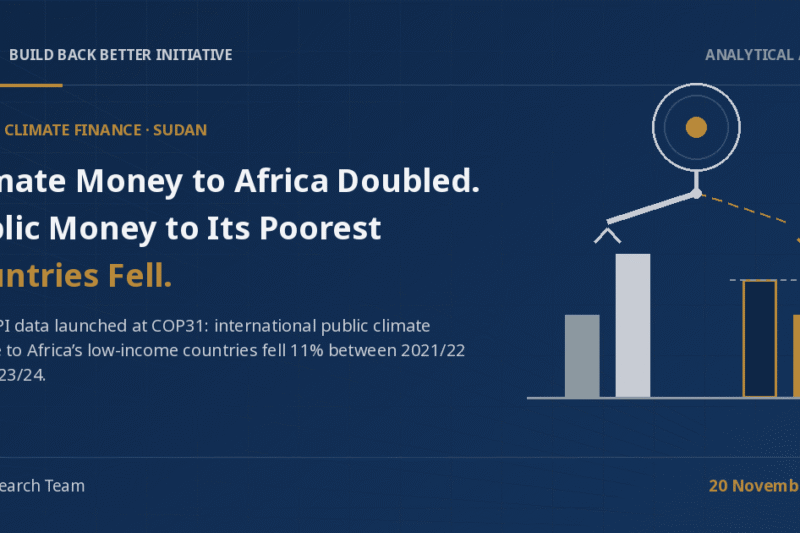
Europe Says Spend What’s Already Pledged. Public Climate Money to Africa’s Poorest Countries Fell. Sudan Should Ask Who Gets It.
Europe says COP31 should deploy money already pledged. New CPI data show climate finance to Africa doubled, but international public money to its low-income countries fell 11%. Sudan,…
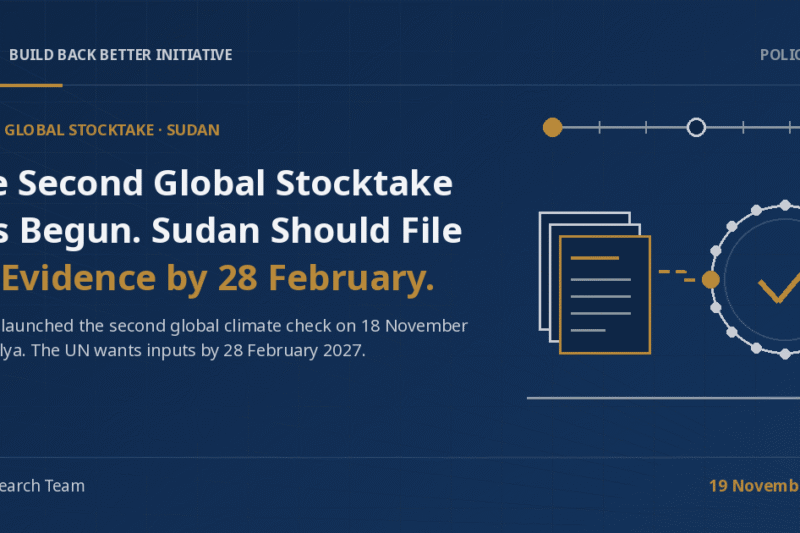
COP31 Has Opened the Second Global Climate Stocktake. Inputs Close on 28 February. Sudan Should File Its Own Evidence.
COP31 launched the second Global Stocktake in Antalya on 18 November, and inputs are due by 28 February 2027. Sudan has a 2016 adaptation plan, a 2025 national…
COP31 Points Countries to Their Regional Seas on Ocean Action. Sudan’s Is the Red Sea. It Should Report Its Coastal Plan and Work Through PERSGA.
COP31’s new Antalya Ocean and Seas Compact points countries to their regional seas bodies, and the draft cover decision invites ocean reporting. Sudan has about 800 km of…