Sudan Has Imported More Than a Gigawatt of Solar Panels Since January 2025. Its Grid Rebuild Should Be Planned Around Them.
3Bi Research Team | Policy Brief | 22 November 2026
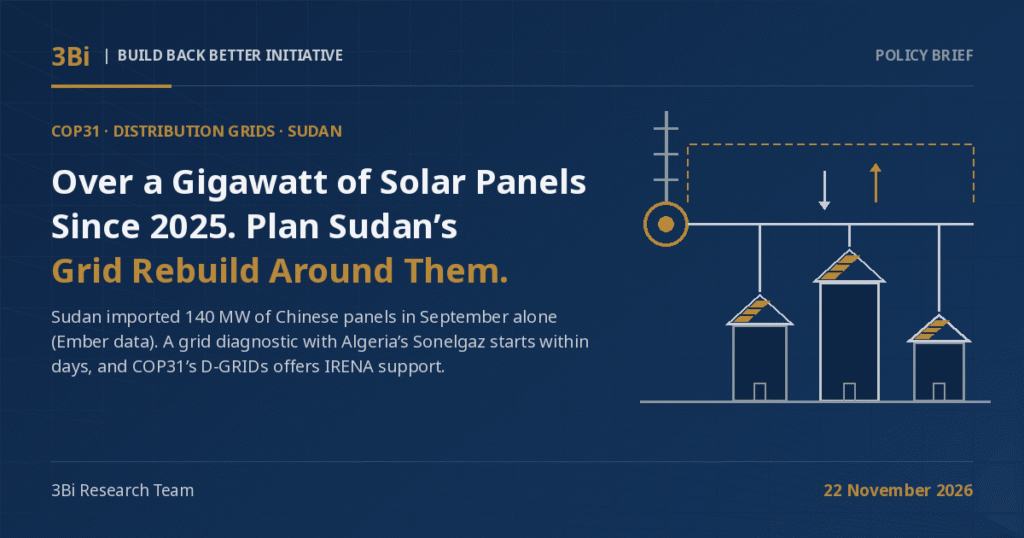
Sudan imported 140 MW of Chinese solar panels in September and more than a gigawatt since January 2025. As a grid diagnostic with Algeria’s Sonelgaz begins, Sudan should count that solar and ask IRENA’s new D-GRIDs initiative for help.
On 21 November 2026, Algeria said it would explore a government agreement to help rehabilitate Sudan’s power facilities and networks through Sonelgaz, starting with a remote technical meeting to diagnose needs; the next day attaqa.net, citing Ember, reported that Sudan imported 140 MW of Chinese solar panels in September 2026. (Illustration: 3Bi)
3Bi Research Team | Policy Brief | 22 November 2026
The Ask
This week, when engineers from Algeria’s Sonelgaz group and Sudan’s electricity company hold their first remote meeting to diagnose what Sudan’s power system needs, the Ministry of Energy and Oil should make sure the diagnostic covers the distribution network and the solar panels now being connected to it. Then, by the end of January 2027, the Higher Council for Environment and Natural Resources (HCENR), Sudan’s UNFCCC focal point, should send the letter of interest the COP31 Presidency asks for to join the Global Electrification Initiative, and request support from D-GRIDs, its distribution-grid pillar led by the International Renewable Energy Agency (IRENA). Both steps cost a line in a terms of reference and a one-page letter. Without them, Sudan risks rebuilding its grid for the power system it had, not for the one its households and businesses are already building on their rooftops.
Why Now
Two things happened this weekend. On 21 November, Algeria’s Minister of Energy and Renewable Energies, Mourad Adjal, met a Sudanese delegation that included the director general of Sudan’s electricity company and said Algeria would explore a government agreement to help rehabilitate Sudan’s damaged power facilities and networks, mainly through Sonelgaz. The two sides agreed to hold a remote technical meeting “in the coming days” to diagnose actual needs and set rehabilitation priorities, followed by meetings of technical teams to prepare an urgent roadmap. The cooperation would also cover technical support and training for Sudanese staff (Anadolu Agency, Arabic, 21 November 2026; translation by 3Bi).
The next day, attaqa.net reported that Sudan was the seventh-largest Arab importer of Chinese solar panels in September 2026, at 140 megawatts (MW), up from about 10 MW a year earlier (attaqa.net, citing Ember, 22 November 2026). We checked the underlying customs-based dataset, which Ember last updated on 20 November. It shows Sudan importing 139.5 MW of Chinese panels in September, against 12.3 MW in September 2025. That is the second-largest monthly figure on record for Sudan, after June 2025 (Ember, China’s Solar PV Export Explorer, data updated 20 November 2026; 3Bi calculation).
Meanwhile in Antalya, COP31 ran into a second day of overtime. Delegations were given until 03:00 GMT on Sunday to raise objections to a revised deal before a session to approve it (Reuters via The Japan Times, 22 November 2026). The final text was not public when we wrote this. But both earlier drafts of the summit’s cover decision called for the accelerated expansion, modernisation and greater resilience of “electricity grids, transmission and distribution networks” (UNFCCC, draft cover decision, 16 November 2026; second draft, 19 November 2026). And on 10 November, the COP31 Presidency announced that IRENA would lead D-GRIDs “to help developing countries identify grid investment needs, prepare projects and access finance” (COP31 Presidency, 10 November 2026). Sudan’s diagnostic and the international offer are opening in the same fortnight. That will not happen often.
The Evidence
First, Sudan’s solar boom is large, sustained and mostly outside official view. According to Ember’s data, Sudan imported 1,124 MW of Chinese panels between January 2025 and October 2026, almost three times the 388 MW it imported in the eight years from 2017 to 2024. In the first ten months of 2026 it imported 544 MW. That makes Sudan the tenth-largest African destination for Chinese panels this year, ahead of Tunisia and Zambia, and the fifth-largest in Africa in September alone (Ember, data updated 20 November 2026; 3Bi calculation). Policy has pushed in the same direction. On 18 August, Prime Minister Kamil Idris exempted solar systems imported for personal use from customs duties, taxes and other government fees (attaqa.net, 19 August 2026), and customs began applying the exemption in September (attaqa.net, 25 October 2026). 3Bi is not claiming that the exemption alone explains September’s jump. Imports were already high in 2025. Across Africa, Ember estimates that three-quarters of the solar capacity added from 2023 to 2025 was distributed solar, “a category largely missing from official national and international statistics”, and that only three African countries publish solar capacity data every quarter (Ember and African Tech Futures Lab, 27 August 2026).
Second, a grid rehabilitation plan that cannot see this solar will plan for the wrong grid. Rooftop and yard systems change when and where people draw power from the network, and some of them can feed power back. At a COP31 side event on 18 November, IRENA’s head of energy planning and modelling, Simon Benmarraze, said distribution planning “starts with baseline diagnostics and load forecasts to know where the network can accept loads and where it cannot”. He called for “information below the substation level” and a sequence that “begins with measuring to see what works and then only commit to construction where needed”. A speaker for Türkiye’s distribution companies’ association added that as “energy consumers also become energy producers”, grids need to use data to respond to change (IISD ENB, 18 November 2026). Joel Nana of African Tech Futures Lab has described distributed energy across Africa as “in many cases, overtaking grid capacity” in a transition that is “chaotic and disruptive, and far from the orderly model planned in national strategies” (Ember and African Tech Futures Lab, 27 August 2026). A diagnostic that counts only damaged substations and lines will miss the part of Sudan’s power system that is growing fastest.
Third, the international help on offer is built for exactly this task, and Sudan can join it. The COP31 concept note says D-GRIDs will focus on distribution-grid planning, investment, digitalisation, flexibility, resilience and institutional capacity. It will place “particular emphasis” on helping developing countries identify grid investment needs, improve project readiness, reach finance and integrate renewable energy, storage and wider electricity access. IRENA will act as its secretariat. The note also sets out how to join: countries “may formally express their interest through an official communication submitted by their designated UNFCCC national focal point” (COP31 Presidency, Global Electrification Initiative concept note, October 2026). Sudan has been a member of IRENA since the agency’s statute entered into force for it on 18 June 2011 (IRENA Statute, depositary status list, German Federal Foreign Office). It needs no new membership, only a letter.
Addressing the Counter-Case
The strongest objection is that Sudan’s first task is to restore generation and high-voltage transmission, and that distributed solar is a side issue. That is a fair concern, and 3Bi is not recommending that rooftop planning come before restoring power stations and main lines. Our point is narrower. The Sonelgaz diagnostic will set priorities whatever its scope. Adding the distribution network and distributed solar to its terms of reference now costs very little. Leaving them out means the roadmap is drawn without the fastest-growing source of supply in the country. Sudan imported more panel capacity in September 2026 alone than in any full year before 2025 (Ember, data updated 20 November 2026; 3Bi calculation).
A second objection is that imports are not installations. Some panels may be stockpiled, resold or carried across borders. That is true, and 3Bi is not claiming that every panel recorded as shipped to Sudan is working on a Sudanese roof. Ember’s own African estimates assume that around 73% of exported panels are typically installed within six months, a rate calibrated on other markets, not on Sudan (Ember, 27 August 2026). The uncertainty is the reason to measure, not a reason to wait.
A third objection is that D-GRIDs is one more initiative without its own money. The concept note promises help with identifying needs, project readiness and access to finance, not grants, and it names no fund. But it mentions no fee or contribution for participating countries, and its delivery partners include multilateral development banks and climate funds (COP31 concept note, October 2026). A distribution-grid diagnostic prepared with IRENA is the kind of document those lenders ask for. This brief also follows two earlier 3Bi briefs. In September we urged Sudan to get its grid pipeline named in COP31’s electrification push (3Bi, 24 September 2026). In October we asked for a rooftop-solar rulebook, a registry and a grid-connection rule (3Bi, October 2026). What is new now is that a diagnostic is about to start and D-GRIDs has a door Sudan can knock on.
What 3Bi Recommends, Specifically
First, before the remote technical meeting with Sonelgaz, expected within days, the Ministry of Energy and Oil and Sudan’s electricity company should add two items to the needs diagnostic: the condition of the distribution network, feeder by feeder where data exist, and the location and approximate size of distributed solar connected behind customers’ meters. The urgent roadmap that follows should state how it treats that solar.
Second, by the end of January 2027, HCENR, as Sudan’s UNFCCC national focal point, should send an official expression of interest to the COP31 Electrification Action Agenda team, as the concept note specifies. The letter should ask to take part in D-GRIDs and request IRENA’s support for a baseline distribution-grid diagnostic that includes distributed solar. The Ministry of Energy and Oil should be named as the technical lead.
Third, until the registry 3Bi proposed in October exists, the Ministry of Energy and Oil should publish a short quarterly estimate of solar imports, built from Sudanese customs records and checked against Ember’s public dataset. The first should cover the full year 2026 and appear by the end of March 2027.
Fourth, Sudan’s delegation should bring the diagnostic and its D-GRIDs request to the Bonn session in June 2027 and to COP32 in Addis Ababa in November 2027, where electrification progress is to be reported through the initiative’s tracking work.
Fifth, 3Bi will update Sudan’s figures from Ember’s monthly releases and publish a follow-up when full-year 2026 data are available, noting whether the diagnostic and the letter have gone ahead.
Sourcing & Contact
Primary sources: Anadolu Agency (Arabic), “الجزائر تبحث اتفاقا حكوميا للمساهمة في إعادة تأهيل كهرباء السودان” (Algeria explores a government agreement to help rehabilitate Sudan’s electricity), 21 November 2026; attaqa.net, “لأول مرة.. موريتانيا بين أكبر 10 دول عربية مستوردة للألواح الشمسية الصينية” (For the first time, Mauritania among the top 10 Arab importers of Chinese solar panels), 22 November 2026, citing Ember; Ember, China’s Solar PV Export Explorer and monthly export dataset (panels, by destination), last updated 20 November 2026, accessed 22 November 2026; Ember and African Tech Futures Lab, “Africa is on track for a record year of solar installations in 2026, up 45% year-on-year, driven largely by distributed solar”, 27 August 2026; COP31 Presidency, “COP31 Global Electrification Initiative” concept note, October 2026; COP31 Presidency, “COP31 flicks the switch on ‘age of electricity’”, 10 November 2026; IISD Earth Negotiations Bulletin, report of the side event “Resilient and Intelligent Grids Enabling Electrification”, 18 November 2026; UNFCCC, draft text of the COP31 cover decision, unedited versions of 16 and 19 November 2026; Reuters via The Japan Times, “COP31 climate talks close to final deal, summit president says”, 22 November 2026; attaqa.net, report on Sudan’s customs exemption for personal solar systems, 19 August 2026; attaqa.net, “واردات الألواح الشمسية.. 4 دول عربية تخفف الأعباء الجمركية” (Solar panel imports: four Arab countries ease customs burdens), 25 October 2026; German Federal Foreign Office, depositary status list for the IRENA Statute; 3Bi Policy Briefs of 24 September and October 2026. Monthly and cumulative figures are 3Bi calculations from Ember’s panel data, in megawatts of panel capacity. They count Chinese exports only and may differ slightly from attaqa.net’s rounded figures. Quotations from Arabic sources are 3Bi translations. 3Bi has not verified whether Sudan has endorsed the COP31 35-by-35 electrification pledge, and joining the Global Electrification Initiative, as the concept note describes it, does not depend on that. For methodology questions or to propose a correction, contact 3Bi’s Research Team via 3bisudan.org.
This piece was produced through 3Bi’s automated daily publications workflow, which monitors regional and international climate and energy reporting.
This publication is produced with support from 3Bi’s institutional donors; see the full funder list at 3bisudan.org.
About the Authors
Related Publications
COP31 Went Into Overtime, but It Has Already Created a Platform to Turn Poor Countries’ Adaptation Plans Into Projects. Sudan Should Join Early.
COP31 ran past its deadline, but Friday’s plenary created a platform to help the least developed countries turn adaptation plans into fundable projects. It brings no new money.…
Europe Says Spend What’s Already Pledged. Public Climate Money to Africa’s Poorest Countries Fell. Sudan Should Ask Who Gets It.
Europe says COP31 should deploy money already pledged. New CPI data show climate finance to Africa doubled, but international public money to its low-income countries fell 11%. Sudan,…
COP31 Has Opened the Second Global Climate Stocktake. Inputs Close on 28 February. Sudan Should File Its Own Evidence.
COP31 launched the second Global Stocktake in Antalya on 18 November, and inputs are due by 28 February 2027. Sudan has a 2016 adaptation plan, a 2025 national…