
COP31’s 35% Electrification Target Assumes Grids Are Growing. Sudan’s Is Collapsing.
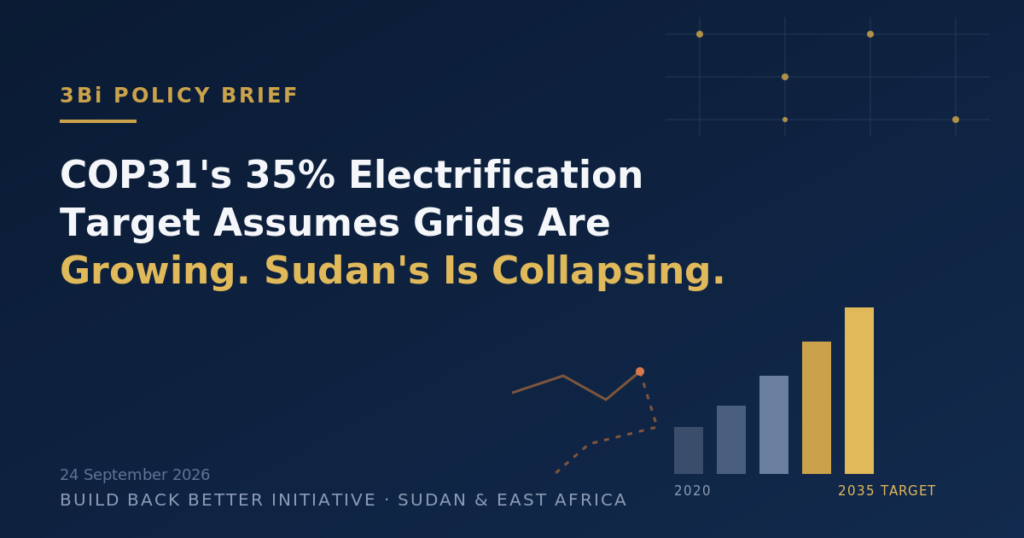
COP31's Presidency wants global electrification at 35% by 2035. Sudan's grid capacity has collapsed by roughly three-quarters since 2023 — 3Bi recommends getting Sudan's reconstruction pipeline into the COP31 Implementation Bridge now, before Antalya.
Policy Brief — 3Bi Research Team — 24 September 2026
The Ask
Sudan’s federal Ministry of Energy and Oil, the Sovereign Council’s international-partnerships office, and 3Bi’s donor and multilateral contacts should push now — before COP31 opens in Antalya on 9 November — to get Sudan’s grid-reconstruction pipeline explicitly named inside the COP31 Presidency’s “35 by 35” electrification programme, rather than left to compete for attention as a generic post-conflict reconstruction ask once the summit’s implementation tracks are already set.
Why Now
On 9 June 2026 in Bonn, Türkiye’s COP31 Presidency, working with Australia as president of the negotiations, launched the headline target of its Global Climate Action Agenda: raise the share of global final energy demand met by electricity from just over 20% today to 35% by 2035 (UNFCCC, 9 June 2026). The International Energy Agency was commissioned to map the pathway, and its analysis — reported by attaqa.net’s Energy Research Unit on 23 September 2026 — finds that electricity could realistically reach 33% of final consumption by 2035 using only technology that already exists, just two points short of the political target.
The timing is not incidental. Attaqa.net’s report ties the sudden momentum behind electrification directly to the Strait of Hormuz crisis, described as the second major global energy shock in five years, which is pushing import-dependent states to look for ways to cut their exposure to fossil-fuel supply shocks. The IEA’s modelling puts a number on the incentive: an accelerated electrification path could cut global energy-import bills by more than $400 billion by 2035 relative to 2025, and cut emissions from transport, buildings and industry — together more than half of all energy-related CO2 — by around 40% over the same period.
Sudan sits at the exact intersection of these two logics — energy-security anxiety and climate ambition — that the COP31 Presidency is using to sell the target to sceptical governments. It should be a natural candidate for early inclusion in the programme’s country-level implementation work. Instead, Sudan’s electricity system has moved in the opposite direction of every trend the Presidency is counting on.
The Evidence
Sudan’s national generation capacity stood at roughly 4,400 megawatts before the war that began in April 2023. Sudan’s Ministry of Energy and Oil reported in July 2026 that available capacity had fallen to approximately 1,100 megawatts — a loss of about three-quarters of the country’s pre-war generation — after repeated drone strikes on power infrastructure attributed to the Rapid Support Forces, combined with the halt of the grid interconnection that had been importing power from Ethiopia. The ministry says roughly 260 megawatts have since been restored through maintenance, with ongoing projects expected to bring available capacity above 600 megawatts — still well under one-sixth of what the grid carried in 2022.
The human effect of that math is blackouts that regularly exceed eighteen hours a day in Khartoum and several other states, worsened this year by a combination of summer cooling demand, the return of displaced residents to some areas, and rising agricultural and industrial consumption competing for a shrunken supply. Al Jazeera reported in April 2026 on households in Khartoum studying by candlelight and tracking fuel-station queues as a matter of routine; the Washington Times reported on 6 September 2026 that rising numbers of Sudanese households are turning to solar power to cope with the outages, but that high upfront equipment costs are keeping the option out of reach for many of the families who need it most. Underlying all of this is a quieter capacity crisis: Sudan’s Ministry of Energy and Oil has acknowledged that nearly half of the country’s most experienced power engineers and technicians have left the country since 2023, a loss that will slow reconstruction even where financing exists.
Pre-war, in 2021, about 62% of Sudanese had access to electricity — 84% in urban areas, 49% in rural ones. No comprehensive access survey has been possible since; every indicator available points to that figure having fallen substantially, not held steady, over the past three and a half years.
Set this against the IEA’s own regional breakdown of the 35-by-35 opportunity, also reported via attaqa.net: full use of current electrification potential would raise regional electrification rates by roughly 5 percentage points in the Middle East, compared with close to 15 points in Europe and India. The Presidency’s target was built on an assumption of incremental gains layered onto functioning grids. Sudan does not have a functioning grid to layer gains onto — it has a grid that lost capacity faster over the past three years than the IEA’s most ambitious 2035 scenario expects any region to gain it.
Addressing the Counter-Case
The obvious objection is that COP31’s Action Agenda is a voluntary framework, not a negotiated allocation of finance, and that a country in active civil conflict is not where implementation partners will want to commit scarce, high-visibility climate money first — humanitarian and stabilization channels, the argument goes, are the more appropriate and more fundable route for Sudan’s power sector right now, and climate diplomacy should wait for a ceasefire.
That case has real force, and 3Bi does not dispute that humanitarian energy access — hospitals, water pumping, cold-chain for medicine — should keep first claim on whatever emergency power capacity exists. But the Action Agenda’s own logic undercuts a wait-and-see posture: Executive Secretary Simon Stiell’s remarks at the Bonn launch explicitly framed electrification finance as reaching “developed and developing countries” without leaving anyone behind, and the Presidency’s Climate Implementation Bridge is designed precisely to convert national plans into investable project pipelines before, not after, a country’s situation stabilizes. A reconstruction pipeline that already exists on paper, with technical specifications for grid and generation rebuild ready to go, is a far more fundable object the day conditions allow disbursement than a pipeline started from scratch. Waiting until after a ceasefire to begin that paperwork means Sudan enters the post-conflict reconstruction queue a full planning cycle behind neighbours who started earlier — and behind other crisis-affected states also competing for COP31-branded finance.
There is a second, sharper critique worth taking seriously: Euronews reported on 23 September 2026 that independent experts are warning of a “fossil fuel loophole” in the 35-by-35 target as currently worded, since it counts any additional electrification, not only electrification from renewable sources — and noted that Türkiye itself, the host and architect of the target, is currently on track for only around 25% electrification by 2035, below its own headline goal. 3Bi shares this concern and believes it strengthens, rather than weakens, the case for early Sudanese engagement: if the loophole is closed only after implementation plans are locked in, countries that engaged early will shape how “electrification” gets defined for their own grid-rebuild finance; countries that engage late will simply inherit whatever definition emerges from richer, earlier movers.
What 3Bi Recommends, Specifically
First, the Ministry of Energy and Oil should prepare, within the next eight weeks, a short technical note — capacity lost, capacity restored, capacity achievable with defined investment — formatted for direct submission to the COP31 Climate Implementation Bridge, explicitly requesting that Sudan’s grid-reconstruction plan be logged as a candidate project pipeline ahead of Antalya, independent of the broader ceasefire and stabilization timeline.
Second, 3Bi’s own donor-facing materials for Q4 2026 should frame Sudan’s grid collapse using the COP31 vocabulary — “electrification,” “energy security,” “import-bill exposure” — rather than solely the humanitarian-reconstruction vocabulary donors have already heard for three years; the Hormuz-crisis framing that is currently winning attention from finance ministries elsewhere applies with at least as much force to a country that has lost grid-connected power to a neighbouring state entirely.
Third, any external financing or equipment support that reaches Sudan’s power sector under a climate or electrification label should be tracked and reported by generation type, so that Sudan’s own reconstruction is not quietly filled in with diesel or emergency thermal generation that would count toward a bare “electrification” percentage while working against the emissions logic the target is supposed to serve — the same fossil-fuel-loophole risk 3Bi flags above, applied at the country level rather than the global one.
Fourth, 3Bi should raise the specific 5-percentage-point regional ceiling the IEA has modelled for the Middle East with regional partners and donors directly, since a number that low — set before Sudan’s capacity losses of the past year were fully reflected in regional baselines — likely understates what is achievable in a single post-conflict country whose starting point has already fallen this far, and should not be allowed to stand unchallenged as the ambition ceiling for the wider region.
Sourcing & Contact
Primary sources: UNFCCC, “COP31 Presidency announces new targets on global electrification, cutting waste, resilient cities,” 9 June 2026; attaqa.net Energy Research Unit, “أزمة هرمز تضع الكهربة في صدارة مناقشات كوب 31.. هل يتحقق هدف 35%؟”, 23 September 2026; Euronews Arabic, “Türkiye warned of fossil fuel loophole in COP31 electrification plan,” 23 September 2026; Sudan Ministry of Energy and Oil statements reported July 2026; Al Jazeera, “Sudan power crisis: Studying using candles, counting gas station trips,” 16 April 2026; Washington Times, “Sudan’s war-driven blackouts push residents toward solar power but high costs shut many out,” 6 September 2026; World Bank/Africa Energy Portal electricity-access data, 2021 baseline. For questions on this brief, contact 3Bi’s Research Team via the channels listed at 3bisudan.org.
This publication was produced through 3Bi’s automated daily publications workflow, which monitors regional and international climate reporting and drafts a publication each day without a same-day human editorial pass.
This publication is produced with support from 3Bi’s institutional donors; see the full funder list at 3bisudan.org.
About the Authors
Related Publications
The Paris Compliance Committee Named Three Silent Countries. Sudan Answered. Now It Owes a Date.
The Paris Agreement's compliance committee has named three countries that ignored its letters on missing climate plans. Sudan is not among them: it replied. Before COP31, 3Bi argues,…
The Kigali Amendment Turns 10 With 175 Parties. Sudan Should Ratify Before the Montreal Protocol Meets in Kigali.
Ten years after the Kigali Amendment was adopted, 175 of 198 Montreal Protocol parties have ratified it. Sudan has not. As parties meet in Kigali on 2–6 November,…
The Adaptation Fund Board Meets in Bonn With US$146.8 Million to Approve. Sudan Has No Project of Its Own.
The Adaptation Fund Board meets in Bonn from 19 to 23 October with US$146.8 million in approvals before it, including a US$30 million Mandera Triangle project. Sudan has…