A New $500 Million Africa Solar Facility Targets Farm and Off-Grid Solar. Sudan Has Been an ISA Member Since 2018. It Should Ask In Before Antalya.
3Bi Research Team | Policy Brief | 4 November 2026
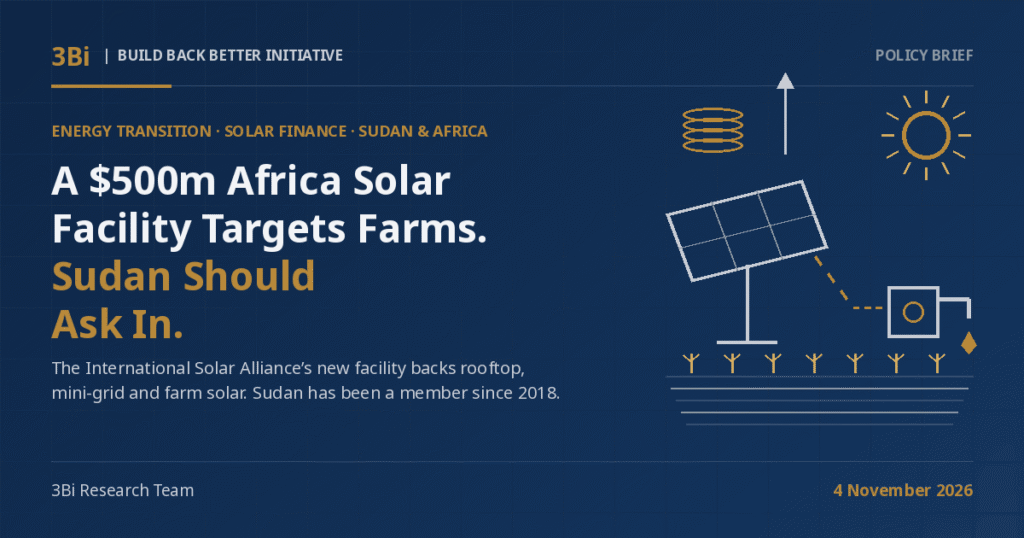
The International Solar Alliance launched a US$500 million Africa Solar Facility on 3 November for rooftop, mini-grid and farm solar. Sudan has been a member since 2018 and wants solar irrigation. Its energy ministry should ask to join, with groundwater safeguards, before COP31 closes.
The International Solar Alliance announced a US$500 million Africa Solar Facility on 3 November 2026 to mobilise private investment in decentralised solar across Africa, including rooftop systems, mini-grids and agricultural applications. Sudan ratified the Alliance’s Framework Agreement in 2018. (Illustration: 3Bi)
3Bi Research Team | Policy Brief | 4 November 2026
The Ask
Before COP31 closes in Antalya on 20 November, Sudan’s Ministry of Energy and Oil should write to the International Solar Alliance (ISA) asking for Sudan to be scoped for its new Africa Solar Facility, starting with solar-powered irrigation. The cost is a letter and a named focal point. Sudan is already a full member of the Alliance, and on 3 November its energy minister said that one season of irrigation fuel can cost as much as a complete solar system.
The hook came on 3 November, when ISA Director General Ashish Khanna announced a US$500 million Africa Solar Facility to mobilise private investment in decentralised solar across the continent, including rooftop systems, mini-grids and agricultural applications. He said the facility was set up with the World Bank, the Nigeria Sovereign Investment Authority and Africa50, among other partners, and has already produced a US$300 million distributed renewable energy facility for Nigeria (ETEnergyWorld, 3 November 2026). Nigeria is the first country platform. The question for Khartoum is whether Sudan will be among the next.
Why Now
On the same day, Sudan’s energy ministry set out its own solar plans. In an interview with the Sudan News Agency (SUNA), Minister of Energy and Oil Al-Motasem Ibrahim called solar power a core pillar of the ministry’s plan to diversify supply, and disclosed a 2027–2030 plan to develop the electricity sector. He said the head of the Sovereignty Council and the Prime Minister had directed that customs duties on solar inputs be removed, and that the Central Bank of Sudan (CBOS) be instructed to ease financing for solar systems (SUNA, 3 November 2026). In a second part of the interview, he said a working group had been formed with the Saudi developer ACWA Power to follow up on solar opportunities, and that the ministry intends to expand solar use “particularly in the agricultural sector” (SUNA, 3 November 2026).
The window is short for two reasons. First, the facility is building its pipeline now. When ISA introduced the Africa Solar Facility at its Assembly in October 2025, its own concept note said the aim was to “invite other African countries, in addition to Nigeria, to join the facility”, and announced an upcoming solar pump programme for agriculture (ISA, Africa Solar Facility session note, 29 October 2025). Early country requests shape what a facility finances. Second, COP31 runs in Antalya from 9 to 20 November (UNFCCC, COP31 page), and it brings energy ministries, development banks and solar finance initiatives into the same city for two weeks. A request lodged before or during Antalya can be discussed face to face. One lodged in January joins a queue.
The Evidence
First, the facility is designed for the kind of solar Sudan says it wants. ISA says the facility targets decentralised solar, mini-grids and agricultural applications (ETEnergyWorld, 3 November 2026). Its 2025 concept note describes a pipeline of distributed renewable energy, mini-grids and “productive-use” projects, selected for scalability, financial viability and fit with national energy access goals (ISA, 29 October 2025). Sudan’s updated Nationally Determined Contribution (NDC) already prices this kind of programme. Its second mitigation measure, stand-alone and mini-grid systems for the residential, agricultural and industrial sectors, is costed at US$846 million and would displace 1,529 GWh of fossil-fired electricity, cutting about 1.09 million tonnes of CO2-equivalent in 2030. Its adaptation component lists the installation of solar-powered irrigation as an action for climate-resilient irrigated farming (Republic of the Sudan, Updated First NDC, October 2021). The fit is close. Sudan does not need a new strategy to apply. It needs to send in the one it has.
Second, Sudan is already eligible and already has the domestic tools. Sudan ratified the ISA Framework Agreement on 6 March 2018, and it took effect for Sudan on 5 April 2018 (UN Treaty Collection, registration no. 54949). Sudan has used customs relief for solar irrigation since 2017: the NDC records that Government resolution 58/2017 exempts all solar-powered irrigation equipment from customs and other fees. Customs began applying this year’s wider exemption in September, and the Prime Minister directed CBOS and the relevant ministries to ease concessional finance for solar systems (attaqa.net, 25 October 2026). In mid-October, CBOS launched a portfolio of about SDG 15 billion for solar and agricultural inputs in Northern State, through five banks led by the Bank of Khartoum, aimed at around 10,000 beneficiaries (Sudan Tribune, 15 October 2026). This gives the facility what it looks for in a country: lower import costs, a central bank channel, and banks that already lend for solar.
Third, the facility’s model targets Sudan’s binding constraint, which is foreign currency. The minister said that expanding generation, especially hydropower, requires large amounts of foreign currency and time, and that most electricity equipment, from small fittings to large transformers, is imported (SUNA, 3 November 2026). ISA’s concept note says the facility is “driving a paradigm shift toward local currency financing”, working through insurers and local financial institutions to reduce exposure to foreign exchange risk. It sits within a Global Solar Facility that offers payment guarantees, insurance and concessional capital (ISA, 29 October 2025). The same note says Africa receives only about 1 percent of global solar investment. A farmer who borrows in Sudanese pounds to replace a diesel pump, with the exchange risk carried by a guarantee further up the chain, is the kind of transaction such instruments are meant to make possible. We are not claiming that ISA will accept Sudan or set up a Sudan window. We are claiming that Sudan matches the facility’s stated purpose, and that it cannot be considered if it does not ask.
Addressing the Counter-Case
The strongest objection is that cheap solar pumping can drain groundwater. This is a fair concern, and 3Bi has raised it before. In Northern State, new irrigation on the desert terraces “relies entirely on groundwater” from the Nubian Sandstone Aquifer, which receives “only very limited recharge” (Fragaszy and Closas, Water Alternatives, 2016). Once a pump runs on free sunlight, there is little cost to stop it running longer. The answer is to build the safeguard into the request rather than drop the request. Evidence from north-west Bangladesh found that solar and diesel users used similar amounts of water under a fee-for-service model. The researchers recommend groundwater monitoring, suitability maps and tying pump support to cropping patterns and water efficiency (IWMI, 7 January 2026). Morocco and India already link solar-pump subsidies to micro-irrigation (Aklan, Lackner and Al-Saidi, Frontiers in Water, 26 September 2025). A Sudan window can carry the same conditions from day one.
A second objection is that private investors will not take Sudanese risk, whatever the facility says. Investors are cautious, and 3Bi is not suggesting a large first tranche. The case for asking is that de-risking is the facility’s purpose, and that a modest first request, such as pump finance through the banks already in the Northern State portfolio, is easier to approve than a national programme. The ACWA Power working group also shows that Gulf developers are willing to talk solar with Khartoum (SUNA, 3 November 2026).
What 3Bi Recommends, Specifically
First, before 20 November, the Ministry of Energy and Oil should write to the ISA Director General asking for Sudan to be scoped for the Africa Solar Facility, with solar-powered irrigation and agricultural productive use as the first line. It should also name a national focal point. Sudan’s COP31 delegation should ask for a meeting with ISA in Antalya to hand the request over in person.
Second, within 30 days, CBOS and the Ministry of Finance should publish the lending terms for the state solar portfolios, and confirm in writing that farm pumps and their components qualify for the customs relief. Earlier reporting described the exemption as covering systems for personal use (attaqa.net, 25 October 2026). Investors and banks need that ambiguity removed.
Third, the Ministry of Agriculture and Irrigation and the Ministry of Energy and Oil should set three conditions for any facility-backed pump: a flow meter, pump sizing matched to the farm, and a link to drip or other efficient irrigation where groundwater is the source. These conditions should be in the request, so that ISA sees them as part of the design.
Fourth, the ministry should draw the request from NDC mitigation measure 2 and the 2027–2030 electricity plan, so that the figures ISA sees match those Sudan has already given the UNFCCC. If the 2027–2030 plan is not yet public, publishing its renewable targets would strengthen the request.
Fifth, 3Bi will follow the facility’s country announcements and Sudan’s activity in Antalya, and will publish a follow-up after COP31 closes.
Sourcing & Contact
Primary sources: ETEnergyWorld, “ISA launches $500 mn Africa Solar Facility to boost private investment in decentralised projects”, 3 November 2026; International Solar Alliance, “Africa Solar Facility: Catalysing Tailored Financing for Productive Use of Solar” (ISA Assembly session note), 29 October 2025; Sudan News Agency (SUNA), “وزارة الطاقة: الطاقة الشمسية محور أساسي لتنويع مصادر الكهرباء وتلبية احتياجات البلاد” (Ministry of Energy: solar is a core pillar for diversifying electricity sources), 3 November 2026; SUNA, “Energy Minister: Understandings Reached with Egypt, Saudi Arabia and Russia to Strengthen Cooperation in the Energy Sector”, 3 November 2026; UN Treaty Collection, Framework Agreement on the establishment of the International Solar Alliance (registration no. 54949), accessed 4 November 2026; Republic of the Sudan, Updated First Nationally Determined Contribution, October 2021 (UNFCCC registry copy); attaqa.net, “واردات الألواح الشمسية.. 4 دول عربية تخفف الأعباء الجمركية” (Solar panel imports: four Arab countries ease customs burdens), 25 October 2026; Sudan Tribune, “«المركزي» يدشن محفظة تمويل بـ(15) مليار جنيه للزراعة والطاقة الشمسية في الشمالية” (Central bank launches a 15 billion pound portfolio for agriculture and solar energy in Northern State), 15 October 2026; S. Fragaszy and A. Closas, “Cultivating the desert: Irrigation expansion and groundwater abstraction in Northern State, Sudan”, Water Alternatives 9(1), 2016; IWMI, “What the evidence says about solar irrigation and groundwater sustainability in Bangladesh”, 7 January 2026; M. Aklan, H. Lackner and M. Al-Saidi, “Solar-powered irrigation as a curse for vulnerable water basins?”, Frontiers in Water, 26 September 2025; UNFCCC, COP31 page. ISA’s 2025 note and the 3 November report give different sizes for the Nigeria facility (US$500 million and US$300 million). We use the 3 November figures. 3Bi could not find an ISA press release, the facility’s eligibility rules or its application process, and makes no claim about them. For methodology questions or to propose a correction, contact 3Bi’s Research Team via 3bisudan.org.
This piece was produced through 3Bi’s automated daily publications workflow, which monitors regional and international climate and energy reporting.
This publication is produced with support from 3Bi’s institutional donors; see the full funder list at 3bisudan.org.
About the Authors
Related Publications
COP31 Went Into Overtime, but It Has Already Created a Platform to Turn Poor Countries’ Adaptation Plans Into Projects. Sudan Should Join Early.
COP31 ran past its deadline, but Friday’s plenary created a platform to help the least developed countries turn adaptation plans into fundable projects. It brings no new money.…
Europe Says Spend What’s Already Pledged. Public Climate Money to Africa’s Poorest Countries Fell. Sudan Should Ask Who Gets It.
Europe says COP31 should deploy money already pledged. New CPI data show climate finance to Africa doubled, but international public money to its low-income countries fell 11%. Sudan,…
COP31 Has Opened the Second Global Climate Stocktake. Inputs Close on 28 February. Sudan Should File Its Own Evidence.
COP31 launched the second Global Stocktake in Antalya on 18 November, and inputs are due by 28 February 2027. Sudan has a 2016 adaptation plan, a 2025 national…