
Africa Wants COP31 to Measure Adaptation. Sudan’s Own Adaptation Plan Is Ten Years Old.
3Bi Research Team | Analytical Article | 18 October 2026
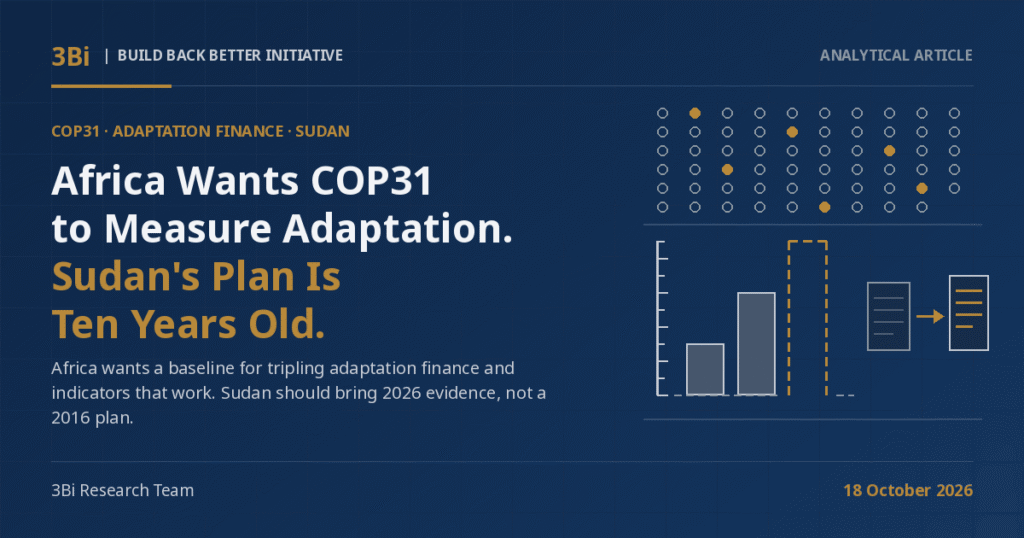
Africa's COP31 adaptation demands are about measurement: a baseline for tripling adaptation finance by 2035 and working methods for the 59 Belém indicators. Sudan's National Adaptation Plan dates from 2016, and Sudan should bring current evidence to Antalya.
On 14 and 16 October 2026, the African Group of Negotiators and South Africa set out COP31 demands for a baseline to track the tripling of adaptation finance and working methods for the 59 Belém adaptation indicators. Sudan’s National Adaptation Plan was posted in September 2016. (Illustration: 3Bi)
3Bi Research Team | Analytical Article | 18 October 2026
The Hook
Three weeks before COP31 opens in Antalya, Africa’s adaptation demands are mostly about measurement. On 14 October the chair of the African Group of Negotiators (AGN), Dr Nana Antwi-Boasiako Amoah, told the incoming COP31 presidency in virtual informal consultations that the talks need structured discussions on tripling adaptation finance by 2035, with clear baselines and financing trajectories, plus a two-year technical process on the metadata and methodologies behind the adaptation indicators (Africa Climate Reports, 16 October 2026). On 16 October South Africa’s environment minister, David Maynier, said at a national consultation on his country’s COP31 mandate that it will push for a benchmark for the tripling target, a process at COP31 to monitor it, and a “balanced technical task force” to improve the indicator methodologies (South African Government, 16 October 2026). His chief negotiator, Maesela Kekana, put it plainly: on mitigation, the national pledges add up to roughly 2.8°C of warming, “but on adaptation, we don’t really know where we are” (Mail & Guardian, 16 October 2026). Closing that gap starts with the evidence each government brings. Sudan’s main piece of evidence is a National Adaptation Plan (NAP) posted in September 2016 (NAP Central, last updated 7 October 2026).
The Argument
First, the tripling target agreed in Belém has no agreed starting point, so whoever defines the baseline defines the ambition. COP30’s final decision called for efforts to “at least triple” adaptation finance by 2035, “in the context of” the new $300bn climate finance goal (Carbon Brief, 3 December 2025). The Glasgow pledge it replaces was clearer: double developed countries’ adaptation finance from a fixed 2019 baseline of US$18.8bn, implying about US$40bn by 2025. Reported flows reached US$28.9bn in 2022, the latest official year in Carbon Brief’s analysis. The least developed countries (LDCs) had asked for “a tripling of grant-based adaptation finance by 2030 to at least $120bn”, with support from the African Group. The final text pushed the date to 2035 and dropped a mention of 2025 as the baseline year (Carbon Brief, 3 December 2025). Lina Yassin, an adaptation adviser to the LDC group, told Carbon Brief that the LDCs “wanted a clear number, tied to a clear baseline year, that you can actually track and hold providers accountable for”. UNEP’s adaptation gap report puts modelled adaptation costs for developing countries at about US$310bn a year by 2035, and country-reported needs at about US$365bn a year (Carbon Brief, citing UNEP, 3 December 2025). So the AGN’s call for baselines and South Africa’s call for a benchmark are not technicalities. They decide whether “tripling” means roughly US$120bn, three times the Glasgow goal, as World Resources Institute (WRI) analysts read it, or something smaller (Carbon Brief, 3 December 2025).
Second, the indicators that are supposed to show progress were adopted without the methods to use them, and Bonn failed to fix that. COP30 adopted 59 “Belém Adaptation Indicators” for the Global Goal on Adaptation, cut from an initial pool of roughly 10,000. They were introduced in the summit’s final hours and gavelled through despite objections from several delegations. The decision set a two-year window for countries to test the indicators, with a task force to improve their metadata and methodologies (Adaptation Community / GIZ, 5 December 2025). At the June 2026 talks in Bonn, that task force was never set up: the adaptation talks closed under Rule 16, with no agreed outcome. Developing countries wanted the text to build on the tripling commitment, while developed countries argued that finance belongs in other negotiating tracks. The two camps also disagreed over whether the task force should be led by experts or by countries (IISD, 30 June 2026). The work restarts from scratch in Antalya, and whatever task force emerges will have less than a year to deliver before the two-year Belém–Addis Vision on adaptation ends at COP32 in Addis Ababa (IISD, 30 June 2026). Without agreed definitions, data sources and baselines, IISD notes, the indicators cannot yet produce data that add up across countries. Hence the AGN chair’s assurance on 14 October that the group is “not seeking a permanent body”, only a two-year process (Africa Climate Reports, 16 October 2026).
Third, measurement cuts both ways: countries that arrive with current plans and data shape the indicators, and Sudan’s evidence is dated. Sudan’s NAP was posted to the UNFCCC’s NAP Central on 26 September 2016 (NAP Central, last updated 7 October 2026). It aimed to build adaptation into national development planning across vulnerable sectors such as agriculture, water resources, health and disaster risk management (PreventionWeb summary of Sudan’s NAP 2016). Other African governments have moved since Belém. Six African countries have posted NAPs on NAP Central since mid-November 2025: Lesotho, Tanzania, Ghana, Guinea, Nigeria (29 September 2026) and Angola (5 October 2026). Sudan’s entry still carries its 2016 date (NAP Central, last updated 7 October 2026). The Africa NDC Hub lists Sudan’s NDC 3.0 as “Pending” and its Biennial Transparency Report as “NO BTR”, and records adaptation needs of US$3.85bn within total NDC financing needs of US$8.24bn (Africa NDC Hub, Sudan snapshot, accessed 18 October 2026). The groundwork for an update exists: a Green Climate Fund readiness grant of US$1,605,235, delivered through FAO and coordinated by the Higher Council for Environment and Natural Resources (HCENR), started in June 2020. It targeted gaps in climate data, impact modelling and state-level adaptation committees. The proposal describes the project as building “the enabling environment needed to update the 2016 NAP, which will be the focus of a follow up proposal” (FAO, project page; GCF readiness proposal, 9 June 2020). Its website lists climate-data and crop-modelling training and state-level work (NAP Readiness Project, HCENR, accessed 18 October 2026). 3Bi has not found a public timeline for the updated plan or for that follow-up proposal. We are not suggesting that the 2016 plan is obsolete or that the readiness work failed. The point is narrower: an indicator system tested on 2025 and 2026 data will reflect the countries that supply 2025 and 2026 data.
Why It Matters to the Reader
If you work on adaptation or climate finance for Sudan, COP31’s adaptation agenda will shape the questions you must answer for the rest of the decade. Evidence reported against the Belém indicators will inform the second global stocktake, which begins at COP31 and concludes at COP33 in 2028, and South Africa wants that stocktake to judge finance delivery as well as emissions (IISD, 30 June 2026; South African Government, 16 October 2026). NAPs themselves return to the COP31 agenda, where overall progress will be assessed against the 2026 NAP progress report (Adaptation Community / GIZ, 5 December 2025). The need is not abstract. On 15 October the UN Resident and Humanitarian Coordinator in Sudan warned of “severe rainfall deficits in certain parts of Sudan” and said smallholder farmers “urgently need support ahead of the winter planting season” (UN RC/HC Sudan via ReliefWeb, 15 October 2026).
Our view is that Sudan’s delegation can take three low-cost steps before Antalya. First, the HCENR, as UNFCCC focal point and GCF national designated authority, should announce a dated timeline for the updated NAP and say whether the follow-up GCF proposal has been submitted. Second, Sudan should volunteer to test the Belém indicators under the two-year vision, mapping the climate-data and modelling outputs of the readiness project against them. The COP30 decision invites exactly this, and the IISD analysis argues that countries which have done the mapping “will arrive in Antalya with concrete experience to contribute” (IISD, 30 June 2026). Third, Sudan should back the AGN’s two-year task force and put forward a technical nominee, so that the methods take account of countries where data collection is hard. Our briefs of 24 August and 9 September urged Sudan to use the same readiness work to pre-position adaptation finance and to build a climate-risk coordination body. Here it has a third use: helping to set the rules by which Africa’s adaptation progress, and the money behind it, will be counted.
3Bi is not claiming that a new plan alone will unlock finance. The indicators are voluntary, but the COP30 decision invites the GEF, the GCF and the Adaptation Fund to help countries align national plans with the adaptation targets, which GIZ says raises a concern that indicators could evolve into funding criteria (Adaptation Community / GIZ, 5 December 2025). A country that wants a say in that should be in the room with current numbers.
Close
Africa is asking COP31 to define what “tripling” means and how resilience will be counted. Sudan should make sure it is counted on 2026 evidence, not 2016.
Sourcing & Contact
Primary sources: Africa Climate Reports, “African group demands action on climate finance and adaptation ahead of COP 31” (AGN chair’s remarks at the 14 October informal consultations), 16 October 2026; South African Government, Minister David Maynier, opening remarks at the national stakeholder consultation on South Africa’s COP31 mandate, 16 October 2026; Mail & Guardian, “SA to push for triple adaptation finance by 2035 at COP31”, 16 October 2026; Carbon Brief, “Analysis: Why COP30’s ‘tripling adaptation finance’ target is less ambitious than it seems”, 3 December 2025 (background, citing UNFCCC, WRI and UNEP data); Adaptation Community (GIZ), “COP30 and the State of Global Adaptation: What Was Agreed – and What Comes Next”, 5 December 2025; IISD, “Stalemate on the Global Goal on Adaptation in Bonn: What does this mean for countries?”, 30 June 2026; UNFCCC NAP Central, submitted NAPs from developing country Parties (last updated 7 October 2026, accessed 18 October 2026); PreventionWeb, summary of Sudan’s National Adaptation Plan 2016; Africa NDC Hub, Sudan country snapshot, accessed 18 October 2026; FAO, GCF readiness project page for Sudan, and GCF readiness proposal “Strengthening adaptation planning processes and capacity for implementation of adaptation actions in agricultural and water sectors in the Sudan”, 9 June 2020; HCENR NAP Readiness Project website, accessed 18 October 2026; statement by the UN Resident and Humanitarian Coordinator in Sudan on rainfall deficits, via ReliefWeb, 15 October 2026. For methodology questions or to propose a correction, contact 3Bi’s Research Team via 3bisudan.org.
3Bi Research Team. This piece was produced through 3Bi’s automated daily publications workflow, which monitors regional and international climate and energy reporting.
This publication is produced with support from 3Bi’s institutional donors; see the full funder list at 3bisudan.org.
About the Authors
Related Publications
The Paris Compliance Committee Named Three Silent Countries. Sudan Answered. Now It Owes a Date.
The Paris Agreement's compliance committee has named three countries that ignored its letters on missing climate plans. Sudan is not among them: it replied. Before COP31, 3Bi argues,…
The Kigali Amendment Turns 10 With 175 Parties. Sudan Should Ratify Before the Montreal Protocol Meets in Kigali.
Ten years after the Kigali Amendment was adopted, 175 of 198 Montreal Protocol parties have ratified it. Sudan has not. As parties meet in Kigali on 2–6 November,…
The Adaptation Fund Board Meets in Bonn With US$146.8 Million to Approve. Sudan Has No Project of Its Own.
The Adaptation Fund Board meets in Bonn from 19 to 23 October with US$146.8 million in approvals before it, including a US$30 million Mandera Triangle project. Sudan has…