
Africa’s New Solar Factories Are Built for American Rooftops. Sudan Should Stop Waiting for the Leftovers.
Sudan and the December Tariff Deadline
New African solar factories in Egypt and Tanzania are built almost entirely for US export, not African rooftops. Sudan has no manufacturing of its own — and six weeks before a December tariff shift, it needs a procurement strategy now.
3Bi Research Team
The Ask
Sudan’s energy authorities and the donors funding its off-grid electrification programmes should start now, not after the fact, to capture the redirection of Africa’s solar manufacturing capacity that a new tariff shift is about to trigger — by pre-qualifying regional (not just Chinese) panel suppliers and piloting a modest local assembly step, before that capacity settles into new export patterns that once again bypass Sudan entirely. If Sudan waits for the market to sort itself out, it will keep importing finished panels from China at prices set by everyone else’s trade disputes, with no seat at the table and no local industry of its own.
Why Now
A new analysis by Ember and the African Tech Futures Lab, reported by ESI Africa on 9 September 2026, finds that Africa’s solar panel manufacturing output is set to roughly quadruple this year, reaching about 3,500 megawatts, as two large new factories — EliTe Solar in Egypt and Tanzol in Tanzania — come online. That sounds like the continent-wide industrial breakthrough Sudan’s own energy planners have been waiting for. It is not. Both factories were built almost entirely to sell into the United States, where tariffs on Chinese-made panels make African-assembled ones commercially attractive — a dynamic that has nothing to do with African demand and everything to do with a trade fight between Washington and Beijing.
That matters to Sudan for a specific, dated reason: new US tariffs on imported solar cells and panels take effect on 1 December 2026, raising costs specifically for the cell and wafer plants driving this boom in Egypt, Tanzania, and Ethiopia. At almost the same time, China cancelled a 9% value-added-tax export rebate in April 2026, pushing Chinese panel prices up 4 to 8% and narrowing the price gap between imported and African-made panels. Taken together, these two shifts are, for the first time, making it plausible that some African-manufactured panels get redirected toward African rooftops — not because any government planned it, but because the export margin that justified building for the US market is shrinking from both directions at once. Sudan has roughly six weeks from the date of this brief before the December tariff change resets the economics; a policy response drafted after that date is a policy response to a market that has already moved on.
The Evidence
Sudan does not appear anywhere in this story, and that absence is itself the finding. The Ember/African Tech Futures Lab analysis names eight African countries building manufacturing capacity — Egypt, Tanzania, Morocco, South Africa, Algeria, Tunisia, Nigeria, and Kenya. Sudan, despite an electrification gap larger than several of those countries combined after years of conflict-driven grid damage, has no domestic panel assembly, no cell manufacturing, and no announced pipeline for either.
The mechanics of the current boom illustrate exactly why simply “waiting for African manufacturing to mature” will not help Sudan. EliTe Solar’s $115-million complex in Egypt’s Ain Sokhna economic zone, which began production early this year, combines 2,000 megawatts of cell capacity with 3,000 megawatts of module assembly — a genuine step up from pure assembly, since Egypt is manufacturing cells on modern production lines rather than just bolting together imported components. Tanzania’s Tanzol plant in Kibaha, reportedly relocated from Vietnam and China, has not confirmed an official capacity figure, but exists for the same reason as Egypt’s: tariff arbitrage, not local supply. Ethiopia, meanwhile, imports solar cells despite having no panel manufacturing capacity of its own, and Tanzania and Kenya have both received large wafer shipments despite lacking factories able to use them — a pattern the report’s authors read as re-export activity, most likely destined for the US, rather than genuine African processing.
Chinese customs data make the scale of that mismatch concrete: over the past two and a half years, China has exported to Africa roughly ten times more solar cells and wafers — 28 gigawatts’ worth — than African factories have turned into finished panels, just 2.7 gigawatts. Some of that gap reflects real manufacturing growth still working through the pipeline, but the report’s authors believe most of it is transshipment. Manufacturing boom headlines, in other words, are a poor proxy for what actually reaches a rooftop. And what reaches African rooftops today is still overwhelmingly Chinese: 94% of solar panels physically installed on African roofs in 2026 were imported directly from China, according to the same analysis — a figure that has barely moved despite the manufacturing capacity quadrupling around it.
Even Egypt’s more advanced position has hard limits worth naming plainly, because Sudan’s own future ambitions should be sized to the real ceiling, not the headline. No African country manufactures solar glass. Backsheets and junction boxes are still imported everywhere on the continent, including at Egypt’s cell plants. India is cited in the underlying report as the closest thing to a working alternative model — one of the few countries to build a supply chain deep enough to compete with China on price rather than merely assembling Chinese inputs.
Addressing the Counter-Case
The most obvious objection is that Sudan, mid-crisis, with a damaged grid and a fraction of the state capacity Egypt or Kenya can deploy, has no realistic path to building even Tanzania’s modest assembly-line model, let alone Egypt’s cell-manufacturing complex — so a recommendation aimed at that end of the spectrum is not credible advice for Sudan specifically. That is a fair read of the ceiling, and this brief is not recommending Sudan attempt cell manufacturing. The recommendation below is deliberately scoped to the floor: procurement strategy and a pilot assembly step, both of which are achievable by humanitarian and development-finance actors already active in Sudan’s off-grid space, not dependent on a functioning industrial ministry.
A second objection is that the December tariff shift is a US-China story with no clear transmission channel into Sudan’s market, which buys panels through informal and cross-border trade routes rather than direct manufacturer contracts. This is true today, and it is precisely the gap the recommendation targets — without a deliberate effort to pre-qualify regional suppliers now, that transmission channel will not build itself in time to matter, and Sudan will simply keep buying whatever reaches its existing informal supply chains at whatever price China’s shifting rebate policy sets.
What 3Bi Recommends, Specifically
First, donors and implementing partners funding Sudan’s off-grid and mini-grid solar programmes — including UN agencies, the World Bank’s relevant facilities, and bilateral energy-access funds — should add regional manufacturers (Egypt’s EliTe Solar in particular, given its cell-manufacturing base) to their approved-supplier lists within the next procurement cycle, rather than defaulting to direct Chinese sourcing by habit. This costs nothing beyond a due-diligence exercise most of these institutions already run.
Second, 3Bi should convene a short scoping study, in partnership with an Egyptian or East African assembly operator, on the feasibility of a small-scale panel assembly pilot inside Sudan or in a cross-border free zone serving Sudanese demand — modelled on Tanzania’s Tanzol plant rather than Egypt’s far larger EliTe complex, since the realistic entry point is assembly of imported cells, not cell manufacturing. This is a study, not a construction commitment, and should report within one quarter.
Third, Sudanese and regional civil-society and business associations engaged in energy policy should be briefed on the 1 December 2026 tariff deadline specifically, so that any procurement decisions made in the next six weeks account for the price shifts it is likely to trigger, rather than being locked in under today’s pricing assumptions.
Sourcing & Contact
Primary source: “New solar power factories in Africa are designed for rooftops in North America, not Africa,” ESI Africa, 9 September 2026, drawing on analysis by Ember and the African Tech Futures Lab. Cross-checked against Ember’s own published analysis, “Africa is on track for a record year of solar installations in 2026,” Ember, September 2026, and pv magazine, “Africa’s solar panel manufacturing capacity to reach 3.5 GW this year,” 9 September 2026. For questions on this brief, contact 3Bi’s Research Team via 3bisudan.org.
This publication was produced through 3Bi’s automated daily publications workflow, which monitors regional and international climate and energy reporting.
This publication is produced with support from 3Bi’s institutional donors; see the full funder list at 3bisudan.org.
About the Authors
Related Publications
Turkey’s COP31 Electrification Push Is Sudan’s Opening. Khartoum Should Table a Pledge Before Antalya, Not After.
Turkey's COP31 electrification coalition rewards early, credible pledges with finance access. Sudan should draft and table one before Antalya, not after.
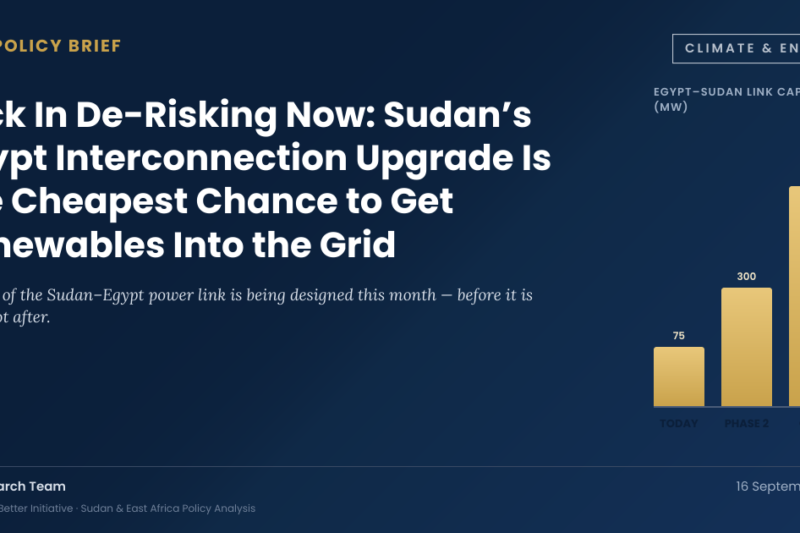
Lock In De-Risking Now: Sudan’s Egypt Interconnection Upgrade Is the Cheapest Chance to Get Renewables Into the Grid
Sudan's Egypt interconnection is being redesigned this month. 3Bi recommends locking in a renewable-generation share and a currency-risk guarantee now, before Phase 2 is built on last decade's…
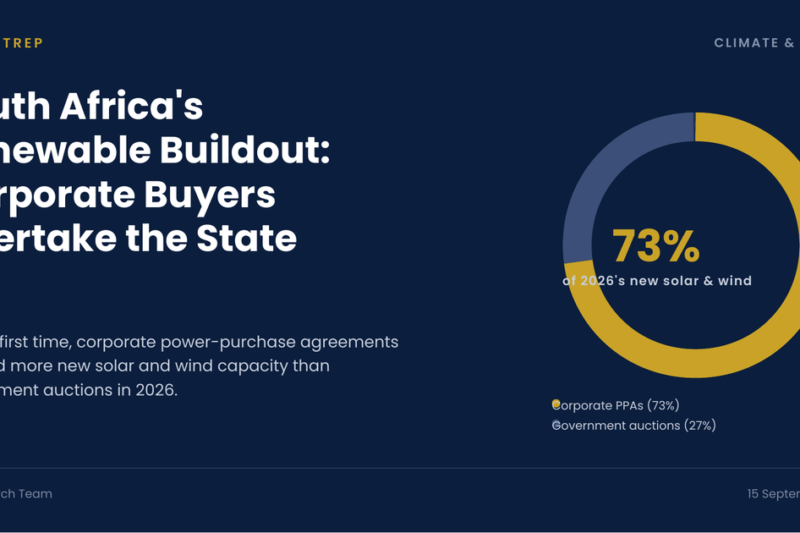
SITREP: South Africa’s Renewable Buildout — Corporate Buyers Overtake the State
For the first time, corporate power-purchase agreements will fund more of South Africa's new solar and wind capacity than government auctions in 2026 — even as national renewable…