Africa’s Record Solar Year — And Sudan’s Absence From It
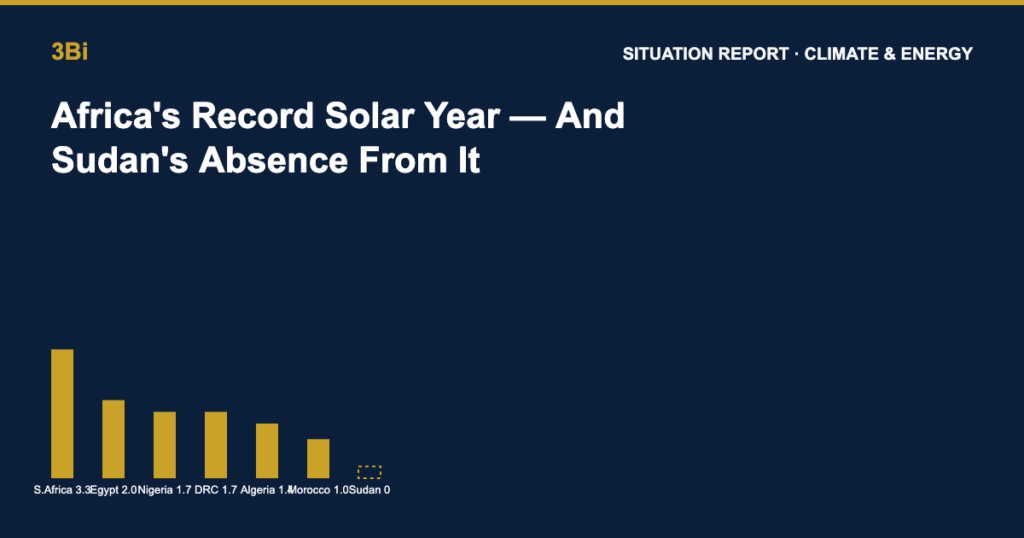
Africa is on track for a record 17GW of solar in 2026, up 45% year-on-year — but Sudan doesn't appear among the countries driving the boom, and solar remains just 0.23% of its grid mix.
Headline Fact
Africa is set to install a record 17 gigawatts (GW) of solar power in 2026 — up 45% year-on-year for a third consecutive record year — according to new estimates published by energy think tank Ember on 28 August 2026 and picked up in detail by regional energy outlet Attaqa on 11 September 2026. Three-quarters of that capacity, roughly 20 GW installed since 2023, is small-scale distributed or rooftop solar that barely appears in official national statistics. Sudan does not appear among the six countries driving the boom.
Timeline
28 August 2026 — Ember, working with the African Tech Futures Lab, publishes "The take-off in African solar that official statistics can’t yet see," building its estimate from Chinese customs export data rather than incomplete national reporting. The report finds Africa installed roughly 100,000 solar panels a day through 2026, following a 51% rise in 2025 and a 25% rise in 2024.
Same week — Bloomberg, Semafor, ESI-Africa, and Forbes Africa independently report the Ember figures, confirming the headline numbers (17 GW in 2026; 75% distributed) without material discrepancy.
11 September 2026 — Attaqa publishes an Arabic-language breakdown crediting Pakistan’s 2023-2025 experience (27 GW of distributed solar added, a 21% jump in electricity demand) as the template African markets are now following. It identifies the six countries expected to add more than 1 GW each in 2026: South Africa (3.3 GW), Egypt (2 GW), Nigeria (1.7 GW), the Democratic Republic of Congo (1.7 GW), Algeria (1.4 GW), and Morocco (1 GW).
12 September 2026 — 3Bi cross-checks the country list and the underlying Sudan data: none of the reporting identifies Sudan among either the top additions or the broader distributed-solar wave. Separately, Sudan’s own numbers, per a UNDP Solar Energy Value Chain Study published in March 2026, show solar contributing just 0.23% of Sudan’s electricity mix, against roughly 66% national electrification (Al-Rikabi et al., 2025, Engineering Reports) — already among the lowest access rates in the region even before the current war disrupted grid operations further.
What We Know / What We Don’t
We know: the 17 GW/45% figures are independently corroborated across five outlets citing the same Ember dataset; the six named top-adding countries are drawn directly from that dataset; Sudan’s 0.23% solar share and 66% access figure come from separately published, dated academic and UN sources, not from the Ember report itself, which does not appear to disaggregate Sudan at all.
We don’t know: whether Sudan’s absence from Ember’s country breakdown reflects genuinely negligible installation activity, a data gap caused by the conflict (Ember’s method relies on customs and market data that a fragmented, war-affected state may not generate in trackable form), or both. We also do not have a verified 2026 estimate for Sudan-specific distributed solar imports comparable to the continent-wide $2.4 billion in Chinese panel imports Attaqa cites for the 12 months to June 2026 — Sudan’s share of that figure is not broken out in any source reviewed.
Do-No-Harm Note
This item concerns energy-market and infrastructure data, not named individuals, displaced populations, or active combat. No identifying details of any community or person were involved; no do-no-harm review issue was identified.
What to Watch
The World Bank’s ASCENT-Sudan project ($76.3 million, IDA-financed) and the smaller GEF/UNDP off-grid solar programme (~$2.9 million, running through 2026) are the two live channels that could move Sudan off zero in next year’s Ember count — watch for disbursement or procurement announcements from either. Watch also for Ember’s next quarterly update (historically released alongside IRENA’s annual statistics in Q1) to see whether Sudan is added to the tracked-country list at all, which would itself be a signal that installation activity has become large enough to register.
Sourcing & Next Update
Ember, "The take-off in African solar that official statistics can’t yet see" (28 August 2026); Attaqa.net, "الطلب على الكهرباء في أفريقيا.. هل تكسر الطاقة الشمسية حالة الجمود؟" (11 September 2026); Bloomberg, Semafor, ESI-Africa, Forbes Africa (26 August-1 September 2026, corroborating); UNDP Sudan Solar Energy Value Chain Study (March 2026); Al-Rikabi et al., "Renewable Energy in Sudan: Current Status and Future Prospects," Engineering Reports (2025); World Bank ASCENT-Sudan project documentation. This is a single-edition SitRep; 3Bi will issue a follow-up if Sudan-specific installation data becomes available or if either financing channel above shows movement.
This publication was produced through 3Bi’s automated daily publications workflow, which monitors regional and international climate and energy reporting.
This publication is produced with support from 3Bi’s institutional donors; see the full funder list at 3bisudan.org.
About the Authors
Related Publications
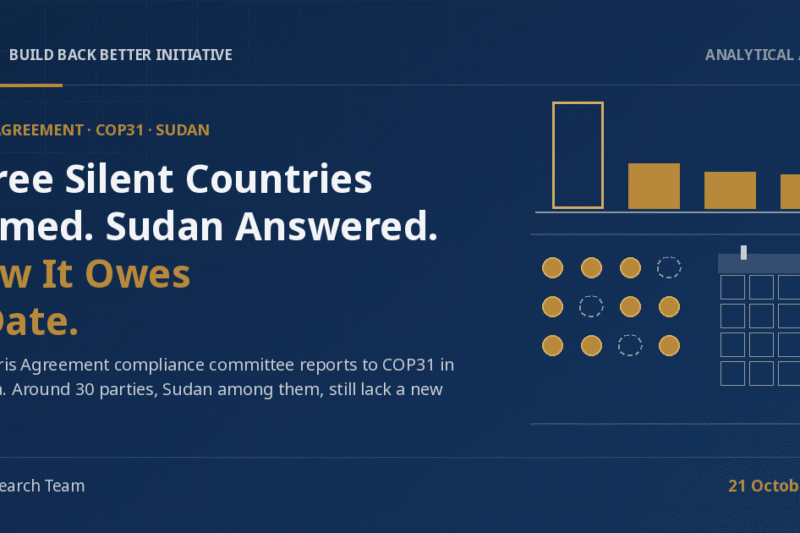
The Paris Compliance Committee Named Three Silent Countries. Sudan Answered. Now It Owes a Date.
The Paris Agreement's compliance committee has named three countries that ignored its letters on missing climate plans. Sudan is not among them: it replied. Before COP31, 3Bi argues,…
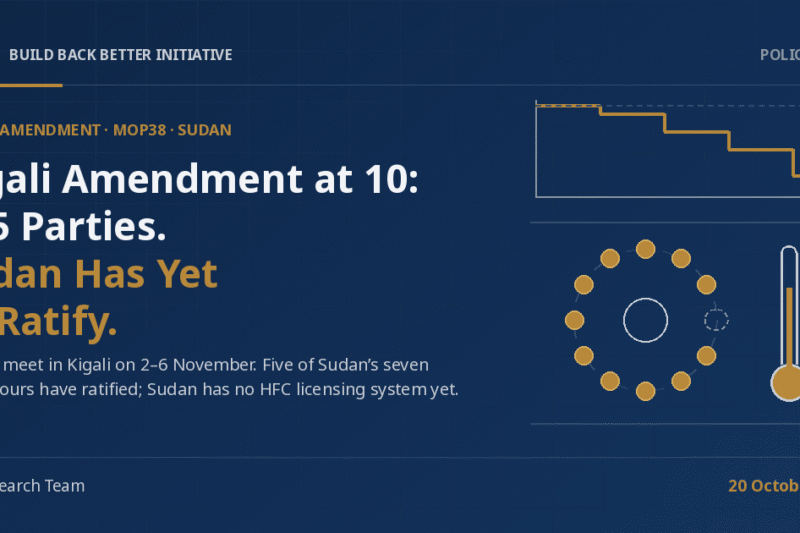
The Kigali Amendment Turns 10 With 175 Parties. Sudan Should Ratify Before the Montreal Protocol Meets in Kigali.
Ten years after the Kigali Amendment was adopted, 175 of 198 Montreal Protocol parties have ratified it. Sudan has not. As parties meet in Kigali on 2–6 November,…
The Adaptation Fund Board Meets in Bonn With US$146.8 Million to Approve. Sudan Has No Project of Its Own.
The Adaptation Fund Board meets in Bonn from 19 to 23 October with US$146.8 million in approvals before it, including a US$30 million Mandera Triangle project. Sudan has…