Heat Deaths Are Up 36% Since Paris, the Lancet Countdown Says. COP31 Has Put Health on Its Agenda. Sudan Should Sign the Belém Health Action Plan Before Antalya.
3Bi Research Team | Analytical Article | 30 October 2026
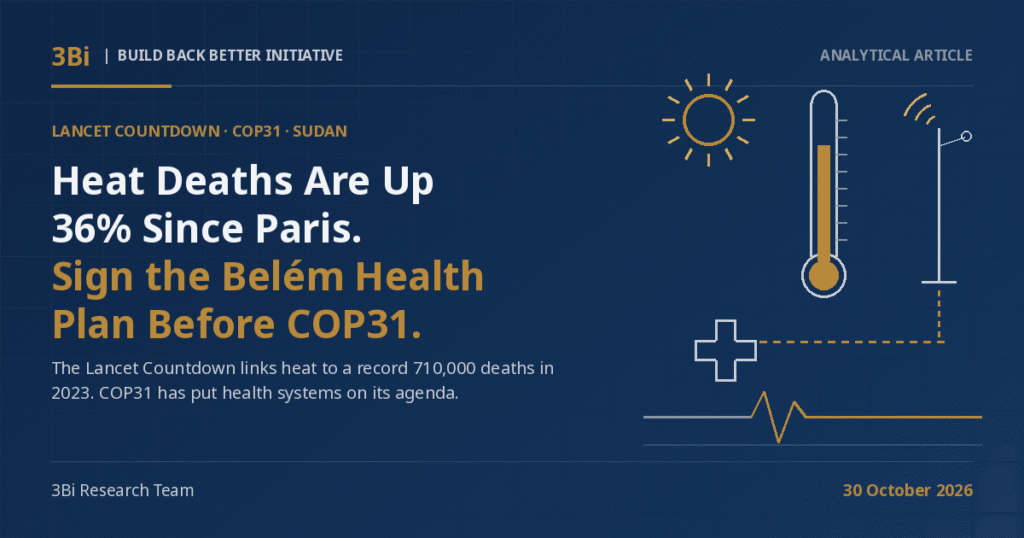
The Lancet Countdown says heat-related deaths are up 36% since the Paris Agreement, and COP31 has put health systems on its agenda. Egypt, Ethiopia and Kenya have joined the main climate-and-health frameworks. Sudan has not. One diplomatic note before Antalya would change that.
The 2026 Lancet Countdown on Health and Climate Change, released on 28 October 2026 ahead of COP31, links heat to a record 710,000 deaths in 2023. 3Bi could not find Sudan among the Belém Health Action Plan’s endorsers or ATACH’s members. (Illustration: 3Bi)
3Bi Research Team | Analytical Article | 30 October 2026
The Hook
Ten days before COP31 opens in Antalya, the world’s main scientific tracker of climate and health has published its starkest warning yet. The 2026 report of the Lancet Countdown on Health and Climate Change, released on 28 October and produced in strategic collaboration with the World Health Organization (WHO), finds that annual heat-related deaths were nearly 36% higher in the years after the Paris Agreement than in the decade before. In 2023 alone, heat was linked to a record 710,000 deaths, with more than 70% of that burden attributed to human-caused climate change (WHO, 28 October 2026). Heat exposure also cost 573 billion potential work hours in 2025, 35% more than the 2006–15 average, and extreme drought affected more than half of the world’s land for at least a month that year (Lancet Countdown 2026 Data Explorer, accessed 30 October 2026). The report’s authors want climate change formally treated as a global health emergency (Lancet Countdown, 28 October 2026).
The diplomacy is moving with the science. In May, Türkiye’s Ministry of Health confirmed that “dynamic and resilient health systems” had been formally included as a priority item on the COP31 action agenda, which it described as a first in COP history. It also committed to holding a Health Day at COP31 (WHO, 20 May 2026). WHO will run a Health Pavilion in Antalya throughout the conference, from 9 to 20 November (WHO, 28 October 2026).
Our argument is that Sudan should arrive in Antalya inside the two frameworks that will shape this agenda: the Belém Health Action Plan (BHAP), launched at COP30, and the WHO-hosted Alliance for Transformative Action on Climate and Health (ATACH). Neither is a treaty. Both are cheap to join. And Sudan’s health system has already started the work that both frameworks are built to support.
The Argument
First, Sudan’s neighbours have signed, and Sudan has not. The latest list of BHAP endorsements, issued by Brazil’s Ministry of Health in Brasília on 5 October 2026, names 39 countries. They include Egypt, Ethiopia, Kenya, South Sudan, Iraq and the United Arab Emirates (Brazilian Ministry of Health, BHAP endorsement list, 5 October 2026). Sudan is not on it. The same is true of ATACH. Its website lists 108 countries and areas that have made commitments at health-minister level to make their health systems more climate-resilient, more low-carbon, or both. Egypt, Ethiopia, Kenya, Uganda, Somalia, Tanzania, Yemen and Jordan are among them. 3Bi could not find Sudan on the list (ATACH, “Countries and areas”, accessed 30 October 2026). We are not suggesting that Sudan has declined to join. More likely, nobody has yet sent the paperwork. But the result is the same: when health ministers compare notes in Antalya, Sudan will be outside both rooms.
Second, the plan asks for what Sudan already needs. The BHAP is built around three action lines. The first is surveillance and monitoring. It calls on countries to build partnerships between health institutions and meteorological agencies, to develop early-warning systems adapted to local climates, and to give communities practical tools such as heat maps, seasonal alerts and health-specific climate bulletins (Belém Health Action Plan, Action Line 1, measures 1.1.1–1.1.6). For Sudan, that is not an abstract agenda. It describes the link between a heat forecast and a clinic that Sudan does not yet appear to have in published form. 3Bi could not find a published health-sector climate adaptation plan for Sudan. That does not mean none is being drafted. If one exists, publishing it would strengthen Sudan’s case in Antalya.
Egypt shows how quickly this can move. In February, its Ministry of Health and Population reviewed the final draft of a national health adaptation plan for 2026–2030, with the Egyptian Meteorological Authority, the finance and environment ministries, WHO and UNICEF in the room. The plan covers climate-risk forecasting, flood and extreme-weather planning for health services, and early warning for climate-linked diseases (Youm7, reported by Sudan Independent, 17 February 2026). Egypt has also endorsed the BHAP and is an ATACH member.
Third, the groundwork in Sudan is real, and it is recent. In February, Sudan’s Federal Ministry of Health met the Higher Council for Environment and Natural Resources (HCENR) to discuss how climate change is affecting public health, including the spread of vector-borne diseases. The two agreed to reactivate the “One Health” platform, which brings HCENR together with the ministries of health, agriculture, forestry and livestock. They also agreed to set up a coordination mechanism that would link health, environment, mining and water institutions to monitor diseases with environmental roots (Sudan Government Spokesperson platform, 24 February 2026). Then, on 25 October, WHO’s Sudan office issued a request for proposals to adapt and finalise a training package for community health workers on climate-related health risks, in Arabic and English and for online and offline use (UN Global Marketplace, notice WHO/SUD/PROC/2026/0067, published 25 October 2026). Community health workers are the people who would carry a heat warning to the households that need it. The pieces of a climate-and-health system are being assembled. What is missing is the international frame that would make them visible, comparable and easier to fund.
Why It Matters to the Reader
The strongest objection is that Sudan’s health system has more urgent priorities than signing voluntary declarations, and that a signature changes nothing on the ground. That is a fair concern, and 3Bi is not arguing that a signature is a substitute for clinics, staff or medicines. Our narrower point is about cost and timing. The BHAP is endorsed by sending a formal note verbale to the Brazilian Embassy, with a copy to Brazil’s Ministry of Health (Belém Health Action Plan, “How to endorse”). Reporting is voluntary and goes to WHO. By COP33 in 2028, endorsing parties will be invited to report progress through the Global Stocktake, aligned with the Global Goal on Adaptation indicators (Belém Health Action Plan, “Reporting and coordination mechanisms”). Those are indicators Sudan will be asked about anyway. ATACH membership is requested from WHO, which acts as the alliance’s secretariat (ATACH, “Structure and governance”, accessed 30 October 2026). Neither step needs new money. Both put Sudan in the networks where technical help and peer learning on climate-resilient health systems are being organised.
If you work in the Federal Ministry of Health, the Ministry of Foreign Affairs or HCENR, three low-cost steps follow.
First, before COP31 opens on 9 November, send the note verbale endorsing the Belém Health Action Plan. If that cannot be done in time, announce the intention at COP31’s Health Day and send the note in the weeks after. Either way, Sudan’s health adaptation work would have a home in the UNFCCC process.
Second, ask WHO to register Sudan’s commitment to ATACH at ministerial level, starting with the climate-resilient health systems track. Sudan already works with WHO on climate and health, as the community health worker tender shows. Joining ATACH would formalise that relationship and put Sudan in the same peer group as Egypt, Ethiopia and Kenya.
Third, connect the new community health worker training to weather information. The BHAP’s first action line asks for health and meteorological agencies to work together. A simple start would be for the Sudan Meteorological Authority to share heat and flood advisories with the health ministry’s emergency and disease-control teams, so that community health workers trained under the new package receive them. This could be done through the One Health platform the ministry agreed to reactivate in February.
Close
The Lancet Countdown’s message this week is that climate harm to health is growing faster than the response. Sudan cannot change that trend on its own. It can, however, make sure that its own response is counted, connected and supported. A diplomatic note and a letter to WHO are among the cheapest climate decisions Sudan could take before Antalya. We will follow up after COP31 with an update on which countries endorsed the Belém Health Action Plan during the conference, and whether Sudan is among them.
Sourcing & Contact
Primary sources: World Health Organization, “Climate change is a growing health emergency, Lancet Countdown warns”, 28 October 2026; Lancet Countdown, “The 2026 Global Report of the Lancet Countdown” (report page), 28 October 2026; Lancet Countdown 2026 Data Explorer, indicators 1.1.5 (heat-related mortality) and 1.1.3 (change in labour capacity) and the health hazards and impacts overview, accessed 30 October 2026; World Health Organization, “Belem Health Action Plan High Level Side Event, World Health Assembly”, 20 May 2026; Brazilian Ministry of Health, “Plano de Ação em Saúde de Belém para a Adaptação à Mudança do Clima: Lista de Endossos” (Belém Health Action Plan: list of endorsements), Brasília, 5 October 2026; Belém Health Action Plan for the Adaptation of the Health Sector to Climate Change (English text, WHO-hosted copy); ATACH, “Countries and areas” and “ATACH structure and governance”, accessed 30 October 2026; UN Global Marketplace, WHO Sudan request for proposals WHO/SUD/PROC/2026/0067, published 25 October 2026; Sudan Government Spokesperson platform, “وزارة الصحة تعقد إجتماعاً تنسيقياً مع المجلس الأعلى للبيئة” (Ministry of Health holds coordination meeting with the Higher Council for Environment), 24 February 2026; Sudan Independent, citing Youm7, “الصحة: مراجعة شاملة للخطة الوطنية للتكيف الصحي مع تغيرات المناخ 2026–2030” (Health: comprehensive review of the national health adaptation plan, 2026–2030; an Egyptian Ministry of Health and Population item), 17 February 2026; Climate Home News, “Africa wants adaptation finance on COP31 agenda, raising risk of a fight”, 28 October 2026 (COP31 dates). For methodology questions or to propose a correction, contact 3Bi’s Research Team via 3bisudan.org.
3Bi Research Team. This piece was produced through 3Bi’s automated daily publications workflow, which monitors regional and international climate and energy reporting.
This publication is produced with support from 3Bi’s institutional donors; see the full funder list at 3bisudan.org.
About the Authors
Related Publications
COP31 Gave the UN’s Farm-Climate Talks One More Year in a Two-Paragraph Text. Sudan Should Use That Year to Bring Its Farm Projects to COP32.
COP31 has given the UN’s only agriculture work programme one more year, in a two-paragraph decision that says nothing about finance for farmers. Sudan, where about 40% of…
COP31’s Early-Warning Stocktake Says Systems Fail When the Projects End. Sudan Has a Roadmap. Now It Needs a Budget That Lasts.
A COP31 stocktake finds Africa improved early warning faster than any region, but warns that systems falter when project money ends. Sudan now has a roadmap. It should…
COP31 Wants Loss and Damage Help Delivered Faster. Sudan Is Not Among the 17 Active Requests. Name a Liaison and File One in Antalya.
COP31 is writing rules to speed up the Santiago Network, the UN’s loss and damage help desk, which has 17 active requests, including Yemen, Iraq and Kenya. Sudan…