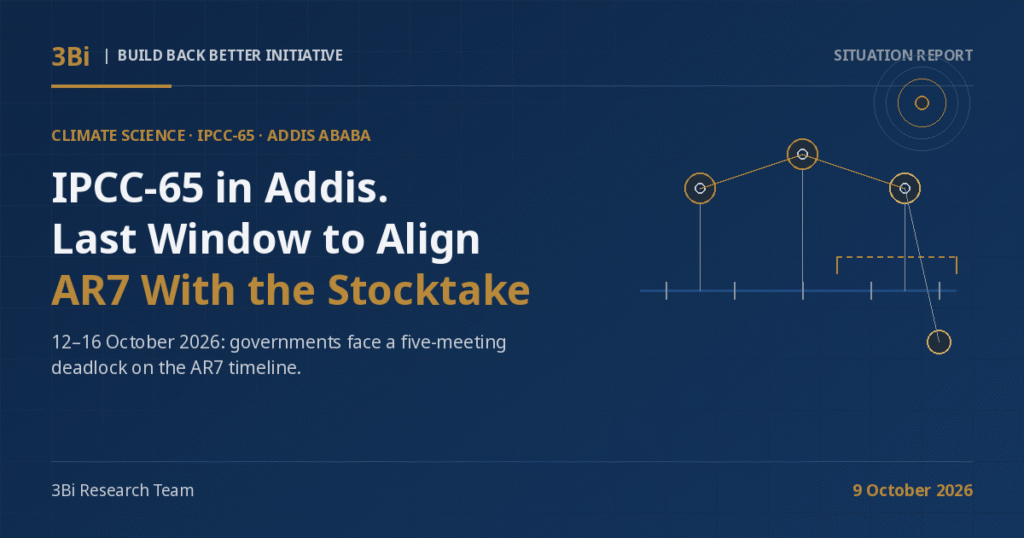
IPCC-65 Meets in Addis Ababa: Last Window to Align AR7 With the 2028 Stocktake
3Bi Situation Report — Climate & Energy Desk | First edition
IPCC-65 meets in Addis Ababa, 12–16 October 2026 — likely the last chance to align AR7 reports with the 2028 global stocktake. 3Bi Situation Report — Climate & Energy Desk | First…
IPCC-65 meets in Addis Ababa, 12–16 October 2026 — likely the last chance to align AR7 reports with the 2028 global stocktake.
3Bi Situation Report — Climate & Energy Desk | First edition | Information cut-off: 9 October 2026, 04:00 UTC
Headline Fact
The Intergovernmental Panel on Climate Change’s 65th session (IPCC-65) opens in Addis Ababa, Ethiopia, on 12 October 2026 and runs through 16 October, at the UN Economic Commission for Africa conference centre (IPCC Secretariat, provisional annotated agenda, 7 October 2026; Earth Negotiations Bulletin IPCC-65 page; Carbon Brief, Cropped, 7 October 2026). After five consecutive sessions ended without agreement on when the seventh assessment cycle’s (AR7) working-group reports will be published, Carbon Brief’s April 2026 Q&A — updated in July — describes this Addis meeting as likely the last moment at which governments could still lock in a timeline that keeps those reports synchronised with the Paris Agreement’s second global stocktake, which culminates at COP33 in 2028 (Carbon Brief, 2 April 2026, updated July 2026).
Timeline
- July 2023: AR7 formally begins at IPCC-59 in Nairobi (Carbon Brief, 2 April 2026).
- January 2024: Governments agree that the AR7 synthesis report will be published in 2029, but they do not yet ratify delivery dates for the three working-group reports that precede it (Carbon Brief, 2 April 2026).
- 2024–March 2026: Timeline talks deadlock at five successive sessions — Istanbul, Sofia, Hangzhou, Lima and Bangkok — an outcome Carbon Brief has described as unprecedented for an assessment cycle (Carbon Brief, 2 April 2026; Carbon Brief, 1 April 2026).
- March 2026 (IPCC-64, Bangkok): About 330 delegates from more than 100 countries fail to agree a way forward on the AR7 timeline. IPCC chair Prof Jim Skea describes the meeting to Carbon Brief as “frustrating and disappointing,” with “minimal outcomes.” Outstanding items, including the timeline, are pushed to IPCC-65 in Addis Ababa (Carbon Brief, 1 April 2026).
- 7 October 2026: Carbon Brief’s Cropped newsletter lists IPCC-65 for 12–16 October in Addis Ababa. The IPCC Secretariat’s annotated agenda confirms the same dates and the UNECA venue (Carbon Brief, 7 October 2026; IPCC Secretariat, 7 October 2026).
- 12–16 October 2026: IPCC-65 convenes. The Earth Negotiations Bulletin previews the session as the Panel’s chance to resolve the AR7 delivery plan, noting that budget approval for the rest of the cycle hinges on the anticipated workload (Earth Negotiations Bulletin, IPCC-65 about page).
What We Know / What We Don’t
We know the venue, dates and host: Addis Ababa, 12–16 October 2026, confirmed by the IPCC Secretariat and listed by Carbon Brief and the Earth Negotiations Bulletin. We know that for five meetings running, governments have failed to approve delivery dates for Working Group I (physical science), Working Group II (impacts and adaptation) and Working Group III (mitigation). We know the broad split: one camp wants all three reports in 2028 so they can inform the second global stocktake; another — with India, Kenya, Russia and Saudi Arabia among the most vocal, per Earth Negotiations Bulletin write-ups cited by Carbon Brief — argues that developing-country authors, experts and governments need more time to review and approve, which would push one or more reports past the stocktake (Carbon Brief, 2 April 2026; Carbon Brief, 1 April 2026). We know Dr Bill Hare of Climate Analytics told Carbon Brief that a stocktake-aligned timeline has majority support “across geographies and levels of development, including least developed countries and small-island developing states” (Carbon Brief, 2 April 2026). We know Skea wants a decision by the end of 2026, because proposals diverge in 2027 and the 2027 budget needs certainty, and that scientific drafting has continued with lead-author meetings and zero-order drafts already under way by Bangkok (Carbon Brief, 2 April 2026; Carbon Brief, 1 April 2026).
We do not know whether Addis will produce consensus. We do not know which of the four timeline options Skea counted as still feasible — two that finish all working-group reports before the 2028 stocktake, two that leave Working Groups II and III into 2029 — will prevail, if any do (Carbon Brief, 2 April 2026). We do not claim a verified Sudanese national position at IPCC-65; none of the sources we reviewed names one. We also do not treat “majority support” as a formal vote count — IPCC decisions run by consensus, and Bangkok showed how easily that can fail.
Implications
For East Africa and the wider African climate calendar, the location matters. Ethiopia hosts this decisive IPCC business meeting and is also the accepted host of COP32 in Addis Ababa from 8 to 19 November 2027 (UNFCCC dates-and-venues decision; Reuters, 11 November 2025; African Union Commission, 14 November 2025). African governments are not of one voice on AR7 timing: Kenya has argued for a slower review schedule on inclusivity grounds, while many least developed and small-island states have backed a stocktake-aligned path (Carbon Brief, citing Earth Negotiations Bulletin, 1–2 April 2026). Readers in Sudan and neighbouring states should watch the outcome as users of IPCC products; this report does not document a Sudanese national position.
For the Paris Agreement’s ambition cycle, the stakes are concrete. The second global stocktake’s information-collection phase is due to begin at COP31 in Antalya in November 2026; the technical assessment runs from June 2027 to June 2028; the political phase culminates at COP33 in November 2028 (Carbon Brief, 2 April 2026). A compromise timeline discussed by IPCC co-chairs could still place Working Group I in the technical phase and Working Groups II and III in time for the political phase — but only if governments decide now (Carbon Brief, 2 April 2026). If the reports slip past the stocktake, Climate Analytics’ Hare has warned that the disconnect would be a “major historical break” that could be used to weaken the Paris process (Carbon Brief, 2 April 2026). 3Bi is not predicting that outcome; we are recording the risk the cited sources describe.
Watch Next
- 12–16 October 2026: Whether IPCC-65 adopts a working-group delivery timeline, and whether that timeline keeps all three reports available for the second stocktake’s 2028 political phase (Earth Negotiations Bulletin; IPCC Secretariat).
- By end of 2026: Skea’s stated deadline for a decision that can still support a coherent 2027 budget and schedule (Carbon Brief, 2 April 2026).
- 9–20 November 2026: COP31 in Antalya, where the second stocktake’s information phase is due to open (Carbon Brief, 2 April 2026).
- 8–19 November 2027: COP32 in Addis Ababa — the next major UNFCCC summit on the same host city’s calendar (UNFCCC dates-and-venues decision).
Sourcing & Next Update
Primary sources: Carbon Brief, “Q&A: Why the standoff between nations over the next IPCC reports matters” (2 April 2026, updated July 2026); Carbon Brief, “IPCC: ‘Frustrating and disappointing’ meeting leaves AR7 timeline in deadlock” (1 April 2026); Carbon Brief, “Cropped 7 October 2026” (7 October 2026); IPCC Secretariat, IPCC-65 provisional annotated agenda (7 October 2026); Earth Negotiations Bulletin, IPCC-65 about page; UNFCCC dates-and-venues decision (COP32, Addis Ababa, 8–19 November 2027); Reuters (11 November 2025); African Union Commission statement (14 November 2025). For methodology questions or to propose a correction, contact 3Bi’s Research Team via 3bisudan.org.
Next update expected when IPCC-65 closes or when a formal AR7 timeline decision is published.
3Bi Research Team. This piece was produced through 3Bi’s automated daily publications workflow, which monitors regional and international climate and energy reporting.
This publication is produced with support from 3Bi’s institutional donors; see the full funder list at 3bisudan.org.
About the Authors
Related Publications
The Paris Compliance Committee Named Three Silent Countries. Sudan Answered. Now It Owes a Date.
The Paris Agreement's compliance committee has named three countries that ignored its letters on missing climate plans. Sudan is not among them: it replied. Before COP31, 3Bi argues,…
The Kigali Amendment Turns 10 With 175 Parties. Sudan Should Ratify Before the Montreal Protocol Meets in Kigali.
Ten years after the Kigali Amendment was adopted, 175 of 198 Montreal Protocol parties have ratified it. Sudan has not. As parties meet in Kigali on 2–6 November,…
The Adaptation Fund Board Meets in Bonn With US$146.8 Million to Approve. Sudan Has No Project of Its Own.
The Adaptation Fund Board meets in Bonn from 19 to 23 October with US$146.8 million in approvals before it, including a US$30 million Mandera Triangle project. Sudan has…