
Pre-COP31 Wrote a Plan to Unblock Climate Finance for the Poorest Countries. Thirty-Two of Them Are African.
3Bi Research Team | Analytical Article | 10 October 2026
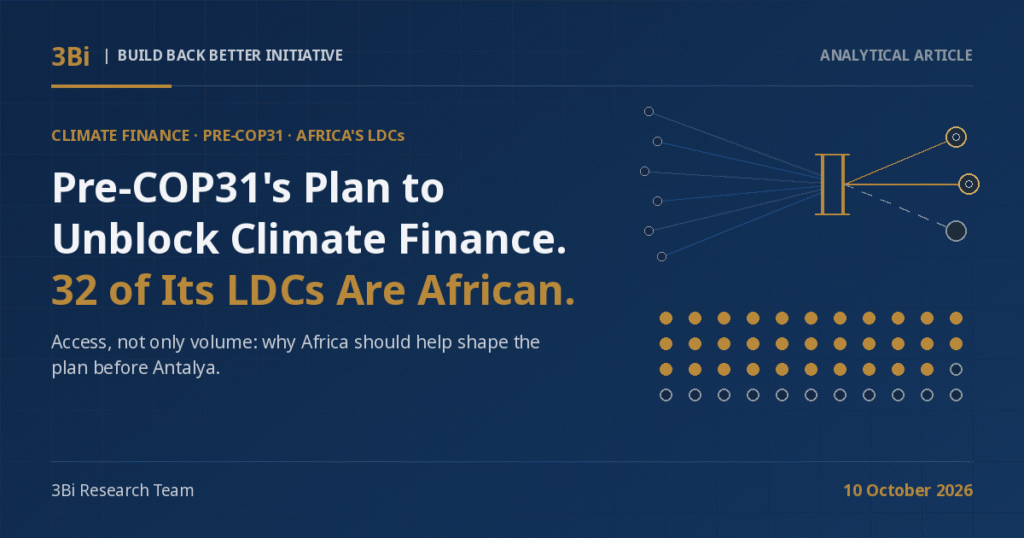
Pre-COP31 in Fiji closed on 8 October with an Australian plan to make climate finance easier for small islands and least developed countries to reach. Thirty-two of the 44 LDCs are African, Sudan included. Africa should help shape the plan before Antalya.
Pre-COP31 in Nadi, Fiji, closed on 8 October 2026 with an Access to Finance plan for small island states and least developed countries — 32 of the 44 LDCs are African.
3Bi Research Team | Analytical Article | 10 October 2026
The Hook
The pre-COP31 meeting in Nadi, Fiji, closed on 8 October with the usual declarations about keeping 1.5C within reach. COP31 president Murat Kurum called the goal “a matter of survival” (Carbon Brief, citing Reuters, 9 October 2026). The outcome with the most practical reach for Africa was quieter. Australia, which holds the presidency of the COP31 negotiations, launched an Access to Finance Statement and Action Plan for small island developing states (SIDS) and least developed countries (LDCs), and asked governments and multilateral development banks to back it (Climate Home News, 8 October 2026; Australia–Pacific Partnership for COP31, 8 October 2026). The plan grew out of Pacific frustration with red tape, slow disbursement and loan-heavy terms. Yet 32 of the 44 countries on the UN’s list of LDCs are in Africa, and Sudan is one of them (UN-OHRLLS, list of LDCs, accessed 10 October 2026). On paper, a plan written for the Pacific is also a plan for the Horn of Africa and the Sahel. COP31 opens in Antalya on 9 November (PINA, 9 October 2026). African governments have about a month to decide whether to treat this plan as their own.
The Argument
First, the plan names the right bottleneck: access, not only volume. The Pacific brought hard numbers to Nadi. More than US$16 billion in climate finance has been committed to Pacific countries since the Paris Agreement, but over US$5 billion of it remains undisbursed (Australia–Pacific Partnership for COP31, 8 October 2026). Nauru’s president, David Adeang, listed the obstacles: “complicated procedures, heavy reporting, delays in approval and disbursement”. The Green Climate Fund’s executive director, Mafalda Duarte, said the coastal adaptation project that leaders visited in Tuvalu showed “climate finance works”, while noting that it took eight years to implement (Climate Home News, 6 October 2026). Chiara Falduto of the think tank E3G put it plainly: for SIDS and LDCs, “the problem is not only how much climate finance is being provided, but how hard it is to reach” (E3G, 9 October 2026). Africa’s own numbers point the same way. Mohamed Adow of Power Shift Africa, writing in Climate Home News, puts Africa’s annual adaptation needs at close to US$70 billion, against adaptation finance flows of around US$14 billion (Climate Home News, 5 October 2026). That is an advocacy estimate, not an official tally, but it frames the gap that access reforms are meant to narrow. At a pre-COP31 strategy meeting for African negotiators, the chair of the African Group of Negotiators, Dr Nana Antwi-Boasiako Amoah, said: “Antalya must therefore be about delivery, not another cycle of pledges and promises” (Science Africa, 9 October 2026).
Second, the plan’s terms match what African negotiators already ask for. According to Climate Home News, the plan stresses the need for “grant-based and highly concessional financing”, especially for adaptation and for responding to loss and damage (Climate Home News, 8 October 2026). That is close to the African line. Kwame Ababio of the African Union Development Agency (AUDA-NEPAD) cautioned that a shift towards loans could worsen the debt burden of developing countries, warning that the current path “is likely to deepen our debt profile”. He called a tripling of adaptation finance “the barest minimum” (Science Africa, 9 October 2026). Pacific leaders made the same case in starker words. Palau’s president, Surangel Whipps Jr, said islands in trouble are offered “loans, debt that adds weight to a sinking boat” (Climate Home News, 6 October 2026). The Taku Pakasoa Declaration endorsed in Nadi calls for “direct, accessible, and grant-based climate finance” (PINA, 9 October 2026). The co-hosts are also building support for a presidency-led COP31 decision that would back the pathway to US$1.3 trillion in climate finance and more adaptation funding for vulnerable countries (Australia–Pacific Partnership for COP31, 8 October 2026; The Straits Times, 8 October 2026). For African negotiators, that means an ally in the chair on the terms of finance, not only on the totals.
Third, the plan is voluntary, so it only becomes Africa’s if African governments join it. The organisers say other countries can join the plan as part of the COP31 Action Agenda (Australia–Pacific Partnership for COP31, 8 October 2026). Its main tracking tool is a proposed annual high-level forum on climate finance access (Climate Home News, 8 October 2026). A forum like that will measure what it is shown. The Pacific arrived with a disbursement figure. African governments will need comparable country-level evidence: what was approved, what was actually paid out, and how long it took. Two moments already exist to assemble it. Dr Rose Mwebaza, who directs UNEP’s Africa office, pointed to a planned joint session of African environment and finance ministers in March 2027 on financing climate responses. Walters Tubua of the UNFCCC’s Regional Collaboration Centre urged countries to come to COP31 with well-developed projects that can attract funding (Science Africa, 9 October 2026). 3Bi has not seen the full text of the plan. This analysis relies on the organisers’ summary and on press reporting, and we are not claiming the plan will move money by itself.
Why It Matters to the Reader
If you work on climate finance for Sudan, in a ministry or a donor office, the plan already covers you. Sudan is on the UN’s LDC list, as are Ethiopia, Eritrea, Djibouti, Somalia, South Sudan, Uganda and Tanzania (UN-OHRLLS, accessed 10 October 2026). What the plan will not do is prepare your projects. Access reforms reward countries that arrive with projects ready to fund. Sudan’s power sector shows early signs of that groundwork. On 6 October, Sudan Electricity Holding Company opened prequalification for local manufacturers, contractors, suppliers and consultants that want to work on public and private solar projects, with applications due by 30 November 2026 (Alsudantoday, citing Al-Tayar, 6 October 2026). A prequalified supplier base is not yet a bankable project. It is, though, the kind of preparation that faster and simpler finance windows are designed to reach.
Our view is that Sudan’s climate-finance focal points, and those of its East African neighbours, should endorse the access plan before Antalya. They should also ask that its first annual forum track African cases by name: approval times, disbursement rates and the share of grants. The region has a second reason to engage early. Ethiopia hosts COP32 in Addis Ababa in 2027 (UNFCCC dates-and-venues decision; Reuters, 11 November 2025). That would be a natural moment for the forum to show whether access has improved for African LDCs, not only for Pacific islands. 3Bi is not suggesting the plan replaces the larger fight over how much finance flows. It is one practical lever, and it is on the table now.
Close
The Pacific turned its frustration into a plan. Africa has 32 reasons to help write its next chapter before Antalya.
Sourcing & Contact
Primary sources: Climate Home News, “Pre-COP draws attention to Pacific’s climate plight and 1.5C goal” (8 October 2026); Climate Home News, “Pacific leaders rail at climate finance failures after pre-COP trip to Tuvalu” (6 October 2026); Climate Home News, comment by Mohamed Adow, “Africa should not have to adapt to an unjust climate system” (5 October 2026); Australia–Pacific Partnership for COP31, “Pacific Pre-COP sets launchpad for climate summit in Türkiye” (8 October 2026); PINA, “With the Taku Pakasoa Declaration, Pacific countries look to turn political momentum to delivery at COP31” (9 October 2026); E3G, “Positive tone for cooperation at Pre-COP – setting the stage for COP31” (9 October 2026); The Straits Times (AFP), “COP31 organisers aim to break negotiating deadlock with bold climate blueprint” (8 October 2026); Carbon Brief, “DeBriefed 9 October 2026” (9 October 2026); Science Africa, “New Push for Grant-based Climate Finance as Adaptation Needs Soar” (9 October 2026); UN-OHRLLS, list of least developed countries (accessed 10 October 2026); Alsudantoday, citing Al-Tayar, on Sudan Electricity Holding Company’s solar prequalification (6 October 2026); UNFCCC dates-and-venues decision and Reuters (11 November 2025) on COP32 in Addis Ababa. For methodology questions or to propose a correction, contact 3Bi’s Research Team via 3bisudan.org.
3Bi Research Team. This piece was produced through 3Bi’s automated daily publications workflow, which monitors regional and international climate and energy reporting.
This publication is produced with support from 3Bi’s institutional donors; see the full funder list at 3bisudan.org.
About the Authors
Related Publications
The Paris Compliance Committee Named Three Silent Countries. Sudan Answered. Now It Owes a Date.
The Paris Agreement's compliance committee has named three countries that ignored its letters on missing climate plans. Sudan is not among them: it replied. Before COP31, 3Bi argues,…
The Kigali Amendment Turns 10 With 175 Parties. Sudan Should Ratify Before the Montreal Protocol Meets in Kigali.
Ten years after the Kigali Amendment was adopted, 175 of 198 Montreal Protocol parties have ratified it. Sudan has not. As parties meet in Kigali on 2–6 November,…
The Adaptation Fund Board Meets in Bonn With US$146.8 Million to Approve. Sudan Has No Project of Its Own.
The Adaptation Fund Board meets in Bonn from 19 to 23 October with US$146.8 million in approvals before it, including a US$30 million Mandera Triangle project. Sudan has…