
Sudan Doesn’t Need More Solar Panels. It Needs the Batteries That Go With Them.
Why Sudan's solar donors should fund storage now, while the global battery glut makes it cheap
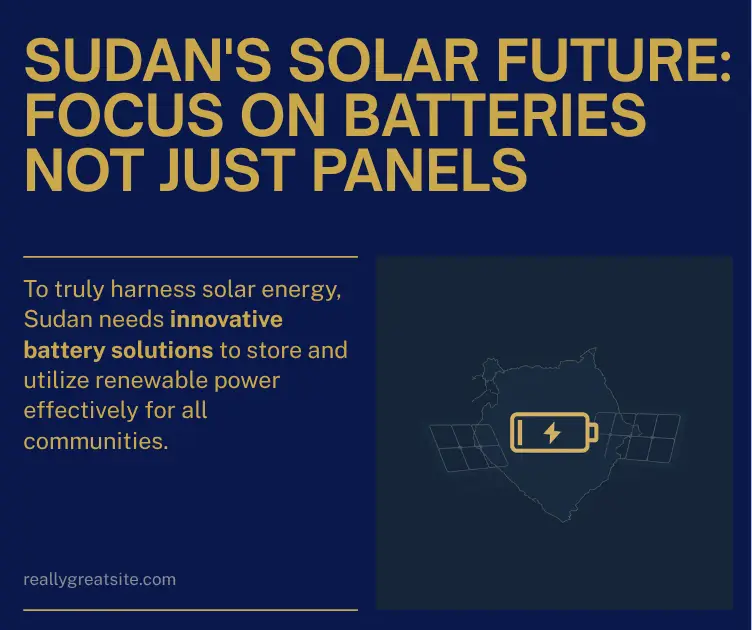
Global battery storage supply is growing fastest in the small-scale segment Sudan needs. 3Bi's policy brief argues Sudan's solar donors should fund storage now, while it's cheap.
Policy Brief | 3Bi Research Team | 15 August 2026
Build Back Better Initiative — Sudan & East Africa Policy Analysis
The Ask
Donors and UN agencies funding Sudan’s solar response should make battery storage a default line item in every new solar grant, not an optional upgrade. Global battery supply is growing fastest in exactly the distributed, small-scale segment Sudan needs, and prices are still falling. Sudan’s donor community should lock in that window now, before it closes.
Why Now
Two things are converging. First, Sudan’s only sizable pilot pairing solar with battery storage — a $2.9 million Global Environment Facility (GEF) and UNDP-backed project run through the Ministry of Energy and Petroleum — is scheduled to conclude in 2026 after four years, having retrofitted diesel mini-grids with 2 megawatts of solar and 6.9 megawatt-hours of storage for roughly 144,000 people (SolarQuarter, 11 February 2026). Whether it becomes a template for scale-up or a one-off pilot gets decided in the next few months, as FY2027 donor planning cycles open.
Second, the global battery market just handed Sudan’s donors an unusually good moment to make that call. Worldwide shipments of battery storage cells rose 94.76% year-on-year in the first half of 2026, but the small-scale, distributed-storage segment — the kind that powers a clinic or a water pump, not a national grid — grew 202.57%, more than twice as fast as utility-scale storage (attaqa.net, citing InfoLink, 14 August 2026). That is the segment Sudan actually needs, and it is the one getting cheaper and more available fastest. Donor budgets planned this year will buy more storage per dollar than they could have eighteen months ago, and — per the supplier reshuffling already underway — possibly less than they will in 2027.
The Evidence
The equipment Sudan needs is the fastest-growing category in the global market. InfoLink, the Taiwanese consultancy whose data attaqa.net’s Energy Research Unit cited on 14 August 2026, tracked global battery storage cell shipments at 467.84 gigawatt-hours in the first half of 2026. Utility-scale storage — the giant grid-balancing installations that dominate headlines — accounted for 402.36 GWh of that, up 84.09% year-on-year. But small-scale storage, the category covering mini-grids, health-facility backup, and solar-water-pumping systems, jumped 202.57% to 65.48 GWh. InfoLink has revised its full-year 2026 global forecast upward to 1,026 GWh on the strength of this demand. Markets outside China took 53.2% of total shipments (248.73 GWh), meaning the supply Sudan would draw on through regional distributors is not a China-only phenomenon — it is broadly available.
This is not a one-off spike; it is Africa’s structural trend, too. The Africa Finance Corporation’s 2026 State of Africa’s Infrastructure report found the continent’s installed battery storage capacity rose from 31 megawatt-hours in 2017 to more than 1.6 gigawatt-hours in 2024, with lithium-ion battery costs down roughly 20% in 2024 alone, and projects continent-wide storage capacity to keep growing at more than 20% annually through 2030 (Africa Finance Corporation, cited by Nairametrics, 26 April 2026). The AFC is explicit about what is holding most African markets back from capturing that growth: not technology or demand, but financing. South Africa, with a dedicated Battery Energy Storage Independent Power Producers Procurement Programme, accounts for most of the continent’s installed grid-scale capacity; most other markets, Sudan included, remain financing-constrained rather than technology-constrained.
Sudan’s need is severe, and its delivery capacity — even mid-conflict — is proven. Sudan’s electricity grid has sustained up to $3 billion in war damage since fighting broke out in April 2023, including strikes on the El-Obeid thermal plant and the 1.25-gigawatt Merowe Dam, which previously supplied roughly 40% of national electricity (UNDP study, cited by Dabanga Radio TV and allAfrica, 26 May 2026; Middle East Economic Survey, 5 June 2026). Nearly a third of Sudan’s population has no electricity access at all, and diesel — where it can be found — now costs multiples of the equivalent solar price (SolarQuarter, 11 February 2026). Yet the delivery mechanism already works under these conditions: UNFPA Sudan’s ongoing hospital solarization programme keeps facilities such as Al Fasher Maternity Hospital running Emergency Obstetric and Neonatal Care equipment on solar power in an active conflict zone (UNFPA Sudan, accessed 15 August 2026). The GEF/UNDP mini-grid pilot cited above operated through the same period. The problem was never whether solar-plus-storage projects could be delivered in Sudan today. It is that too few of them include enough storage.
Peer markets show donor and blended capital moving faster than Sudan’s. Nigeria attracted an estimated $2.4 billion in renewable energy investment in 2025, and its off-grid solar sector is now attracting institutional, not just donor, capital: pay-as-you-go solar providers d.light and Sun King raised a $50 million green bond (June 2026) and $286 million in securitized customer-receivables debt (mid-2025) respectively, testing whether mainstream investors will back distributed solar at commercial scale (Associated Press, reported via Barchart and other wire subscribers, 2026). Sudan’s fragile banking sector rules out replicating that securitization model directly, but it underscores how far ahead of Sudan’s pipeline the regional off-grid storage conversation already is.
Addressing the Counter-Case
The strongest objection: Sudan’s active conflict, collapsed banking sector, and absent sovereign credit rating make it the wrong moment for a storage financing push — better to stabilize first, then build storage properly once peace and normal capital markets return.
This gets the financing model wrong, not the timing. Nobody is proposing Sudan replicate Nigeria’s securitized-debt structure or issue its own green bonds; that channel is closed for now, and no one credible is arguing otherwise. The financing this brief is about is the kind already flowing — GEF, UNDP, UNFPA, and comparable humanitarian and multilateral grants — which has demonstrably continued operating inside Sudan throughout the war, including in an active conflict zone like Al Fasher. The ask is not for new money or a new financing channel. It is for the donors already writing solar grants to size them for storage at today’s component costs rather than solar-only kits that leave a clinic dark after sunset or a water pump silent under cloud cover. Waiting for stabilization to “do it properly” risks doing it at a worse price: InfoLink’s data shows the supplier landscape already reordering mid-2026, and the AFC’s own framing — that African storage costs are falling but adoption remains “uneven” and financing-constrained — describes exactly the gap that grant funding, not commercial capital, is positioned to close first.
What 3Bi Recommends, Specifically
- Donors and UN agencies funding Sudan’s health, WASH, and livelihoods solar programmes — UNFPA, UNDP, ICRC, and comparable implementers — should adopt storage-inclusive procurement as the default standard for solar RFPs entering FY2027 planning now, benchmarked against 2026 component costs rather than older, solar-only quotes.
- Sudan’s Ministry of Energy and Petroleum and UNDP should jointly scope a Phase II of the GEF-backed mini-grid programme before the current pilot closes out in 2026, sized to at least match its original 2 MW / 6.9 MWh footprint at three to four additional off-grid sites, using the pilot’s own operating data as the design basis.
- 3Bi will maintain a quarterly battery-storage cost and financing tracker for Sudan-relevant procurement, drawing on InfoLink, AFC, and comparable market data, so implementing partners negotiate donor budgets against current prices rather than the stale quotes that currently push storage out of solar RFPs as a “nice to have.”
- Sudan-focused civil society and diaspora energy-finance advocates should raise the storage-financing gap explicitly in pre-COP31 donor consultations ahead of the Antalya summit (9–20 November 2026), framing the current global supply surge as the argument for front-loading capital before the price window narrows.
Sourcing & Contact
Primary source: attaqa.net Energy Research Unit, citing InfoLink Consulting, “Battery storage cell shipments jump 95% in six months” (14 August 2026). Cross-checked and extended via: Africa Finance Corporation, 2026 State of Africa’s Infrastructure, cited by Nairametrics (26 April 2026); SolarQuarter, “Sudan Advances Solar Mini-Grids to Expand Clean Energy Access in Rural Areas” (11 February 2026); UNDP Sudan grid-damage study, cited by Dabanga Radio TV, allAfrica, and Middle East Economic Survey (May–June 2026); UNFPA Sudan, “Solarization of Hospitals” (accessed 15 August 2026); Associated Press reporting on Africa’s off-grid solar financing, via Barchart (2026); Nigeria renewable-investment figures via Streamline Feed (2026). For follow-up: 3Bi Research Team, research@3bisudan.org.
This publication was produced through 3Bi’s automated daily publications workflow monitoring regional and international climate and energy reporting.
This publication is produced with support from 3Bi’s institutional donors; see the full funder list at 3bisudan.org.
About the Authors
Related Publications
The Paris Compliance Committee Named Three Silent Countries. Sudan Answered. Now It Owes a Date.
The Paris Agreement's compliance committee has named three countries that ignored its letters on missing climate plans. Sudan is not among them: it replied. Before COP31, 3Bi argues,…
The Kigali Amendment Turns 10 With 175 Parties. Sudan Should Ratify Before the Montreal Protocol Meets in Kigali.
Ten years after the Kigali Amendment was adopted, 175 of 198 Montreal Protocol parties have ratified it. Sudan has not. As parties meet in Kigali on 2–6 November,…
The Adaptation Fund Board Meets in Bonn With US$146.8 Million to Approve. Sudan Has No Project of Its Own.
The Adaptation Fund Board meets in Bonn from 19 to 23 October with US$146.8 million in approvals before it, including a US$30 million Mandera Triangle project. Sudan has…