The UN Says the Ocean’s Carbon Sink Is Weakening and Africa’s Coasts Are Under-Measured. Sudan’s Red Sea Climate Pledge Has No Number. Get One Before COP31.
3Bi Research Team | Policy Brief | 29 October 2026
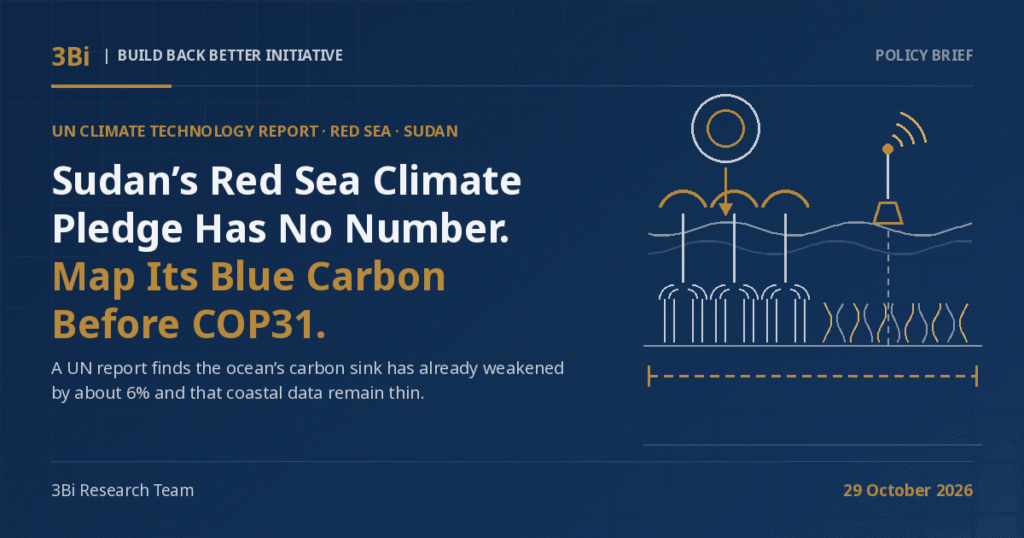
The UN’s 2026 Climate Technology Progress Report, released on 28 October 2026 ahead of COP31, finds that climate change has already reduced the ocean’s carbon sink capacity by about 6% and that…
The UN’s 2026 Climate Technology Progress Report, released on 28 October 2026 ahead of COP31, finds that climate change has already reduced the ocean’s carbon sink capacity by about 6% and that coastal regions remain under-observed. (Illustration: 3Bi)
3Bi Research Team | Policy Brief | 29 October 2026
The Ask
Before COP31 opens in Antalya on 9 November, Sudan’s Higher Council for Environment and Natural Resources (HCENR) and the Red Sea State government should ask the UN Climate Technology Centre and Network (CTCN), through Sudan’s national designated entity, for technical assistance to build a blue-carbon baseline for the Red Sea coast: a map of its mangroves and seagrass beds, a measure of the carbon they hold, and a simple way to monitor both. The cost to Sudan is a request form and a scoping note, and the result would give a number to the one coastal climate commitment in Sudan’s national climate plan that currently has none.
The hook is the UN’s 2026 Climate Technology Progress Report, released on 28 October. It finds that climate change has already cut the ocean’s capacity to absorb carbon by an estimated 6% and that the observations needed to track this are thinnest in the Indian Ocean and “many coastal regions” (UNEP Copenhagen Climate Centre, CTCN and UNFCCC Technology Executive Committee, Climate Technology Progress Report 2026, 28 October 2026). Sudan’s 2021 Nationally Determined Contribution (NDC) already budgets US$150 million for coastal adaptation and lists “increased carbon sequestration by blue carbon systems” as the expected result, but sets no baseline or target (Republic of the Sudan, Updated First NDC, October 2021). This brief argues that closing that gap is cheap, timely and within reach.
Why Now
The report was launched in Copenhagen with COP31 in view. Its authors describe a framework they call Ocean Carbon Intelligence, which links ocean observation, data systems and models so that governments can see what the ocean is doing to carbon and judge which ocean-based climate measures work (UNEP, press release, 28 October 2026). “As of now, we don’t have full information about the ocean, and what we don’t know, we cannot manage and protect,” lead author Sara Traerup told UN News (UN News via allAfrica, 28 October 2026). The Pacific COP31 Envoy for the Ocean, Inia Seruiratu, said the summit is a chance “to place the ocean where it belongs: at the heart of global climate action” (UNEP, press release, 28 October 2026). COP31 runs in Antalya from 9 to 20 November (UNFCCC, COP31 page, accessed 22 October 2026; Climate Home News, 28 October 2026).
The second clock is Sudan’s own. Sudan’s next NDC, the “NDC 3.0” due under the Paris Agreement’s five-year cycle, was still listed as pending by the Africa NDC Hub when 3Bi last checked (Africa NDC Hub, Sudan snapshot, accessed 18 October 2026). Whatever Sudan writes about its coast in that document will either carry a measurable baseline or repeat the 2021 wording. A technical-assistance request lodged now can shape the first option.
The Evidence
First, the ocean’s carbon service is weakening, and the gaps in knowing by how much are largest in places like Sudan’s coast. The ocean absorbs about 30% of human-caused carbon dioxide emissions and about 90% of the extra heat from climate change. The report estimates that human-induced climate change has already reduced the ocean’s carbon sink capacity by about 6% compared with a world without it. It warns that observations remain patchy, “particularly in the Southern Ocean, the Arctic, the Indian Ocean and in many coastal regions”, and that global capacity to observe the ocean carbon cycle “has declined in recent years” (Climate Technology Progress Report 2026, executive summary, 28 October 2026). The report does not single out the Red Sea, and 3Bi is not claiming that it does. But UNESCO describes Sudan’s Red Sea marine systems as being “from an Indian Ocean origin”, and the Red Sea as “the world’s northernmost tropical sea, the warmest and most saline of the world’s seas” (UNESCO World Heritage Centre, Sanganeb and Dungonab Bay–Mukkawar Island Marine National Parks, accessed 29 October 2026). A warm, semi-enclosed sea on the edge of an under-observed ocean is not a place where carbon numbers can be assumed.
Second, blue-carbon ecosystems are the most usable ocean technology today, and Africa’s data on them are among the weakest. The report groups ocean climate technologies into three families: monitoring, blue-carbon ecosystems such as mangroves, seagrass meadows and salt marshes, and marine carbon dioxide removal. It finds that restoring blue-carbon ecosystems is “relatively more mature” and “deployable at scale”, while marine carbon dioxide removal remains at lower readiness and carries “significant” uncertainties (Climate Technology Progress Report 2026, 28 October 2026). These ecosystems already take up about 111 million tonnes of carbon a year, around 407 million tonnes of carbon dioxide, and protect coasts, fisheries and livelihoods (same report; UN News via allAfrica, 28 October 2026). Yet the report states that “expanding baseline data sets and regional inventories remains a priority, particularly for data-poor regions such as Africa”. It shows what that looks like in practice. Through the MACBLUE project, financed by Germany and run by two Pacific regional bodies, Fiji, Papua New Guinea, Solomon Islands and Vanuatu received satellite remote sensing, GIS mapping and carbon-modelling support (Climate Technology Progress Report 2026). More than 100 people were trained in blue-carbon assessment, “giving governments data to feed into their national climate plans” (UN News via allAfrica, 28 October 2026).
Third, Sudan has already made the commitment. What it lacks is the measurement. Sudan’s updated NDC describes a Red Sea coastline of about 800 km and names the threats plainly: warmer water that can harm corals, acidification, and sea-level rise that can “force inland migration of mangroves” and hurt fishing communities that depend on about 8,000 tonnes of fish a year. Its coastal adaptation line, led by HCENR and the Red Sea State government, costs US$150 million, about 4% of the US$3.85 billion adaptation total, and includes mangrove restoration, protection of coral reefs and seagrass beds, alternative livelihoods for mangrove-dependent communities and the mapping of coastal hazard lines. Its stated indicator is “increased carbon sequestration by blue carbon systems”, with no starting figure. The mitigation section folds “restoration/conservation of mangrove forests in Red Sea State” into a forestry measure covering 1.7 million hectares, without a separate area for mangroves (Updated First NDC, October 2021). The assets are real. Dungonab Bay and Mukkawar Island hold mangroves, seagrass beds and “a globally significant dugong population”, and with Sanganeb atoll they form a 260,700-hectare World Heritage property inscribed in 2016 (UNESCO, accessed 29 October 2026).
Addressing the Counter-Case
The strongest objection is that Sudan’s mangroves are a small carbon store and that scarce attention belongs inland, where most Sudanese face drought and floods. This is a fair concern, and 3Bi is not arguing that the Red Sea should outrank Sudan’s water or farming priorities. The report itself says the carbon potential of blue-carbon restoration is “relatively limited” compared with total removal needs (Climate Technology Progress Report 2026). Our case rests on adaptation and accountability, not on carbon volume. The coastal measures protect fisheries and coastal communities, and the US$150 million line is already in Sudan’s plan. Without a baseline, Sudan cannot show progress on it, and funders have little to assess. We are also not recommending that Sudan sell blue-carbon credits. The report notes that market participation for these projects “remains subject to debate”.
A second objection is that Sudan lacks the capacity to run such a study now. The route has been tested. Sudan’s national designated entity lodged a CTCN request on 21 February 2024 to improve water-harvesting technologies, and CTCN lists that assistance as completed (CTCN, Sudan water-harvesting project page). CTCN says it gives priority to requests from least developed countries that align with NDCs and national adaptation plans (CTCN, “Submit a request”, accessed 29 October 2026). Sudan is a least developed country, and this request would implement its own NDC. Regional expertise exists too. The Regional Organization for the Conservation of the Environment of the Red Sea and Gulf of Aden (PERSGA), to which Sudan belongs, has published standard survey methods for mangroves and seagrass, updated in 2019, and prepared the integrated management plan for Sudan’s World Heritage site (UNEP, Jeddah Convention and PERSGA page, accessed 29 October 2026).
What 3Bi Recommends, Specifically
First, before COP31 opens on 9 November, HCENR and the Red Sea State government should agree a one-page scope for a Red Sea blue-carbon baseline covering mangrove and seagrass mapping, carbon-stock sampling and a monitoring protocol, and Sudan’s CTCN national designated entity should submit it using CTCN’s request template.
Second, in drafting NDC 3.0, HCENR should replace the unquantified coastal indicator with a dated commitment: publish a Red Sea blue-carbon baseline by a set year, then set a restoration and protection target from it. It should also list mangrove area separately from the inland forestry measure.
Third, Sudan should ask PERSGA to propose a Red Sea and Gulf of Aden blue-carbon inventory to its member states, modelled on the Pacific MACBLUE approach and built on PERSGA’s existing survey methods, so that data stay under national and regional control.
Fourth, at COP31, Sudan’s delegation should tell CTCN and ocean-focused partners that the request has been lodged, and ask which of them will support coastal monitoring in under-observed regions, as the report recommends.
Fifth, 3Bi will track the request, the treatment of oceans at COP31 and the coastal section of Sudan’s NDC 3.0, and will publish a follow-up by the end of January 2027.
Sourcing & Contact
Primary sources: UNEP Copenhagen Climate Centre, CTCN and UNFCCC Technology Executive Committee, “The Climate Technology Progress Report 2026: Navigating Ocean-based Technologies”, 28 October 2026 (full report and publication page); UNEP, press release “UN report urges investment in Ocean Carbon Intelligence to safeguard the ocean’s climate role”, 28 October 2026; UN News, “Ocean’s ability to absorb carbon is weakening as climate change intensifies, UN warns”, via allAfrica, 28 October 2026; Republic of the Sudan, Updated First Nationally Determined Contribution, October 2021 (UNFCCC registry copy); UNESCO World Heritage Centre, Sanganeb Marine National Park and Dungonab Bay–Mukkawar Island Marine National Park, accessed 29 October 2026; CTCN, Sudan water-harvesting technical assistance project page (submitted 21 February 2024) and “Submit a request”, accessed 29 October 2026; UNEP, Jeddah Convention and PERSGA page, accessed 29 October 2026; Africa NDC Hub, Sudan snapshot, accessed 18 October 2026; UNFCCC, COP31 page, accessed 22 October 2026; Climate Home News, “Africa wants adaptation finance on COP31 agenda, raising risk of a fight”, 28 October 2026. 3Bi could not verify a current official figure for the area of Sudan’s mangroves or seagrass beds; published estimates differ, and we use none. Sudan’s NDC 3.0 status may have changed since 18 October. For methodology questions or to propose a correction, contact 3Bi’s Research Team via 3bisudan.org.
This piece was produced through 3Bi’s automated daily publications workflow, which monitors regional and international climate and energy reporting.
This publication is produced with support from 3Bi’s institutional donors; see the full funder list at 3bisudan.org.
About the Authors
Related Publications
COP31’s Early-Warning Stocktake Says Systems Fail When the Projects End. Sudan Has a Roadmap. Now It Needs a Budget That Lasts.
A COP31 stocktake finds Africa improved early warning faster than any region, but warns that systems falter when project money ends. Sudan now has a roadmap. It should…
COP31 Wants Loss and Damage Help Delivered Faster. Sudan Is Not Among the 17 Active Requests. Name a Liaison and File One in Antalya.
COP31 is writing rules to speed up the Santiago Network, the UN’s loss and damage help desk, which has 17 active requests, including Yemen, Iraq and Kenya. Sudan…
Sudan Told COP31’s Leaders That Adaptation Is a National Necessity. Now Its Negotiators Should Put a Number and a Date Behind It.
Sudan told the COP31 Leaders’ Summit that adaptation is a national necessity and asked for more adaptation finance, but gave no figure. Its negotiators should back the COP30…