
COP31 Agreed How to Measure Adaptation, Not How to Pay for It. Sudan’s Road to Addis Ababa Runs Through That Gap.
3Bi Research Team | Analytical Article | 23 November 2026
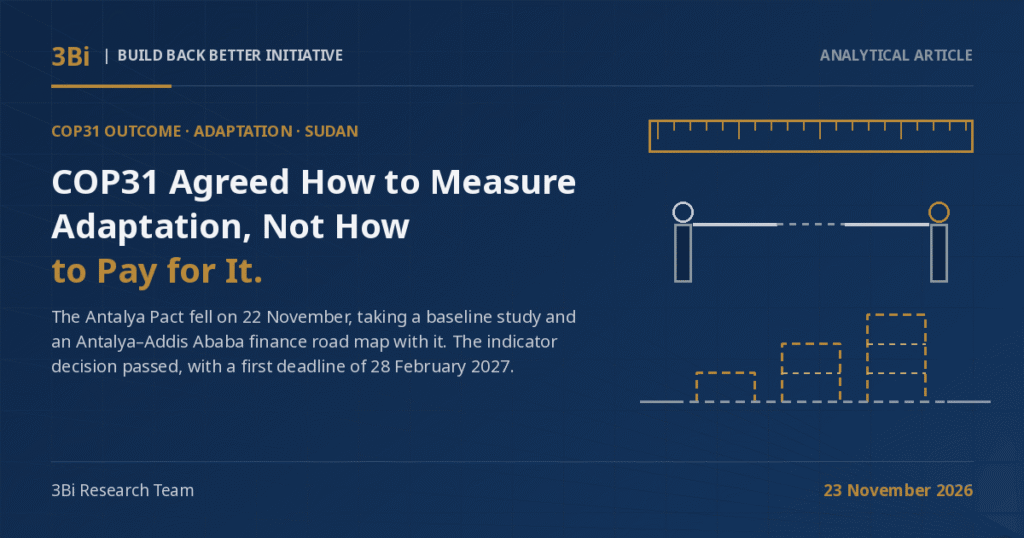
COP31 closed on 22 November without the Antalya Pact. Its decision on measuring adaptation passed with firm deadlines, but proposals for a finance baseline study and an Antalya–Addis Ababa road map fell with the pact. Sudan should work to fill that gap before COP32.
On 22 November 2026, COP31 in Antalya closed without adopting its cover decisions, the “Antalya Pact”, which carried proposals for a study of the adaptation-finance baseline and an Antalya–Addis Ababa road map; parties did adopt a decision on the Global Goal on Adaptation that sets up a task force on the Belém Adaptation Indicators. (Illustration: 3Bi)
3Bi Research Team | Analytical Article | 23 November 2026
The Hook
COP31 ended on Sunday evening without its main outcome. At 7:33 pm Antalya time on 22 November, almost 50 hours after the scheduled finish, the conference closed without adopting the two cover decisions that together made up the “Antalya Pact” (IISD Earth Negotiations Bulletin, 22 November 2026). “I understand that there is no agreement on this text. For that reason, these decisions have not been adopted,” said COP31 President Murat Kurum (UN News, 22 November 2026). The European Union, Panama, the Marshall Islands and Norway objected, chiefly because the text did not mention fossil fuels (The Guardian, 22 November 2026).
Most of the coverage is about that fossil-fuel fight. For Sudan, a quieter result matters more. The decisions that survived Antalya tell countries, in detail and with dates, how adaptation will be measured. The text that would have started work on how adaptation finance will be counted and delivered went down with the pact. That is the gap Sudan will have to work in between now and COP32 in Addis Ababa.
The Argument
First, the money half of the adaptation agenda fell with the Antalya Pact. The latest public version of the Paris Agreement cover decision, dated 22 November at 02:00, contained three adaptation-finance mandates. It asked the Standing Committee on Finance to prepare, for COP32 in November 2027, “a technical report identifying options in relation to the baseline” for the call to at least triple adaptation finance by 2035. It agreed to discuss “an implementation pathway for tripling adaptation finance by 2035” under the work programme on climate finance. And it would have launched “the Antalya–Addis Ababa road map on adaptation and resilience finance”, guided by the COP31 and COP32 Presidencies, with a report to COP32 (UNFCCC, draft cover decision text, version of 22 November 2026, 02:00, paragraphs 51–53). The same draft noted that developing countries’ adaptation finance needs are estimated at US$305 billion a year up to 2035 (paragraph 19). None of this was adopted. As The Detail put it, the target had already shrunk from a proposed annual amount to further talks about its baseline and delivery route, “and countries did not adopt even that compromise” (The Detail, 22 November 2026).
The tripling commitment itself still stands. It was agreed in Belém last year, and as the UK government noted after Antalya, “what has previously been agreed is still agreed” (GOV.UK, 22 November 2026). But the commitment has no agreed starting point, and now there is no formal process to set one. The baseline decides the ambition. Tripling a hypothetical US$20 billion would mean US$60 billion a year, while tripling US$40 billion would mean US$120 billion (Business Today, 23 November 2026). Africa saw the weakness and still backed the deal. The African Group objected to tripling provisions “that lacked a clear baseline” and to an Antalya–Addis Ababa road map “without assured delivery”, but it supported adoption. The least developed countries (LDCs) called the text weak on adaptation finance and warned that it shifted greater burdens onto their countries (IISD ENB, 22 November 2026).
Second, the measurement half passed, with a calendar. Parties did adopt a decision on the Global Goal on Adaptation (IISD ENB, 22 November 2026). It sets up a technical task force to improve the metadata and methods behind the 59 Belém Adaptation Indicators adopted at COP30 (The Asia Business Daily, citing South Korea’s climate ministry, 23 November 2026). The task force will have six experts nominated by each UN regional group, plus three nominated by the LDCs and three by small island developing states. Nominations are due by 28 February 2027. The task force will present preliminary findings at the June 2027 session in Bonn, deliver factsheets and a technical report four weeks before COP32, and end in November 2027. Countries are invited to report their experience of voluntarily testing the indicators, “including any challenges, gaps and needs”, until 31 August 2027, and a virtual technical dialogue is to be held by August 2027 (UNFCCC, decision on the global goal on adaptation, advance unedited version, November 2026, paragraphs 4–6 and 11–27).
On money, the same decision only recalls the Belém call to at least triple adaptation finance (paragraph 49). It does include one protection that matters for countries with thin data: applying the indicators and reporting on them “shall not be a prerequisite for access to finance” (paragraph 48). Read together, the outcomes mean COP32 will receive a detailed technical package on how to count adaptation, and no mandated report on how to count the money, unless parties put one back on the agenda.
One finance channel did move forward. Parties agreed that the Adaptation Fund will serve the Paris Agreement exclusively once the first share of proceeds from the new Article 6.4 carbon market is monetised. The Fund will receive a mandatory 5% of those proceeds, plus voluntary resources under Article 6.2, and its board will have 17 members, including one LDC seat. The Fund says its pipeline of projects under development totals US$2.4 billion (Adaptation Fund, 22 November 2026; UNFCCC, draft CMP decision on the Adaptation Fund, 21 November 2026). That money depends on carbon markets that are not yet producing it. As we reported in October, Sudan has no project of its own at the Fund and no accredited national entity to request one (3Bi, October 2026).
Third, Sudan sat on more than one side of the final split, and the next stop is an African COP. Sudan is one of the 44 members of the LDC Group (LDC Group, accessed 23 November 2026), and it also belongs to the African Group and the League of Arab States. In the closing plenary these groups did not speak with one voice. The African and Arab Groups supported adoption despite their objections. The LDCs warned against retreating from earlier agreements (IISD ENB, 22 November 2026). Speaking for the African Group, Ghana said: “Africa has always chosen to build multilateralism rather than walk away from it” (The Guardian, 22 November 2026). When a country’s groups split, its own priorities can be averaged away unless it states them itself.
The next round will be held in Africa. COP32 and the ninth meeting of the Paris Agreement parties take place in Addis Ababa from 8 to 19 November 2027 (UNFCCC, decision on dates and venues, COP30). The two-year “Belém–Addis vision on adaptation”, the process behind the indicators, ends there (UNFCCC, GGA decision, paragraph 3). The road map on adaptation finance would have been co-guided by the Ethiopian Presidency. It now has no mandate.
Why It Matters to the Reader
The strongest objection is that a failed cover decision changes little. Earlier commitments stand, the technical decisions passed, and better measurement helps everyone, including countries asking for money. That is a fair point, and 3Bi is not arguing that the indicator work is a distraction. Our point is narrower. Measurement without an agreed finance baseline produces precise evidence of adaptation gaps that no one has a clear duty to fill. On 7 November we urged Sudan to help lock in the baseline before Antalya (3Bi, 7 November 2026). Antalya ended without even a mandate to study one. The work now has to be rebuilt through the ordinary agenda.
If you work at the Higher Council for Environment and Natural Resources (HCENR), Sudan’s focal point for the UN climate convention, at the Ministry of Finance and Economic Planning, or on Sudan’s negotiating team, four steps follow.
First, by 28 February 2027, put forward a Sudanese expert for the indicators task force through the African Group or the LDC Group. In October we argued that Sudan should back the task force and offer a nominee (3Bi, October 2026). Now there is a deadline. It is the same date by which inputs to the second global stocktake close (3Bi, 19 November 2026).
Second, by 31 August 2027, submit Sudan’s experience of testing even a handful of the indicators. The decision asks for challenges, data gaps and needs as well as results, so a country with limited data has something useful to report, and the decision says reporting cannot become a condition for finance.
Third, at the June 2027 session in Bonn, work through the LDC and African Groups to give the tripling baseline a formal home again, whether under the work programme on climate finance or with the Standing Committee on Finance, so that COP32 receives baseline options in writing. Ask the incoming Ethiopian Presidency to treat adaptation finance as a presidency priority, as the failed road map would have done.
Fourth, use the year to prepare for the Adaptation Fund’s next phase. That means starting the accreditation of a national entity, so that Sudan can draw on any new carbon-market money directly rather than through the most crowded channel.
Close
COP31 will be remembered for the deal it did not make on fossil fuels. For Sudan, the more lasting result is a split. The rules for measuring adaptation were adopted with deadlines. The proposals on paying for it, including a baseline study and an Antalya–Addis Ababa road map, were lost with the pact. Addis Ababa will close the measurement process. Whether it also settles the money depends on what countries like Sudan put back on the table in the next twelve months. We will follow the task force nominations, the Bonn agenda and any move to revive the baseline work.
Sourcing & Contact
Primary sources: IISD Earth Negotiations Bulletin, “Highlights and images for 22 November 2026”; UN News, “COP31 ends without climate pact as UN chief warns there is ‘no ambiguity in the science’”, 22 November 2026; The Guardian, “Cop31 climate talks break down as key deal rejected”, 22 November 2026; UNFCCC, draft text prepared under COP31 Presidency consultations on the Presidency-led Party-driven cover decision (CMA), version of 22 November 2026, 02:00; UNFCCC, decision -/CMA.8 on the global goal on adaptation, advance unedited version, November 2026; UNFCCC, draft decision -/CMP.21 on matters relating to the Adaptation Fund (FCCC/KP/CMP/2026/L.4), 21 November 2026; Adaptation Fund, “COP31 Completes Adaptation Fund’s Transition to Serve the Paris Agreement Exclusively”, 22 November 2026; The Detail, “Climate talks collapsed after two weeks. South Africa needs over R250bn to adapt”, 22 November 2026; The Asia Business Daily, “COP31 Fails to Adopt Cover Decision, Reaches Agreements on Key Issues Including Adaptation and Climate Finance”, 23 November 2026 (citing South Korea’s Ministry of Climate, Energy and Environment); Business Today, “COP31 promises to triple adaptation finance by 2035, but leaves one crucial question unanswered”, 23 November 2026; GOV.UK, “COP31 Outcomes – your questions answered”, 22 November 2026; LDC Group, member list (accessed 23 November 2026); UNFCCC, COP30 decision on dates and venues of future sessions; 3Bi publications of October, 7 November and 19 November 2026. The cover-decision paragraphs are quoted from the 02:00 version of 22 November, the latest we could verify. The text put to the closing plenary may differ in wording, but The Detail and Business Today describe the same baseline report and road map in the final proposed decision. The Adaptation Fund decision is cited from the President’s proposal and the Fund’s own account of its adoption. The GGA decision is cited from the advance unedited version. For methodology questions or to propose a correction, contact 3Bi’s Research Team via 3bisudan.org.
This piece was produced through 3Bi’s automated daily publications workflow, which monitors regional and international climate and energy reporting.
This publication is produced with support from 3Bi’s institutional donors; see the full funder list at 3bisudan.org.
About the Authors
Related Publications
Sudan Has Imported More Than a Gigawatt of Solar Panels Since January 2025. Its Grid Rebuild Should Be Planned Around Them.
Sudan imported 140 MW of Chinese solar panels in September and more than a gigawatt since January 2025. As a grid diagnostic with Algeria’s Sonelgaz begins, Sudan should…
COP31 Went Into Overtime, but It Has Already Created a Platform to Turn Poor Countries’ Adaptation Plans Into Projects. Sudan Should Join Early.
COP31 ran past its deadline, but Friday’s plenary created a platform to help the least developed countries turn adaptation plans into fundable projects. It brings no new money.…
Europe Says Spend What’s Already Pledged. Public Climate Money to Africa’s Poorest Countries Fell. Sudan Should Ask Who Gets It.
Europe says COP31 should deploy money already pledged. New CPI data show climate finance to Africa doubled, but international public money to its low-income countries fell 11%. Sudan,…