
Before the Rains Fail or Flood: Sudan and East Africa Need Adaptation Finance Pre-Positioned Now, Not After the El Niño Hits
As a strengthening El Niño threatens drought in the Sahel and flooding in East Africa from September 2026, Sudan's proven direct-access route to climate finance sits unused.
As a strengthening El Niño threatens drought in the Sahel and flooding in East Africa from September 2026, Sudan's proven direct-access route to climate finance sits unused ahead of the shock. 3Bi recommends fast-tracking anticipatory-action finance now.
Cover image: 3Bi Research Team, 2026.
The Ask
3Bi recommends that Sudan’s Higher Council for Environment and Natural Resources, alongside UNDP and the Green Climate Fund (GCF), fast-track a direct-access accreditation and anticipatory-action financing package for Sudan before the forecast “super” El Niño peaks around September–October 2026. Every month spent on standard fiduciary review is a month Sudan’s rain-fed farmers and pastoralists spend without the water storage, early-warning systems, or cash-transfer buffers that separate a bad season from a famine.
Why Now
A strengthening El Niño is forecast to bring severe drought to the Sahel and southern Africa and flooding to eastern Africa starting around September 2026 (Foreign Policy, 19 August 2026). The UN World Food Programme has already warned that this pattern could push almost 50 million additional people into “acute food insecurity” by the end of 2027, citing countries already seeing below-average rainfall, flooding, and unusually hot temperatures ahead of planting and harvest seasons (via Carbon Brief’s Cropped newsletter, 12 August 2026, citing WFP). Global food prices reached a three-year high in July 2026, with the UN Food and Agriculture Organization citing heatwaves hitting wheat yields in major producing countries (Reuters, cited in Carbon Brief, 12 August 2026).
Sudan has lived this cycle before. The last comparable El Niño, in 2023–24, washed away crops and livestock across eastern Africa; Elizabeth Nsimadala, president of the Eastern African Farmers Federation, told Carbon Brief that farmers in her region are “still paying debts” from that season and described a straightforward barrier to adapting before the next shock hits: “Access to financing… would be a game-changer, because once you have financing, then you can deal with the rest. You can adapt. You can scale these practices” (Carbon Brief, 12 August 2026).
The window to act is narrow and specific: forecasters point to a September onset. Anticipatory-action finance — cash transfers, pre-positioned seed and water infrastructure, early-warning systems — only works if it arrives before the shock, not after.
The Evidence
The finance gap is regional, not just national. ECOWAS’s own Regional Strategy for Access to and Mobilization of Climate Finance put West Africa’s financing requirement at $294 billion as of 2022; a regional workshop in Abuja this month confirmed that figure has “significantly increased” since member states submitted their third-generation Nationally Determined Contributions, and that the World Bank now estimates up to 32 million people across the region could face climate-driven internal displacement (ThisDay, 13 August 2026). Analysts tracking the continent’s broader position describe climate finance as having “unreachable” scale, predictability, and accessibility for most African countries even as the global adaptation-finance goal has been raised — loss-and-damage funding remains undercapitalised and private capital mobilisation remains risk-averse (ISS Africa, 2026).
Sudan’s access problem is structural, not just financial. Analyses of National Adaptation Plan (NAP) financing gaps point to a consistent set of barriers facing Sudan and comparable states: few internationally accredited entities able to receive GCF funds directly, high fiduciary and safeguard standards that smaller national institutions struggle to meet, limited proposal-writing and monitoring-and-evaluation capacity, and the compounding effect of fragile governance and instability on all of the above (IIED analysis of NAP financing, 2026; GCF Sudan country page). Sudan has done the harder, slower part of the work — it has an approved National Adaptation Plan and a functioning direct engagement with the GCF — but a plan without disbursed, pre-positioned finance behind it does not protect a farmer in West Darfur from a failed rainy season.
Direct-access finance for Sudan is not hypothetical — it is proven and underused. In the one substantial direct-access grant Sudan has received to date, the GCF approved $25.6 million in August 2020 for a five-year project — led by Sudan’s Higher Council for Environment and Natural Resources with UNDP support — that reached roughly 3.7 million people across nine states (Darfur, Kordofan, Kassala, Red Sea, Northern, and Khartoum) with climate-resilient water and food-security infrastructure, leveraging a further $15 million in government co-financing (UNDP Sudan, 23 August 2020). That project demonstrates the model works at scale when accreditation and co-financing align — the question is why, six years and one strengthening El Niño later, no comparable anticipatory-action package is in place ahead of a forecast shock this specific.
Addressing the Counter-Case
The standard objection to fast-tracking finance ahead of a forecast, rather than a confirmed, climate shock is that El Niño forecasts carry genuine uncertainty, and that funds committed to anticipatory action could be judged wasted if the worst-case pattern does not materialize in a given locality. That is a fair caution against blank-cheque disbursement — but it is an argument for calibrated, trigger-based anticipatory-action financing (release tied to specific rainfall, river-level, or vegetation-index thresholds, as WFP and FAO already use in other anticipatory-action programmes), not an argument for waiting until the drought or flood is already confirmed on the ground. The 2023–24 season is the relevant comparison: it produced real, verified losses which took Ugandan and Sudanese farming households more than a year to service financially. Delay itself has a cost; it is simply a cost that shows up later and lands on households rather than on institutional balance sheets.
A second, more institutional objection is that Sudan’s fragile governance context makes accelerated fiduciary review risky. 3Bi’s answer is not to waive due diligence but to route acceleration through UNDP’s existing accredited-entity relationship with the GCF — the same structure that delivered the 2020 grant — rather than requiring Sudanese institutions to complete a fresh accreditation process from a standing start.
What 3Bi Recommends, Specifically
- GCF and UNDP should open a trigger-based anticipatory-action financing window for Sudan within the current GCF Sudan programme, calibrated to the specific September–October 2026 El Niño forecast window, drawing on the accredited-entity relationship already in place from the 2020 grant rather than requiring new accreditation.
- Sudan’s Higher Council for Environment and Natural Resources should publish, within 30 days, an updated inventory of which elements of its National Adaptation Plan are shovel-ready — water storage, seed banks, early-warning systems — so that any accelerated tranche of finance has a pre-vetted disbursement pathway rather than losing weeks to project design after funds are approved.
- Regional donors and the ECOWAS climate-finance platform under development should treat Sudan and comparable fragile states as a pilot case for simplified, trigger-based direct-access windows, rather than leaving them to compete for the same standard-track GCF proposal cycle as more institutionally stable applicants — the 32-million-person regional displacement estimate makes clear that the current pace of access does not match the pace of the risk.
The reader who cannot act on all three recommendations should still take one message from this brief: the finance mechanisms and the accredited-entity relationship needed to move quickly already exist. What is missing is the decision to use them before the rains fail or flood, not after.
Sourcing & Contact
Sources: Foreign Policy (19 August 2026); Carbon Brief, Cropped newsletter (12 August 2026, citing UN World Food Programme and Reuters/FAO); ThisDay, Nigeria (13 August 2026, ECOWAS regional climate-finance workshop, Abuja); ISS Africa (2026); IIED analysis of National Adaptation Plan financing; Green Climate Fund Sudan country page; UNDP Sudan press release (23 August 2020, GCF grant approval).
For questions on this brief or 3Bi’s climate-finance research agenda, contact 3Bi’s Research Team via 3bisudan.org.
This publication was produced through 3Bi’s automated daily publications workflow, which monitors regional and international climate reporting.
This publication is produced with support from 3Bi’s institutional donors; see the full funder list at 3bisudan.org.
About the Authors
Related Publications
Turkey’s COP31 Electrification Push Is Sudan’s Opening. Khartoum Should Table a Pledge Before Antalya, Not After.
Turkey's COP31 electrification coalition rewards early, credible pledges with finance access. Sudan should draft and table one before Antalya, not after.
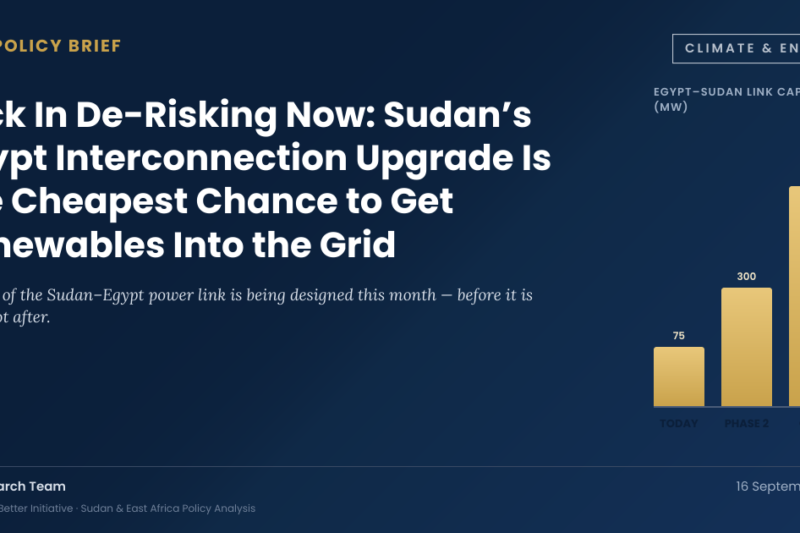
Lock In De-Risking Now: Sudan’s Egypt Interconnection Upgrade Is the Cheapest Chance to Get Renewables Into the Grid
Sudan's Egypt interconnection is being redesigned this month. 3Bi recommends locking in a renewable-generation share and a currency-risk guarantee now, before Phase 2 is built on last decade's…
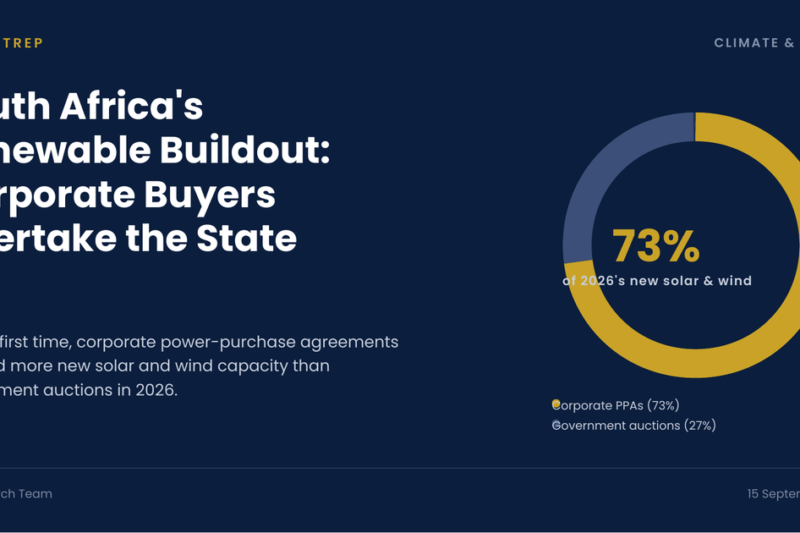
SITREP: South Africa’s Renewable Buildout — Corporate Buyers Overtake the State
For the first time, corporate power-purchase agreements will fund more of South Africa's new solar and wind capacity than government auctions in 2026 — even as national renewable…