El Niño Is Raising Rift Valley Fever Risk Across Eastern Africa, and Southern Sudan Is Already on FAO’s Map. Sudan’s Climate Plan Names the Disease. Tie Its Vaccines to the Forecast.
3Bi Research Team | Policy Brief | 1 November 2026
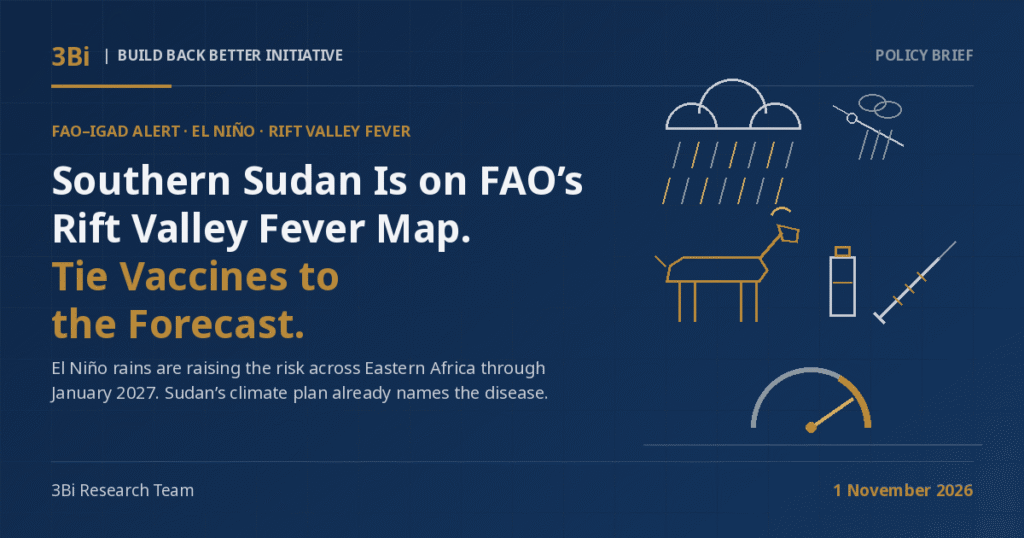
FAO and IGAD warned on 30 October that El Niño rains are raising Rift Valley fever risk across Eastern Africa, and FAO’s forecast tool already flags southern Sudan. Sudan’s climate plan names the disease. Its vets and health ministry should act on the forecast before cases appear.
FAO and IGAD issued a joint alert on 30 October 2026 warning that heavy rainfall and flooding linked to El Niño are raising the risk of Rift Valley fever outbreaks across Eastern Africa between October 2026 and January 2027, with southern Sudan among the areas FAO classifies as suitable for transmission. (Illustration: 3Bi)
3Bi Research Team | Policy Brief | 1 November 2026
The Ask
Within the next two weeks, Sudan’s federal veterinary services and the Federal Ministry of Health should agree a joint Rift Valley fever (RVF) preparedness plan for the southern areas that the Food and Agriculture Organization (FAO) now flags as suitable for transmission. The plan should cover targeted surveillance in sheep, goats and cattle, laboratory readiness, a check of vaccine stocks, and a forecast trigger for acting before cases appear. This costs little more than a meeting and a stock count, and it puts into practice measures Sudan has already written into its national climate plan.
The hook is a joint alert issued on 30 October by FAO and the Intergovernmental Authority on Development (IGAD). It warns that heavy rainfall and flooding linked to an El Niño “approaching record strength” are raising the risk of RVF outbreaks across Eastern Africa between October 2026 and January 2027. FAO’s forecasting tool already lists “southern Sudan” among the areas suitable for transmission (FAO, “El Niño heightens risk of Rift Valley fever outbreaks in Eastern Africa, FAO and IGAD warn”, 30 October 2026). IGAD and FAO first flagged the risk in August, when they put the probability of El Niño persisting into early 2027 at 97 percent (ICPALD, “IGAD and FAO Release Alert on Rift Valley Fever”, 19 August 2026).
Why Now
RVF is a mosquito-borne viral disease of livestock that can also infect people. It causes waves of abortions and deaths in sheep, goats, cattle and camels, and most human cases come from contact with the blood or organs of infected animals (WHO, Rift Valley fever fact sheet, 20 December 2024). FAO and IGAD say current El Niño conditions are comparable to those of 1997–98, when one of the largest recorded RVF epidemics hit Eastern Africa. The countries at highest risk are Ethiopia, Kenya, Somalia, South Sudan, Tanzania and Uganda. Lower but growing risks extend across the Red Sea to south-western Saudi Arabia and western Yemen (FAO, 30 October 2026).
Sudan’s exposure is specific. FAO reports that, after a long period of rainfall deficits, rain has picked up in recent weeks in parts of southern Sudan. Its RVF Early Warning Decision Support Tool, which combines satellite data, climate forecasts and surveillance reports to flag risk up to three months ahead, lists southern Sudan among the areas currently classified as suitable for transmission, after Tanzania, Ethiopia, Kenya and South Sudan. FAO and IGAD are asking countries to strengthen risk-based surveillance, pre-position vaccines and supplies, and coordinate across sectors and borders through a One Health approach (FAO, 30 October 2026).
The window is set by biology. WHO advises routine animal vaccination to prevent outbreaks, but it does not recommend vaccination campaigns once an outbreak is under way, because needles can spread the virus within herds. Outbreaks in animals come before human cases, so active animal surveillance is what gives early warning (WHO, Disease Outbreak News, “Rift Valley Fever – Sudan”, 14 November 2019). The useful time for prevention is before transmission is confirmed. COP31 opens in Antalya on 9 November (UNFCCC, COP31 page, accessed 22 October 2026). A plan agreed by then would also give Sudan’s delegation a concrete example of anticipatory adaptation to take to the talks.
The Evidence
First, Sudan has lived this sequence recently, and it began with rain. After heavy rains on 13 August 2019 brought flash floods to 17 of Sudan’s 18 states, an RVF outbreak began on 19 September in Red Sea State. By 11 November, 293 suspected human cases, including 11 deaths, had been reported from six states, most of them in River Nile (168) and Red Sea (120). Abortions and deaths in goats and sheep were confirmed in the same areas by the Central Veterinary Research Laboratory in Khartoum. WHO noted that RVF is endemic in Sudan and that an earlier outbreak, which it dates to 2008, produced 747 laboratory-confirmed cases and 230 deaths (WHO, Disease Outbreak News, 14 November 2019). The link to climate is well established. WHO says RVF outbreaks in East Africa are “closely associated with the heavy rainfall that occurs during the warm phase” of El Niño, and that satellite and climate-forecast models “can be used to trigger detection of animal cases at an early stage” (WHO fact sheet, 20 December 2024).
Second, the costs fall on herds, households and trade, which is why prevention pays. WHO’s 2019 assessment noted that RVF causes “significant economic losses due to livestock travel and trade restrictions”, and that this matters in a country where livestock exports are “one of the major sources of the national income” (WHO, 14 November 2019). The disease has already crossed the Red Sea once. In September 2000, after infected livestock trade from the Horn of Africa, RVF reached Saudi Arabia and Yemen, the first time it was reported outside Africa (WHO fact sheet, 20 December 2024). FAO now lists both of those areas as facing growing risk. 3Bi is not claiming that any importing country plans restrictions. The point is that early, transparent surveillance is the best way for an exporter to show its animals are safe.
Third, Sudan’s climate plan already contains the measures. What it lacks is the trigger that links them. Sudan’s updated NDC calls the country “a high burden and high-risk country for vector borne disease”. It warns that health policies “do not fully consider potential climate change impacts” and reports an upward trend in livestock disease cases at veterinary hospitals in East Darfur between 2012 and 2017. Its adaptation table includes a US$200 million action on resilient livestock systems that covers “vaccination of animals against epidemic diseases” and mobile veterinary clinics, under the Ministry of Agriculture and Forests and the state governments. A further US$150 million action on livestock resilience includes “forecast-based finance instruments”. A US$500 million public health action, led by the Ministry of Health, names Rift Valley fever explicitly for early diagnosis and treatment and commits to “controlling of diseases shared between humans and animals” (Republic of the Sudan, Updated First NDC, October 2021). The pieces sit in three lines under different ministries. Nothing in the text says who acts when a forecast turns red.
Addressing the Counter-Case
The strongest objection is that Sudan’s main rainy season is over and FAO expects drier-than-normal conditions in southern Sudan, so the risk will fade on its own. This is a fair concern, and 3Bi is not predicting an outbreak in Sudan this season. But FAO’s tool already classifies parts of southern Sudan as suitable for transmission after recent rains, and it expects suitable conditions across the region to increase through January (FAO, 30 October 2026). WHO also notes that irrigation schemes, where mosquitoes are abundant for long periods of the year, are “highly favourable places” for secondary transmission once the virus arrives through livestock movement (WHO fact sheet, 20 December 2024). Sudan’s own NDC refers to its “big irrigated schemes” at Gezira, Suki, Rahad and New Halfa. Surveillance that finds nothing is a cheap outcome. An outbreak found late is not.
A second objection is that Sudan’s veterinary and health services are stretched and cannot take on a new programme. We are not asking for one. In 2019, Red Sea State activated an RVF task force, deployed surveillance teams, ran household vector inspections, and had human and animal samples confirmed in national laboratories in Khartoum (WHO, 14 November 2019). The ask is to reconvene that machinery early and point it at the places a free FAO forecast already identifies. Regional practice points the same way. IGAD ministers meeting in Addis Ababa on 17 September adopted a Call to Action that commits member states to “vaccinate livestock ahead of the rains”, to strengthen surveillance for Rift Valley fever “through a One Health approach”, and to define anticipatory triggers so that money moves “as soon as agreed thresholds are reached” (IGAD, High-Level Call to Action on El Niño Preparedness, Anticipatory Action and Resilience, 17 September 2026).
What 3Bi Recommends, Specifically
These recommendations are 3Bi’s reading of the FAO alert, WHO guidance and Sudan’s NDC cited above. All are low-cost.
First, before COP31 opens on 9 November, Sudan’s federal veterinary services and the Federal Ministry of Health should reconvene a joint RVF task force on the 2019 model. They should agree which southern localities the FAO RVF Decision Support Tool flags and start targeted surveillance there, with reporting of unexplained abortions in sheep and goats as the first signal.
Second, in the same period, the Central Veterinary Research Laboratory and the National Public Health Laboratory should confirm their testing supplies. The veterinary services should count RVF vaccine and supply stocks and, where stocks fall short, ask FAO for help in pre-positioning them, as the alert invites. Vaccination should be limited to at-risk areas with no confirmed transmission, in line with WHO advice.
Third, Sudan should report any confirmed animal or human cases promptly through FAO, WHO and the World Organisation for Animal Health (WOAH), and share alerts with neighbouring veterinary services. Early transparency protects exports better than silence.
Fourth, in drafting NDC 3.0, HCENR should merge the livestock-vaccination, forecast-based finance and RVF health measures into a single One Health early-action line. That line should name the forecast products that trigger action, the pre-agreed steps, the lead ministry, and a contingency budget line, following the structure of IGAD’s Call to Action.
Fifth, 3Bi will track FAO’s monthly RVF risk updates and the treatment of anticipatory action at COP31, and will publish a follow-up by the end of January 2027, when FAO’s current risk window closes.
Sourcing & Contact
Primary sources: FAO, “El Niño heightens risk of Rift Valley fever outbreaks in Eastern Africa, FAO and IGAD warn”, 30 October 2026; IGAD Centre for Pastoral Areas and Livestock Development (ICPALD), “IGAD and FAO Release Alert on Rift Valley Fever”, 19 August 2026; IGAD, High-Level Call to Action on El Niño Preparedness, Anticipatory Action and Resilience, Addis Ababa, 17 September 2026; WHO, Disease Outbreak News, “Rift Valley Fever – Republic of the Sudan”, 14 November 2019; WHO, Rift Valley fever fact sheet, 20 December 2024; Republic of the Sudan, Updated First Nationally Determined Contribution, October 2021 (UNFCCC registry copy); UNFCCC, COP31 page, accessed 22 October 2026. 3Bi could not verify current RVF vaccine stocks in Sudan, the exact localities flagged by FAO’s tool, or whether any RVF cases have been reported in Sudan this season; we make no claim on any of these. For methodology questions or to propose a correction, contact 3Bi’s Research Team via 3bisudan.org.
This piece was produced through 3Bi’s automated daily publications workflow, which monitors regional and international climate and energy reporting.
This publication is produced with support from 3Bi’s institutional donors; see the full funder list at 3bisudan.org.
About the Authors
Related Publications
Eastern Africa Pledged in Mombasa to Act Before Disasters Strike, With Triggers Set by 2027. Sudan Is Named in the Declaration. Start Its Roadmap and Take It to COP31.
On 30 October, seven IGAD states, Sudan among them, adopted the Mombasa Ministerial Declaration on Anticipatory Action. By 2027 each is to set trigger-based protocols, with pre-arranged finance,…
Yerevan Pushed Nature Finance to 2028. Antalya Opens a Rio Synergies Door Next Week. Sudan Should Bring Its Forests Through It.
The UN biodiversity talks in Yerevan deferred nature’s new finance mechanism to 2028. COP31 will launch a Rio Synergies Group in Antalya. Sudan has a costed nature plan…
Khartoum Hosted a UN–Arab Workshop to Link Sudan’s Food and Climate Plans. The Food-Systems Plan Is Being Updated. Build Climate Into It Before COP31.
On 27–28 October, ESCWA, the Arab Organization for Agricultural Development and Sudan’s Ministry of Agriculture met in Khartoum to align food and climate action. Sudan’s 2022–2030 food-systems plan…