
New Study: 583 Million Children Already Live Through 20+ Extra Climate-Driven Heat-Stress Days a Year. West Africa Is Absorbing the Worst of It.
A Situation Report on new attribution science and what it means for Sudan and the wider region
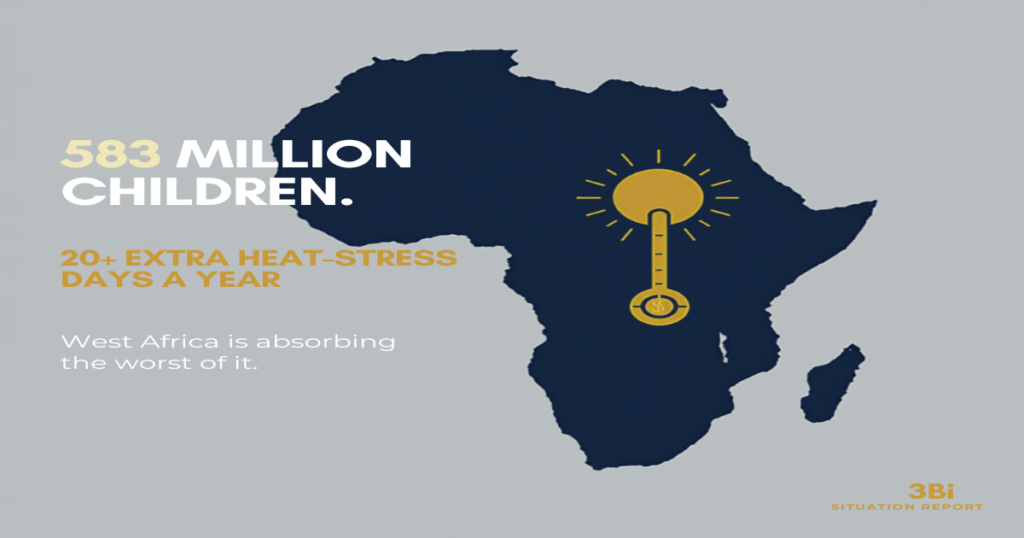
A new peer-reviewed attribution study finds 583 million children under 10 already face 20+ extra climate-driven heat-stress days a year, with west Africa among the hardest-hit regions. 3Bi's Situation Report lays out what's confirmed, what isn't, and what to watch.
Situation Report | 3Bi Research Team
Header
Situation: Global child exposure to climate-attributable humid heat (new peer-reviewed attribution study). First edition. Information cut-off: 27 August 2026, 12:00 GMT.
Headline Fact
A new attribution study published in Science Advances finds that 583 million children under 10 — 44% of all children in that age group worldwide — already experience at least 20 additional “heat-stress days” per year because of human-caused climate change, with south Asia and west Africa recording the heaviest childhood exposure (Pietroiusti et al., Science Advances, 26 August 2026).
Timeline
- 2021: An earlier study by the same research network finds children born in the 21st century will face far more extreme-weather events across their lifetimes than their grandparents did.
- 2025: A follow-up from the same team estimates that more than half of children born in 2020 — around 62 million people — will experience “unprecedented lifetime exposure” to heatwaves even if warming stays within 1.5C.
- 26 August 2026: Rosa Pietroiusti (Vrije Universiteit Brussel) and co-authors publish the new study in Science Advances, combining climate models with demographic data to measure “heat-stress days” — days above a wet-bulb globe temperature of 28C — by age group and country, for 2023’s climate and for 1.5C and 2C warming scenarios. Carbon Brief publishes the first detailed English-language summary the same day.
- 27 August 2026: 3Bi reviews the study and cross-checks it against UNICEF’s 2026 Children’s Climate Risk Report, which separately finds Sudan among eight countries where children already spend more than half the year above 35C, and against UNICEF Sudan’s own reporting on heat rashes, headaches and school closures tied to extreme heat this year.
What We Know / What We Don’t
Confirmed: The study’s headline figures — 583 million children (44% of under-10s) facing 20+ attributable heat-stress days annually, versus 190 million people aged 60-69 (30% of that cohort) — come from a peer-reviewed methodology comparing present-day and pre-industrial climate simulations against gridded population data. Côte d’Ivoire is cited as recording 112 heat-stress days a year, roughly half attributable to climate change. The paper explicitly names west Africa and south Asia as the regions of highest childhood exposure, driven by young, fast-growing populations in low-latitude countries.
Not yet resolved: The study itself acknowledges its wet-bulb globe temperature threshold was not designed specifically around children’s physiology, and that its climate-model resolution cannot capture urban heat-island effects — meaning real exposure in cities is likely underestimated. Independent reviewers quoted by Carbon Brief are divided on one point: whether the paper understates elderly vulnerability, since older adults are more likely to live alone with less access to cooling, even where they show fewer “attributable” heat-stress days on paper. Neither this study nor UNICEF’s separate report yet offers Sudan-specific attribution numbers (how many of Sudan’s heat-stress days are attributable to climate change, as opposed to Sudan’s baseline hot climate) — that gap remains open.
Do-No-Harm Note
This edition relies on aggregate, country-level scientific and UN data; no individual child, family, or specific community is named or otherwise identifiable. The conflict-sensitivity/do-no-harm check required by 3Bi’s editorial guidelines was run before publication, and no identifying or endangering detail was found or included.
What to Watch
- Whether the “global goal on adaptation” (GGA) — left unresolved at June’s Bonn climate talks (SB64) — picks up child-health or heat-specific metrics ahead of COP31 in Antalya, Türkiye (9-20 November 2026).
- Whether follow-up research applies country-specific attribution modelling to Sudan and other high-heat, high-conflict states, closing the gap noted above.
- Whether this year’s continuing Sudanese school closures during heat spikes are captured in future editions of UNICEF’s Children’s Climate Risk Report, which currently draws on exposure data rather than attribution data.
Sourcing & Next Update
Sources: Pietroiusti, R. et al. (2026), “Age-specific exposure to human-induced increases in humid heat,” Science Advances, doi:10.1126/sciadv.aeb3232; Carbon Brief, “Climate change exposes 580 million children to 20 extra ‘heat-stress days’ every year,” 26 August 2026; UNICEF, Children’s Climate Risk Report 2026; UNICEF Sudan, “Sudan’s children face climate and conflict challenges.” No further edition is scheduled unless a significant new development (country-specific attribution data, a COP31 adaptation-finance decision referencing child heat exposure, or a major Sudan-specific heat event) warrants a follow-up.
This piece was produced through 3Bi’s automated daily publications workflow monitoring regional and international climate reporting.
This publication is produced with support from 3Bi’s institutional donors; see the full funder list at 3bisudan.org.
About the Authors
Related Publications

Sudan Should Get a Seat at the Table While the Arab Green Fund Is Still Being Designed
A pooled Arab Green Fund for climate technology is still being designed ahead of COP31 — Sudan should get a seat at the table now, while the rules…
Sudan Should Go Straight to the Egyptian Consortiums Already Building Gigawatts Next Door
Egyptian EPC consortiums are simultaneously building a $2.9bn dam in Tanzania, a hydrogen-ready plant in Hungary, and a $2.6bn plant in Saudi Arabia. Sudan should use the same…
A Blackout Toppled Madagascar’s President. Sudan’s Grid Is Running the Same Script.
Madagascar's 2025 blackout-driven uprising toppled a president. Sudan faces the identical diesel-price-cap-utility equation today — and can't afford the decade-long financing timeline that a proven hybrid solar-diesel retrofit…