Sudan and Egypt Are Due to Sign a Water Memorandum in Cairo This Week. It Reads Like an Adaptation Plan. Take It to Abu Dhabi.
3Bi Research Team | Analytical Article | 24 October 2026
Egypt and Sudan are expected to sign a water MoU at Cairo Water Week (25–29 October) covering flood protection, rainwater harvesting and solar groundwater. 3Bi argues Sudan should cost it and take it to the UN Water Conference in Abu Dhabi.
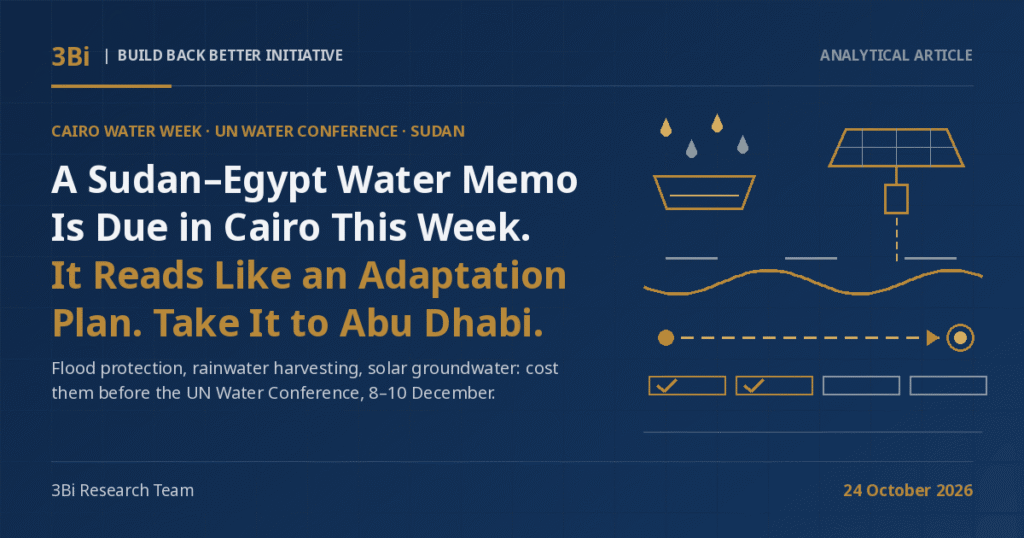
Egypt and Sudan are expected to sign a water memorandum of understanding at Cairo Water Week, 25–29 October 2026, six weeks before the UN Water Conference in Abu Dhabi on 8–10 December. (Illustration: 3Bi)
3Bi Research Team | Analytical Article | 24 October 2026
The Hook
Cairo Water Week opens tomorrow, 25 October, and runs to 29 October. Egypt’s Ministry of Water Resources and Irrigation has planned 137 technical and scientific sessions, and 20 ministers had confirmed attendance by mid-October. The programme includes the last preparatory session for the 2026 UN Water Conference (Elwatan News, 16 October 2026). That conference, co-hosted by the United Arab Emirates and Senegal, meets at ADNEC in Abu Dhabi on 8–10 December. Its purpose is to accelerate progress on Sustainable Development Goal 6 (SDG 6: clean water and sanitation) in the last four years of the 2030 Agenda (UN DESA, 2026 UN Water Conference page, accessed 24 October 2026). On the sidelines in Cairo, Egypt and Sudan are expected to sign a memorandum of understanding (MoU) on water. When Egypt’s minister, Hani Sewilam, hosted Sudan’s Minister of Agriculture and Irrigation on 16 September, the two said the text had been drafted and would be signed during Cairo Water Week. Its priority areas are flood protection, rainwater harvesting, solar-powered groundwater stations, aquatic-weed control, training and capacity-building, and the exchange of expertise in water resources, drinking water and sanitation (Egyptian Ministry of Water Resources and Irrigation statement, reported by Egypt Key and Ahram Online, 16 September 2026).
Read as a list, that is not a diplomatic communiqué. It is the outline of a climate-adaptation programme. Our argument is that its value will depend less on the signing ceremony in Cairo than on whether Sudan carries it to Abu Dhabi six weeks later as something a financier can read.
The Argument
First, the MoU’s list matches the climate Sudan has just had. This year’s rainy season was a dry one. US Geological Survey data reported by Reuters show that rainfall from July to September, the peak of the season, was the lowest in more than three decades across Sudan. In North Kordofan it was the lowest since 1990, and in Gedaref, in the south-east, the lowest since 1991 (Reuters, 23 October 2026). Rainwater harvesting and solar-powered groundwater stations are the tools for a short, failing season: they store what rain does fall and lift groundwater without diesel. Flood protection covers the opposite risk on the Nile and its seasonal streams. Together they cover the two extremes that the UN conference’s preparations call “too much and too little water”. The ministers also discussed upgrading monitoring systems and rehabilitating and modernising measurement stations (Egypt Key, 16 September 2026). Hydrological data of that kind is the evidence base every adaptation proposal needs. We are not claiming the MoU was drafted as a climate document. The point is that, item by item, it already reads like one.
Second, the Abu Dhabi conference is built to absorb exactly this kind of list, if it arrives in the right form. The conference runs on six interactive dialogues, and the UN Secretariat published their concept papers this month (IISD SDG Knowledge Hub, 14 October 2026). Two of them fit the Cairo MoU closely. Egypt and Japan co-chair the Water for Planet dialogue. At the UN-Water meeting in Rome on 1–2 October they said they were aiming for flagship initiatives that include “bridging water, environment, and climate actions” and “global initiatives to cope with too much and too little water” (Earth Negotiations Bulletin, 2 October 2026). France and South Africa co-chair the Investment for Water dialogue, and they reported a flagship initiative “to support existing country platforms and to further develop such platforms” (Earth Negotiations Bulletin, 2 October 2026). So Sudan’s MoU partner co-chairs the dialogue whose flagship matches the MoU’s content, and an African government, South Africa, co-chairs the dialogue on how country-level water investment is packaged. Beyond December, the UAE told the same meeting that it is preparing a resolution to establish a regular UN Water Conference process, and the next conference is already set for May 2028 in Tajikistan (Earth Negotiations Bulletin, 2 October 2026). Abu Dhabi is therefore the start of a cycle, not a one-off. The first projects to be framed as part of it will set the template.
Third, other African governments are arriving with numbers, not lists. Kenya used a national water conference in Nairobi on 22–23 October to set out its position for Abu Dhabi. It proposes raising water-sector financing from an indicative 0.1% of GDP towards at least 0.5% of GDP for sanitation and 1.2% for water by 2030, and creating a dedicated financing instrument for water and climate resilience, either by adapting an existing mechanism or by building a new one. It also wants artificial intelligence used for drought and flood forecasting (Daily Nation, 23 October 2026). “This is the first time as a country we are going to a conference speaking the same language,” the head of Kenya’s water service providers’ association told the conference (Daily Nation, 23 October 2026). As of 24 October, 3Bi could not find a published Sudanese national position for the conference. That does not mean none is being prepared. It does mean that the most concrete Sudanese water commitment in the public record before Abu Dhabi is likely to be the Cairo MoU.
Why It Matters to the Reader
The strongest objection is that an MoU is not money. That is a fair concern. The Egypt–Sudan text, as described by both ministries, is about technical support, training and joint projects, not a financing facility, and 3Bi has not seen it. We are also not suggesting that Sudan should reopen wider Nile questions in Abu Dhabi. The Water for Cooperation dialogue, co-chaired by Finland and Zambia, will promote a “100 Parties Initiative” urging every country to consider joining the UN Water Convention (Earth Negotiations Bulletin, 2 October 2026). The Convention has 61 parties, including 16 African states, but none of the Nile Basin countries, Sudan and Egypt among them (UN Treaty Collection, status of the Convention on the Protection and Use of Transboundary Watercourses and International Lakes, accessed 24 October 2026). Whether to join is a sovereign decision bound up with the Nile, and this article takes no position on it. Our narrower point is that a bilateral MoU, with the Permanent Joint Technical Commission for Nile Waters that both ministers named as the framework (Egypt Key, 16 September 2026), is the cooperation vehicle Sudan actually has. Abu Dhabi is where it can be shown and costed.
If you work in Sudan’s Ministry of Agriculture and Irrigation, the Higher Council for Environment and Natural Resources (HCENR), the Ministry of Finance, or a partner that funds water in Sudan, three low-cost steps follow. First, once the MoU is signed, publish a short summary of it with the first projects under each heading (flood protection, rainwater harvesting, solar groundwater, monitoring) and an indicative cost for each. Second, turn that summary into a one-page Sudan position for Abu Dhabi, with Kenya-style numbers: what the first projects cost, what Sudan can contribute and what it asks partners for. Delegations’ pre-registration closes on 13 November (UN DESA, Participate page, accessed 24 October 2026), so the delegation and the paper should be settled together. Third, use the Cairo week itself. The 7th Arab Water Conference meets alongside it on 26–27 October, with a meeting of the Arab Ministerial Water Council (Elwatan News, 16 October 2026). That is a natural place to ask Egypt, as co-chair of Water for Planet, to feature the Egypt–Sudan programme as a case under its “too much and too little water” flagship.
None of this needs new money before December. It needs a signed text, a costed annex and a delegation that arrives with both.
Close
The ceremony in Cairo this week will be the easy part. The harder test comes in Abu Dhabi on 8–10 December: whether Sudan turns a list of good intentions into a dated, costed adaptation pipeline. We will follow up once the MoU text is public.
Sourcing & Contact
Primary sources: Elwatan News, “بحضور 20 وزيرا.. مصر تستعد لانطلاق أسبوع القاهرة التاسع للمياه 2026” (With 20 ministers attending, Egypt prepares for the 9th Cairo Water Week 2026), 16 October 2026; Egypt Key, “سويلم: مذكرة تفاهم مصرية سودانية مرتقبة خلال أسبوع القاهرة للمياه” (Sewilam: Egyptian–Sudanese MoU expected during Cairo Water Week), 16 September 2026; Ahram Online, “Egypt, Sudan eye October water cooperation deal, advance Jebel Aulia rehabilitation”, 16 September 2026; UN DESA, 2026 UN Water Conference page and Participate page, accessed 24 October 2026; Earth Negotiations Bulletin (IISD), “Highlights and images for 1–2 October 2026” (44th UN-Water Meeting), 2 October 2026; IISD SDG Knowledge Hub, “Concept Papers Out for Interactive Dialogues of 2026 UN Water Conference”, 14 October 2026; Daily Nation, “Kenya to leverage AI to improve water management”, 23 October 2026; Reuters, report on El Niño-driven drought in Sudan, citing US Geological Survey rainfall data (rainfall figures only), 23 October 2026; UN Treaty Collection, status of the Convention on the Protection and Use of Transboundary Watercourses and International Lakes, accessed 24 October 2026. For methodology questions or to propose a correction, contact 3Bi’s Research Team via 3bisudan.org.
3Bi Research Team. This piece was produced through 3Bi’s automated daily publications workflow, which monitors regional and international climate and energy reporting.
This publication is produced with support from 3Bi’s institutional donors; see the full funder list at 3bisudan.org.
About the Authors
Related Publications
The African Water Facility Makes Its Funding Pitch in Cairo This Week. Sudan Is Absent From Its Project List. Prepare One for Abu Dhabi.
The African Water Facility launches its 2026–2030 Strategy at Cairo Water Week on 27 October and asks donors to fund its pipeline. Sudan has no project of its…
Four Years of UN Farm-Climate Talks End at COP31. Africa’s Negotiators Say 0.3% of the Money Reaches Farmers. Sudan Should Back the Fix.
The UN climate process's four-year agriculture workstream ends at COP31 in Antalya with no successor agreed. African negotiators want finance that reaches farmers. Sudan, where about 40% of…
The Loss and Damage Fund Has Set Aside Its First US$20 Million. Sudan Has Three Requests in Line. Get One Ready for December.
The Fund for responding to Loss and Damage made its first allocation on 22 October, US$20 million for Nepal. Sudan has three requests worth US$48.5 million in its…