Sudan Is Making Solar Pumps Cheaper. Ethiopia’s Water and Energy Week Shows What Should Come With Them: A Map of the Water Below.
3Bi Research Team | Analytical Article | 27 October 2026
Sudan has exempted solar systems from customs duties and its central bank is lending for solar power and farm inputs in the north. As Ethiopia’s Water and Energy Week pairs groundwater mapping with solar use, 3Bi argues Sudan should measure the water its new pumps will lift.
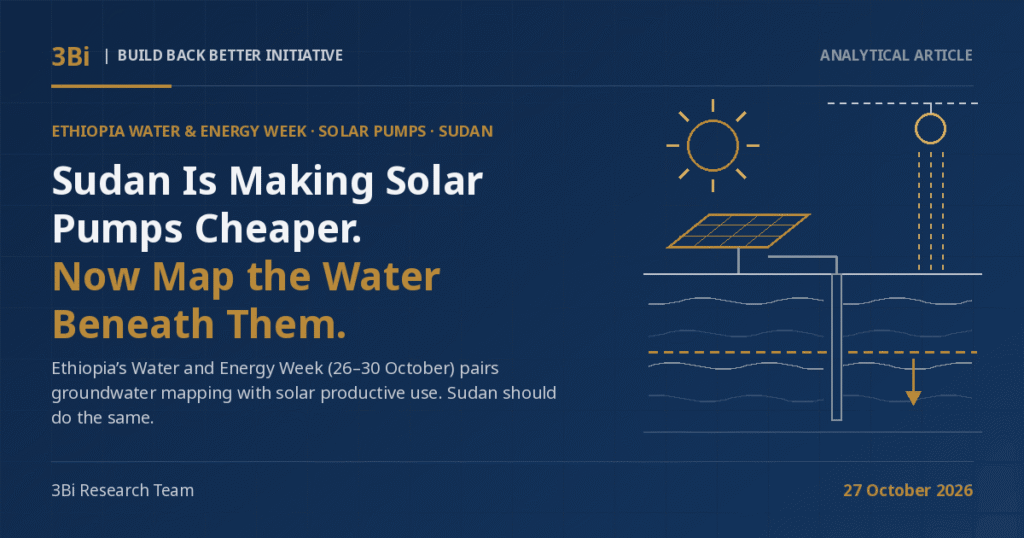
Ethiopia’s Water and Energy Week (Addis Ababa, 26–30 October 2026) puts groundwater mapping and solar-powered productive uses on one agenda. 3Bi found no published groundwater plan attached to Sudan’s new solar measures. (Illustration: 3Bi)
3Bi Research Team | Analytical Article | 27 October 2026
The Hook
The 3rd Ethiopian Water and Energy Week opened in Addis Ababa yesterday, 26 October, and runs to 30 October at the Addis Ababa Science Museum. Ethiopia’s Ministry of Water and Energy expects more than 2,000 delegates under the theme “Advancing Science-Based Policy and Partnerships for a Water and Energy Secure Future” (Ethiopian Water and Energy Week event site, accessed 27 October 2026; ENA, 23 October 2026). Two of the week’s research tracks sit side by side: “groundwater mapping and use” under water resources management, and “solar-powered productive uses” under renewable energy. At the opening, Denmark’s ambassador listed airborne electromagnetic groundwater mapping among the programmes his country supports in Ethiopia (ENA, 26 October 2026).
Sudan has spent the past ten weeks pushing hard on the second of those tracks. On 18 August, Prime Minister Kamil Idris exempted all components of solar systems imported for personal use from customs duties, taxes and other government fees, and directed the Ministry of Finance and the Central Bank of Sudan (CBOS), among others, to ease concessional finance for buyers (attaqa.net, 19 August 2026 and 25 October 2026). Customs began applying the exemption in September (attaqa.net, 25 October 2026). In mid-October, CBOS launched a portfolio of about 15 billion Sudanese pounds for solar energy and farm inputs in Northern State, and announced a second, of about 35 billion pounds, for River Nile State (Sudan Tribune, 15 October 2026; Sudan Independent, 15 October 2026).
Our argument is simple. Cheaper solar power is good policy for Sudan. But in the north, where farms beyond the Nile depend on wells, cheaper solar power means cheaper pumping of groundwater, and Sudan is lowering that cost faster than it is learning how much groundwater there is. Ethiopia’s agenda this week puts the two halves together. Sudan should do the same.
The Argument
First, in Sudan’s north, solar irrigation is groundwater irrigation. Rainfall near Dongola averages about 20 millimetres a year, so the alternative to Nile water is groundwater. A 2016 study of Northern State found that irrigation was moving out of the old Nile basins into the Khway Basin and open desert terraces, where farming “relies entirely on groundwater” (Fragaszy and Closas, Water Alternatives, 2016). Those farms draw on the Nubian Sandstone Aquifer, whose total reserves are enormous. The same study warns, however, that it receives “only very limited recharge”, and that significant drawdown is possible where pumping is intensive, as has already happened at Egypt’s Farafra Oasis on the same aquifer system. The Northern State portfolio is aimed at a winter season in which the state targets 1.2 million feddans, including 320,000 feddans of wheat (Sudan Tribune, 15 October 2026). The exemption covers systems for personal use, and the published decision does not say whether farm pumps qualify. We are not saying that every pound of the portfolios will buy a pump. We are saying that where it does, the water will come from underground.
Second, the research is consistent: solar pumps do not cause depletion, but they remove the brake on it. A diesel pump costs money every hour it runs. A solar pump, once it is paid for, costs almost nothing to run. That is the farmer’s gain. It is also the aquifer’s risk. In Yemen’s Sana’a Basin, solar pumps rose from 0% of the groundwater pumps in the study area in 2012 to 31% by 2020, and the pumping depths farmers reported rose from 15 metres in 2014 to 500 metres in 2020. The basin already had a long-standing overdraft: abstraction exceeds recharge, and water levels fall by 4 to 8 metres a year, according to earlier studies the authors cite. Their warning is that unregulated solar pumping is likely to make that worse (Aklan, Lackner and Al-Saidi, Frontiers in Water, 26 September 2025). The authors place Sudan in a different group: arid, but with large unused water and land resources. That is an advantage, but only while the resource is being measured. The counter-evidence points the same way. The International Water Management Institute (IWMI) found that in north-west Bangladesh, farmers on solar pumps used about as much water as those on diesel, and modelled groundwater fell by less than a metre. That result depended on a fee-for-service model in which an operator sells water and has a reason to ration it. IWMI’s own conclusion is that governments should guide solar pump deployment with groundwater monitoring and suitability maps, and could tie pump subsidies to cropping patterns or irrigation efficiency (IWMI, 7 January 2026). The variable that decides the outcome is not the panel. It is the rules and data around it.
Third, mapping groundwater is now affordable, and a neighbour is doing it. In May 2026, Aarhus University in Denmark awarded a contract of DKK 5 million for a helicopter-borne electromagnetic and magnetic survey of Ethiopia’s Rift Valley Basin. It was designed with Ethiopia’s Ministry of Water and Energy and Addis Ababa University to image layers as thin as 3 metres near the surface and to see up to 500 metres down (EU Tenders Electronic Daily, contract award notice 457845-2026, 3 July 2026). We are not reporting the survey’s results, which we have not seen. The point is that the technology is already in use in the region, under a published contract of known value, and that a neighbouring ministry chose to pay for knowledge of its aquifers rather than wait. Ethiopia has also made science-to-policy the theme of its national water and energy week. ENA reported that the week would emphasise translating research into practical action, with particular attention to drought, flooding and water variability (ENA, 23 October 2026).
Why It Matters to the Reader
The strongest objection is that Sudan has more urgent problems than an aquifer that will last for decades, and that farmers need power now. That is a fair concern, and 3Bi is not recommending that the solar exemption or the CBOS portfolios be slowed. The rains this year make the case for solar pumping stronger, not weaker. FEWS NET reported large 90-day rainfall deficits and drought-driven deterioration of vegetation over western Sudan in late October (FEWS NET Global Weather Hazards, 22–28 October 2026). Our narrower point is that the cheapest time to set rules is before the pumps are in the ground. Once a well has a paid-off solar array on it, every extra hour of pumping is free, and limits become harder to introduce. The Sudanese Electricity Holding Company is also prequalifying local solar contractors, suppliers and consultants until 30 November (Al-Tayyar, reported by Al-Sudan Today, 6 October 2026). The market is being built now.
If you work in the Ministry of Agriculture and Irrigation, the Ministry of Energy and Oil, CBOS or one of the banks lending under the state portfolios, three low-cost steps follow.
First, attach a short water condition to farm solar finance. Before a loan for a solar pump is approved, record the well’s location, depth and pump capacity, and favour drip or other efficient irrigation. Morocco and parts of India already link solar pump support to micro-irrigation (Frontiers in Water, 26 September 2025). This is paperwork, not a new subsidy.
Second, start a groundwater baseline where the money is going. Northern State and River Nile State are where the portfolios are concentrated. A few dozen monitoring wells measured before and after this winter season would show whether new solar wells are lowering water levels, and where. As of 27 October, 3Bi could not find a published groundwater-monitoring plan attached to the solar exemption or the portfolios. That does not mean none exists. If it does, publishing it would strengthen confidence in both programmes.
Third, use the regional platform that exists this week. Ethiopia’s Water and Energy Week is built around partnerships for science-based policy. Sudan’s water and energy institutions, and the partners that fund them, should ask for the method and costing behind Ethiopia’s airborne groundwater survey. They can then scope a similar survey for the Dongola area of the Nubian Sandstone Aquifer.
None of this requires slowing the move to solar. It requires knowing the water that the solar pumps will lift.
Close
Sudan has made a sound choice in making solar power cheaper. The test is whether, in five years, the farms it supports in the north are still pumping from a stable water table, or chasing a falling one. Ethiopia’s agenda this week shows that energy and groundwater can be planned together. We will follow up when CBOS or the Ministry of Agriculture and Irrigation publishes the lending terms for the state portfolios.
Sourcing & Contact
Primary sources: Ethiopian Ministry of Water and Energy, 3rd Ethiopian Water & Energy Week event site (mowe.events/ewew), accessed 27 October 2026; Ethiopian News Agency (ENA), “Ethiopian Water and Energy Week Focuses on Linking Science, Policy and Implementation”, 23 October 2026; ENA, “Denmark and Rwanda Seek Stronger Water, Energy Ties with Ethiopia”, 26 October 2026; EU Tenders Electronic Daily, contract award notice 457845-2026, “Provision of an airborne geophysical survey of the Rift Valley Basin in Ethiopia” (Aarhus University), 3 July 2026; attaqa.net, “الطاقة الشمسية في السودان.. إعفاءات جمركية لحل أزمة الكهرباء” (Solar energy in Sudan: customs exemptions to ease the electricity crisis), 19 August 2026; attaqa.net, “واردات الألواح الشمسية.. 4 دول عربية تخفف الأعباء الجمركية” (Solar panel imports: four Arab countries ease customs burdens), 25 October 2026; Sudan Tribune, “«المركزي» يدشن محفظة تمويل بـ(15) مليار جنيه للزراعة والطاقة الشمسية في الشمالية” (Central bank launches a 15 billion pound portfolio for agriculture and solar energy in Northern State), 15 October 2026; Sudan Independent, “بنك السودان المركزي يدشن محفظة تمويل الطاقة الشمسية” (Central Bank of Sudan launches solar energy finance portfolio), 15 October 2026; Al-Sudan Today, citing Al-Tayyar, “كهرباء السودان تفتح باب تأهيل الشركات لتنفيذ مشروعات الطاقة الشمسية” (Sudan Electricity opens prequalification for solar companies), 6 October 2026; S. Fragaszy and A. Closas, “Cultivating the desert: Irrigation expansion and groundwater abstraction in Northern State, Sudan”, Water Alternatives 9(1), 2016; M. Aklan, H. Lackner and M. Al-Saidi, “Solar-powered irrigation as a curse for vulnerable water basins?”, Frontiers in Water, 26 September 2025; IWMI, “What the evidence says about solar irrigation and groundwater sustainability in Bangladesh”, 7 January 2026; FEWS NET, Global Weather Hazards Summary, 22–28 October 2026. For methodology questions or to propose a correction, contact 3Bi’s Research Team via 3bisudan.org.
3Bi Research Team. This piece was produced through 3Bi’s automated daily publications workflow, which monitors regional and international climate and energy reporting.
This publication is produced with support from 3Bi’s institutional donors; see the full funder list at 3bisudan.org.
About the Authors
Related Publications
The African Water Facility Makes Its Funding Pitch in Cairo This Week. Sudan Is Absent From Its Project List. Prepare One for Abu Dhabi.
The African Water Facility launches its 2026–2030 Strategy at Cairo Water Week on 27 October and asks donors to fund its pipeline. Sudan has no project of its…
Four Years of UN Farm-Climate Talks End at COP31. Africa’s Negotiators Say 0.3% of the Money Reaches Farmers. Sudan Should Back the Fix.
The UN climate process's four-year agriculture workstream ends at COP31 in Antalya with no successor agreed. African negotiators want finance that reaches farmers. Sudan, where about 40% of…
Sudan and Egypt Are Due to Sign a Water Memorandum in Cairo This Week. It Reads Like an Adaptation Plan. Take It to Abu Dhabi.
Egypt and Sudan are expected to sign a water MoU at Cairo Water Week (25–29 October) covering flood protection, rainwater harvesting and solar groundwater. 3Bi argues Sudan should…