
Sudan Should Fast-Track a Phased Restoration of the Ethiopia Power Corridor Before Addis Ababa’s Growing Hydropower Surplus Is Fully Committed Elsewhere

As Ethiopia's Koysha dam nears completion and its hydropower surplus is contracted to Kenya and Djibouti, 3Bi urges Sudan to fast-track a 90-day phased plan to restore the Ethiopia power corridor and reactivate its EAPP membership before the window closes.
The Ask
Sudan’s energy authorities should commission, within the next 90 days, a phased technical and financing plan to restore the Ethiopia–Sudan transmission corridor and renegotiate Sudan’s active participation in the Eastern Africa Power Pool (EAPP) — starting with the safer, already-partially-functional segments of the Northern Grid, not waiting for a nationwide ceasefire. Every quarter this is deferred, more of Ethiopia’s expanding hydropower surplus gets locked into long-term contracts with Kenya and Djibouti instead.
Why Now
Ethiopia’s hydropower base is expanding fast and its export map is being redrawn in real time. The Grand Ethiopian Renaissance Dam (GERD) delivered about 99.5% of its planned output in fiscal year 2025 and now supplies roughly 51.5% of Ethiopia’s total electricity generation (Ethiopian Electric Power, cited by attaqa.net, 27 August 2026). A second major hydropower project, the 1.8-gigawatt Koysha dam on the Omo River, has passed 77% completion and is expected to become Ethiopia’s second-largest hydropower plant once finished (attaqa.net, 27 August 2026).
None of that surplus is currently reaching Sudan. Ethiopia earned an estimated $474 million last fiscal year from electricity exports and power-linked technology and data-extraction activity, with roughly $120 million coming directly from electricity sales to neighboring countries — chiefly Kenya, which can draw up to 200 megawatts at peak demand and 65 megawatts off-peak, and Djibouti (attaqa.net, 27 August 2026). Sudan, once part of the same interconnected arrangement, is absent from that revenue picture: Ethiopia’s electricity exports to Sudan have stopped entirely, which attaqa.net attributes directly to war damage to Sudan’s transmission networks and energy infrastructure.
This is not a hypothetical risk. Sudan’s own Ministry of Energy and Oil has publicly blamed the halted Ethiopian import line, alongside grid damage, for worsening nationwide power cuts that now run as long as 18 hours a day in some areas (Sudan Tribune; Borkena, 22 July 2026). Ethiopia’s electricity exports to Sudan had already fallen by roughly 80% as of last year (Ethio Negari, 26 April 2025). The decision window is narrow and closing: Koysha’s additional 1.8 gigawatts will start reaching the grid within the next one to two years, and Ethiopia is actively courting alternative buyers for that capacity. Every contract Addis Ababa signs with Kenya, Djibouti, or a data-center operator instead of Sudan makes future re-entry more expensive and less likely.
The Evidence
Sudan was never an outsider to this market — it was cut out of it by war, not by geography or policy. Sudan is a founding member of the Eastern Africa Power Pool, which seven countries established by inter-governmental memorandum in 2005, and it sits within the Ethiopia–Sudan–Djibouti synchronized cluster, one of only four such interconnected clusters in the EAPP region (Eastern Africa Power Pool; IRENA EAPP briefing). That is a structural, institutional relationship — not a one-off trading arrangement — and it means the legal and technical scaffolding for reconnection already exists. What has failed is the physical link and the payment relationship, not the underlying framework.
The physical damage is real, but it is not uniform, and Sudan’s own recovery data shows partial restoration is already technically achievable. The conflict split Sudan’s national grid into an operationally separate Northern Grid and Southern Grid, driven overwhelmingly by damage concentrated in and around Khartoum — vandalism, theft, and direct attacks on transformer stations and transmission lines (Middle East Council on Global Affairs, “Rebuilding Sudan’s Energy Sector”). Yet Sudan’s own rehabilitation program has already restored more than 260 megawatts to the national grid through targeted maintenance, demonstrating that segment-by-segment restoration — rather than an all-or-nothing wait for a nationwide settlement — is both feasible and already underway in principle. The Ethiopia corridor question is whether that same phased logic gets applied deliberately to the cross-border link, or left to drift.
The financial relationship, not just the physical one, needs fixing — and the two are connected. Local reporting from 2024 put Sudan’s unpaid electricity bills to Ethiopia at more than $90 million, accumulated over three consecutive years of non-payment even before the current halt (Sudan Tribune reporting, cited via regional coverage). A restoration plan that addresses only pylons and substations while leaving the debt question unresolved will not by itself restart the flow of power; Ethiopian Electric Power has every commercial incentive to prioritize paying customers in Nairobi and Djibouti City over a reconnection with an unresolved arrears history. Any credible 3Bi-recommended pathway has to treat the technical and financial restoration as a single, sequenced negotiation — precisely the kind of package a donor-backed transitional financing facility could underwrite, given Sudan’s continuing access to the EAPP framework and Africa Climate Summit-era attention to concessional clean-energy finance for conflict-affected states.
Addressing the Counter-Case
The strongest objection to this recommendation is straightforward: rebuilding cross-border transmission infrastructure while active conflict continues in parts of Sudan is premature at best and wasteful at worst — new lines or restored substations could simply be damaged or looted again, and scarce reconstruction financing has more urgent competing claims, from hospitals to water systems.
That objection is right about the risk and wrong about the conclusion. It assumes restoration means a single, all-at-once nationwide project — exactly the framing this brief argues against. Sudan’s own 260-megawatt restoration to date shows the alternative: targeted, sequenced work concentrated on the segments of the Northern Grid that are furthest from active fighting and already partially functional, paired with the debt and contractual renegotiation that costs little and can start immediately regardless of the security situation on the ground. Delaying the diplomatic and financial track until the security track is fully resolved does not protect Sudan from risk — it guarantees Sudan arrives at the negotiating table after Ethiopia’s Koysha-era surplus is already contracted elsewhere, at which point there may be no capacity left to buy back in at any price.
What 3Bi Recommends, Specifically
- Within 90 days: Sudan’s Ministry of Energy and Oil, in coordination with relevant transitional authorities, should commission a joint technical assessment with Ethiopian Electric Power and the EAPP Secretariat to map which segments of the Ethiopia–Sudan transmission corridor are (a) already intact, (b) repairable without entering active-conflict zones, and (c) structurally destroyed and requiring full rebuild — mirroring the segment-by-segment logic already used in the 260-megawatt Northern Grid restoration.
- In parallel, not sequentially: open a separate, narrowly scoped negotiating track with Ethiopian Electric Power on the accumulated arrears (reported above $90 million as of 2024), aimed at a restructured payment plan rather than full upfront settlement — donor guarantee mechanisms already used elsewhere in the EAPP region are a relevant precedent.
- Within six months: formally request EAPP Secretariat support to reactivate Sudan’s standing within the Ethiopia–Sudan–Djibouti synchronized cluster, explicitly flagging the 12–24 month window before Koysha’s 1.8 gigawatts is fully allocated to other member states.
- Concurrently: approach concessional and climate-finance windows already active in the region — the kind of donor and multilateral instruments backing comparable interconnection projects elsewhere in East Africa — to co-finance the technical segments identified in step one, framing the request explicitly around clean hydropower access for a conflict-affected population rather than general grid reconstruction, which broadens the pool of eligible funders.
Sourcing & Contact
Primary sourcing: attaqa.net (27 August 2026, reporting Ethiopian Electric Power data); Sudan Tribune and Borkena (22 July 2026); Ethio Negari (26 April 2025); Middle East Council on Global Affairs, “Rebuilding Sudan’s Energy Sector”; Eastern Africa Power Pool and IRENA EAPP technical briefing materials. Methodology note: figures on Ethiopian generation, exports, and revenue are as reported by Ethiopian Electric Power via attaqa.net and have not been independently audited by 3Bi. For follow-up, contact 3Bi’s Research Team via 3bisudan.org.
This publication is produced with support from 3Bi’s institutional donors; see the full funder list at 3bisudan.org.
This piece was produced through 3Bi’s automated daily publications workflow, which monitors regional and international climate and energy reporting.
About the Authors
Related Publications
Turkey’s COP31 Electrification Push Is Sudan’s Opening. Khartoum Should Table a Pledge Before Antalya, Not After.
Turkey's COP31 electrification coalition rewards early, credible pledges with finance access. Sudan should draft and table one before Antalya, not after.
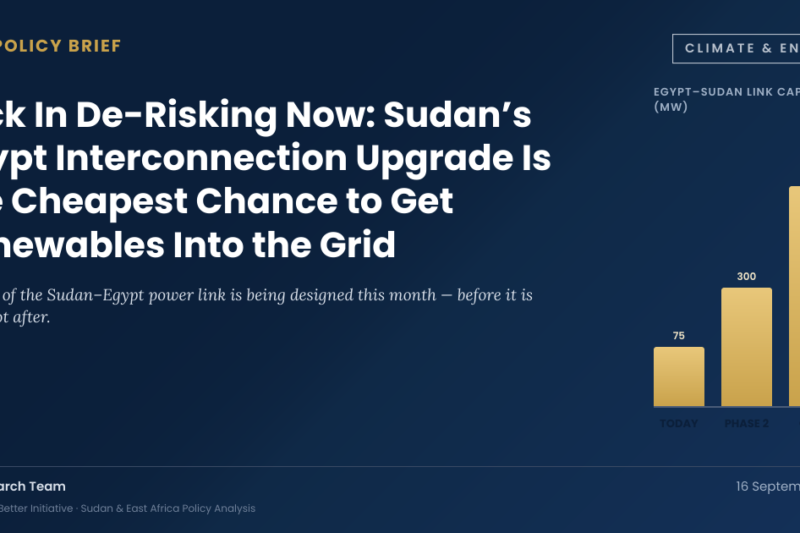
Lock In De-Risking Now: Sudan’s Egypt Interconnection Upgrade Is the Cheapest Chance to Get Renewables Into the Grid
Sudan's Egypt interconnection is being redesigned this month. 3Bi recommends locking in a renewable-generation share and a currency-risk guarantee now, before Phase 2 is built on last decade's…
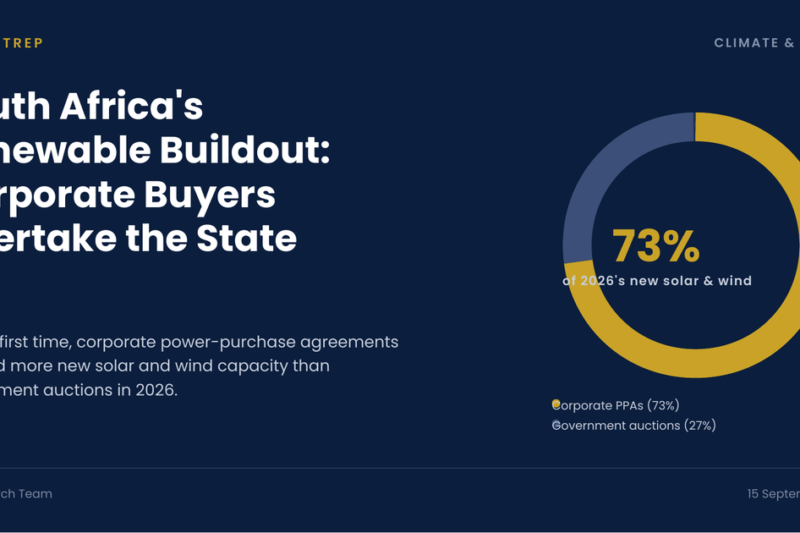
SITREP: South Africa’s Renewable Buildout — Corporate Buyers Overtake the State
For the first time, corporate power-purchase agreements will fund more of South Africa's new solar and wind capacity than government auctions in 2026 — even as national renewable…